The latest GRAF® weather model improvements
Continue reading

Key takeaways
- Forecast verification compares predictions to actual conditions, enhancing forecast accuracy, promoting performance transparency, and building reliability into operational tools.
- Verification confirms the accuracy of AI-powered products like TrACR, capacity forecasts, and deicing risk — converting atmospheric data into aviation insights.
- Collaboration with NVIDIA plus the JEDI data assimilation implementation are creating next-generation aviation AI capabilities trained and tested through proven verification methods.
The confidence to make critical flight decisions doesn’t come from technology alone. It comes from rigorous verification that validates forecasts, refines models, and holds every meteorologist accountable. Not only does verification help our products provide an invaluable service to our clients, it validates the essential human value-add in areas where technology cannot yet replicate expert intuition. Verification is how we prove our forecasts work. It’s also how our experts make them better.
How verification drives continuous improvement
Forecast verification systematically compares predictions to observed conditions. At The Weather Company, it serves three purposes:
- Improving forecast accuracy
- Promoting transparency about performance
- Embedding reliability into decision tools
Our automated verification system evaluates parameters against observed weather data recorded by stations at airports worldwide. This helps unlock consistent, objective performance tracking in near real-time. It also frees forecasters from the burden of manual verification, while delivering nuanced insights that drive continuous improvement.
Verification often reveals that a model might be technically accurate in its intensity prediction but poorly timed. By identifying these discrepancies, a human meteorologist can recognize when an actual storm is developing quicker or slower than the model suggests. This allows the forecaster to refine the forecast window in real-time, minimizing costly downtime and optimizing operational efficiency for the airline.
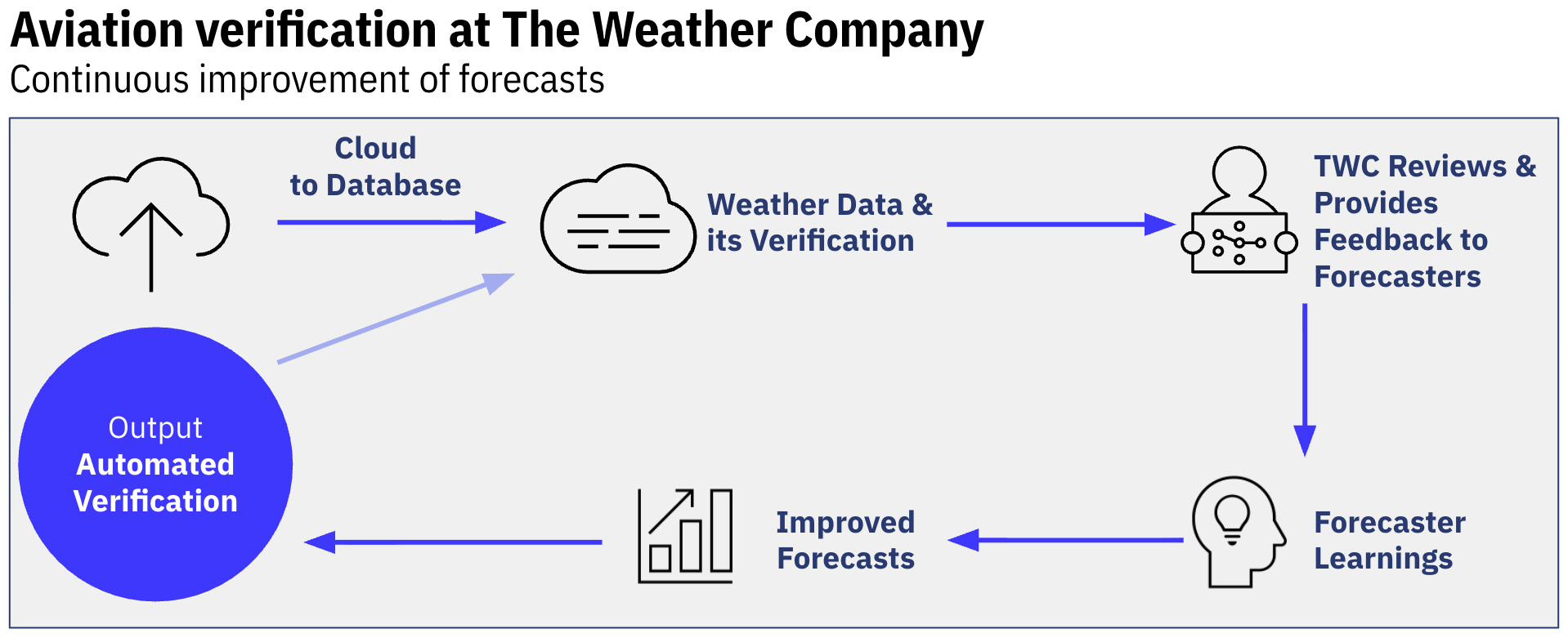
Verification is about creating a feedback loop that meaningfully improves aviation forecasts over time.
The technology behind the trust
The Weather Company is partnering with NVIDIA to train AI models on 20 years of proprietary aviation weather data — developing convective-scale forecast ensembles ideal for aviation decision making. Verification will validate these innovations, helping AI advancements translate into greater operational confidence.
We’ve also implemented the JEDI data assimilation system, which cycles forecasts back into the model rather than starting each hour from scratch and allows timely incorporation of diverse observations. This creates a more realistic, continuous view of the starting state of the atmosphere that powers our Global High-Resolution Atmospheric Forecasting System (GRAF®).
Where verification delivers results
This rigorous verification process delivers measurable improvements across our product suite, including:
Future radar: The latest version of our forecast radar is 2.5 times better at predicting where heavy precipitation will occur during the critical next two hours — giving operations teams earlier warning when conditions are expected to deteriorate.
Gate Convective Forecasts (GCF): This risk product now provides increasingly accurate predictions of thunderstorm coverage, timing, and intensity across terminal airspaces. By validating GCF against actual convective events and sharing those results back with our forecasters, we’ve refined the forecast process to better distinguish between scattered activity and widespread operational disruption.
Fog risk forecasts: Advancements have evolved rapidly through automated verification, providing immediate performance feedback that helped forecasters identify and eliminate bias before full deployment. Each new product undergoes the same accountability loop: forecast, verify, refine, repeat.
Beyond hit or miss: Partial credit matters
Traditional verification relies on binary thinking. For flight operations, this misses what actually matters — was the forecast useful for decision making? And airlines generally communicate risk on a spectrum from “no risk” to “operationally disruptive.” So, when operations see high risk, they hold departures and reroute aircraft.
Here’s the problem: Meteorologists may forecast high convective risk, but moderately impactful convection occurs instead. Traditional verification calls this a “false alarm.” Yet operationally, the forecast was useful— you held departures, rerouted arrivals, and avoided delays. This is why The Weather Company developed a Partial Credit Critical Success Index (PC-CSI) — to capture decision-grade accuracy and reward operational value over exact binary matches.
High-confidence risk assessment
One analysis identified that when The Weather Company forecasts high convective risk, impactful weather occurs approximately 80% of the time — the certainty needed to confidently trigger proactive flight delays or reroutes. This accuracy results from fostering forecaster accountability through continuous feedback.
Closing the feedback loop
Verification data only matters if it drives action. Lead meteorologists receive monthly performance summaries analyzing accuracy across airports and weather scenarios. They identify improvement opportunities and share findings with their forecasting teams — enabling collaborative learning and year-over-year performance gains.
Weather intelligence that moves aircraft
Just as verification can help to address forecast biases in weather prediction, it also validates how AI translates weather into aviation decisions. The same rigorous process enables AI models to correctly link atmospheric conditions to operational impacts.
We aren’t talking about generic weather forecasts. Our verification process validates that AI models accurately translate weather patterns into actionable insights. The Weather Company trains these weather impact models on historical weather data and real operational outcomes, then tests their performance through continuous verification. The result is a suite of predictive tools designed to answer the specific questions flight operations teams face daily:
TrACR (terminal airspace convective risk): AI-driven forecasts visualize thunderstorm risks in the departure and arrival gates around airports up to 7 hours in advance with 30-minute intervals, helping airlines optimize traffic and reduce delays.
Airport-specific capacity predictions: Forecasts limits on arrival and departure rates, giving clear visibility into when demand will outstrip capacity — before it happens.
Runway configuration predictions: Enable optimized route adjustments in advance of ATC clearance.
Ground de-icing insights: Allow dispatchers to proactively plan for icing conditions.
Achieving forecast “consensus”
Our forecasters leverage WxMix®, The Weather Company’s proprietary multi-model ensemble, which analyzes over 100 global weather models and intelligently combines them to create a consensus forecast that is more accurate than any of the inputs. Verification validates that the engine delivers on its promise.
Using these insights with our risk products allows for better preparation – when we forecast widespread convective coverage, it verifies frequently, and you can be more confident in that high risk forecast.
Accuracy that earns trust
The Weather Company is the world’s most accurate forecaster — nearly 4x more likely to be the most accurate than the next closest competitor.1 That accuracy is built on cutting-edge AI, rigorous verification, and human oversight working together to deliver critical aviation insights.
The Weather Company delivers more than accurate weather data — we deliver the confidence to stay ahead of the storm. With FAA-compliant EWINS meteorologists blending aviation and meteorological expertise with innovative forecast technology, our Weather Forecast Services deliver real-time weather analysis and insights you can trust — globally, 24/7. When stakes are high, you need more than data, you need weather intelligence you can act on with confidence.
Let's talk
To learn more about our advanced aviation weather solutions, contact our aviation experts today.
Contact us1 ForecastWatch, Global and Regional Weather Forecast Accuracy Overview, 2021-2024, commissioned by The Weather Company.