The latest GRAF® weather model improvements
Continue reading

Key takeaways
- The GRAF® weather model delivers high-resolution weather intelligence in key economic regions while maintaining efficient global coverage.
- Modern AI weather forecasting capabilities depend on clean, continuously-updated, data assimilation frameworks that improve forecast quality.
- Ensemble weather forecasting provides a range of possible outcomes, helping anyone better understand and manage weather-related risk.
- Cloud-based resilience on AWS supports uninterrupted access to critical weather intelligence during high-impact events.
Weather affects nearly every decision people make – from planning a weekend trip to managing a complex operation. While most people have access to basic weather forecasts, there is a vast difference between a general forecast and the high-precision data required to support accurate, timely decision-making. At The Weather Company, we are constantly improving the technology behind our forecasts so that everyone – from individual users to large enterprises – can rely on the most accurate weather intelligence available.
We provide more than just a weather report. We provide a sophisticated technological ecosystem designed to reduce uncertainty. Through our GRAF system, our adoption of the JEDI framework, and our cloud-based resilience on AWS, we offer a level of accuracy and reliability that helps anyone turn weather challenges into confident decisions. Together, these innovations strengthen modern AI weather forecasting capabilities and smarter decision-making.
High-resolution forecasting with GRAF
At the heart of our capability is GRAF, which stands for the Global High-Resolution Atmospheric Forecasting system. To understand the value of GRAF, it helps to look at how weather models work. Most models divide the world into a grid of squares, and a computer calculates the weather for each square. If the squares are too large, the model misses small but important details like a thunderstorm hitting a specific neighborhood, a wind gust affecting a local power grid, or rain arriving earlier than expected on a travel day.
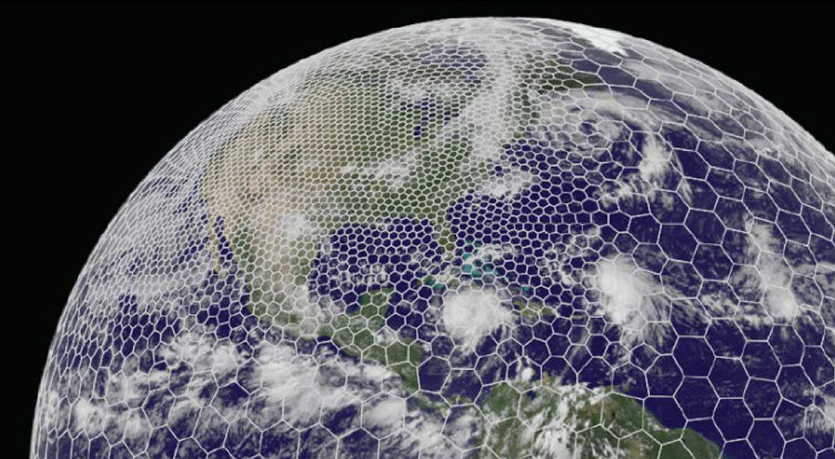
Most models use a square grid of fixed size. GRAF uses a variable resolution grid and provides higher resolution over populated areas.
While many global models use large grid squares (often 10 to 15 kilometers wide), GRAF provides much higher detail where it matters most. It features 4-kilometer refinement regions over the Continental United States and Europe. This means the model provides a much sharper look at weather patterns in these key economic zones, while maintaining a coarser, efficient resolution across the rest of the globe. The result is more precise numerical weather prediction in regions where decisions – personal and professional alike – often carry the greatest impact.
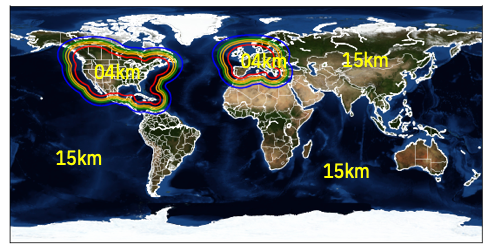
Depiction of 4-km refinement regions over Europe and Continental United States.
The JEDI framework and AI integration
A weather model is only as good as the information you feed into it. In the world of meteorology, the process of feeding real-world data into a computer model is called Data Assimilation (DA).
Understanding data assimilation
Think of data assimilation as a “reality check” for the computer. Every hour, millions of data points arrive from satellites, weather stations, airplanes, and sensors. However, this data is often messy or arrives at different times. Data assimilation takes all these scattered pieces of information and blends them into a single, accurate picture of what the atmosphere looks like right now.
The JEDI framework
To make our data assimilation as powerful as possible, we have adopted a framework called JEDI (Joint Effort for Data assimilation Integration). JEDI acts as a universal adapter for weather data. It allows us to incorporate new types of observational data much faster than traditional systems to improve overall weather forecast reliability and accuracy. These data include but are not limited to: satellite radiances, aircraft observations, radiosondes, and pressure sensor readings from smartphone users (with consent).
Our transition to this technology has moved through several key phases:
- Initial phase: We replaced our older data systems with the JEDI framework, which immediately improved our ability to process complex information.
- Next phase: We began “fully cycling” the system. JEDI now works in a continuous loop, constantly updating the model with fresh data throughout the day.
- Following phase: We implemented new surface assimilation algorithms. This update allows the system to better represent ground-level conditions that affect everyday forecasts.
GRAF AI applications
One of the most significant benefits of the JEDI framework is that it drives GRAF AI applications. These applications have been trained on years of historical weather data to recognize patterns and make fast predictions. Because JEDI provides such a clean and accurate starting point, these AI tools produce even more reliable insights and further advance AI weather forecasting capabilities.
Future advancements in data assimilation
We are constantly working to stay ahead of the curve. A major part of this work involves the development of Ensemble-Based Systems in collaboration with the National Center for Atmospheric Research (NCAR). Instead of running just one forecast, an ensemble system runs many versions at once. This approach is similar to a global ensemble forecast system, helping anyone plan more effectively by providing a probability of an event occurring.
Reliability when it matters most
Accurate weather data is only valuable if it is available when you need it most. Severe weather events are precisely when forecast access matters – and precisely when systems are under the greatest strain. To address this, we have ported our GRAF framework to Amazon Web Services (AWS) architecture, creating a robust disaster recovery solution that keeps our data flowing regardless of conditions.
While most weather models run on specialized physical supercomputers, these systems can be vulnerable to outages. By running on AWS, we have built a highly resilient, always-on architecture that supports our weather recovery solutions and keeps data accessible without interruption – whether you are an individual checking conditions ahead of a trip or an operation depending on continuous forecast feeds during a high-impact event.
A cloud-native future
We are migrating our entire GRAF production environment to AWS. This move offers two major benefits:
- Reliability through redundancy: Built-in redundancy strengthens weather forecast reliability by allowing another part of the system to take over instantly if an issue occurs.
- Scalability: We can increase computing power instantly during massive events, ensuring your GRAF data is delivered on time.
Translating weather intelligence into confident decisions
Whether you are optimizing a global supply chain or simply planning a weekend family outing, the quality of your weather data directly impacts the quality of your choices. An unexpected storm or an unpredicted shift in wind can disrupt a major logistics network just as easily as it can ruin a long-planned trip.
By combining high-resolution numerical weather prediction through the GRAF weather model, cutting-edge AI weather forecasting, and robust cloud architecture, The Weather Company provides everyone with access to a higher standard of weather forecasting accuracy. As we continue to advance our data assimilation capabilities and build toward a cloud-native future, our goal remains clear: to maximize weather forecast reliability so you can navigate changing conditions with total confidence.
Let's talk
To learn more about harnessing the power of weather to make better, more informed decisions across industries, contact our experts today.
Contact usFrequently asked questions
GRAF (Global High-Resolution Atmospheric Forecasting) is The Weather Company’s advanced forecasting system. It combines high-resolution atmospheric modeling, data assimilation, and AI-driven capabilities to deliver detailed weather guidance for decision-making around the world.
JEDI (Joint Effort for Data assimilation Integration) is a modern data assimilation framework used to integrate weather observations from sources such as satellites, weather stations, aircraft, and sensors. The framework helps accelerate the incorporation of new data sources and improves the quality of atmospheric analyses used by forecasting models.
Real-time data assimilation continuously incorporates new observations into a weather model, creating a more accurate representation of current atmospheric conditions. By starting with a more accurate picture of the atmosphere, forecasting systems can improve weather forecast reliability and support more informed decisions.