
Weather intelligence for the future: Crafting a strategic enterprise approach to changing environmental conditions
Continue reading

Key takeaways
-
According to SmithGeiger research, young adults aged 18 to 34 overwhelmingly prefer social media news sources over traditional live TV newscasts for consuming news, including weather updates.
-
Successful vertical videos require minimal production, often utilizing basic smartphone filming, simple editing software, and clear templates.
-
Audiences favor authentic, behind-the-scenes content that feels personal and clocks in at an ideal length of roughly 40 to 60 seconds.
-
Broadcast meteorologists must specifically adapt their graphics and formatting to fit the 9:16 vertical screen.
-
Creating engaging weather content on social media builds digital trust, which stations must leverage to drive audiences back to their websites, apps, and broadcasts for long-term survival.
Local television stations are facing a challenge as young adults change how they consume news. According to Northeastern University’s local TV news research by SmithGeiger, 91% of young adults aged 18 to 34 consume some news media every week.
But it’s not TV.
Social media platforms such as YouTube, Instagram, TikTok, and Facebook are the preferred social media news sources for this important group of consumers. Toward the bottom of the list is the live local newscast, which most television stations consider their bread and butter.
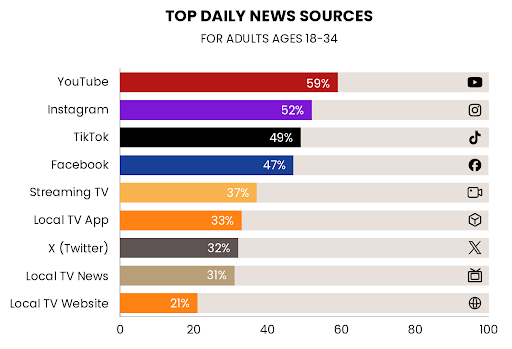
(Source) Reinvent: A Survival Guide for Local TV News
Not surprisingly, among the content craved by these young adults are updates on the weather. Yes, the reason people watch local TV news is also the reason people follow local news on social media.
This preference is reflected in the consistent growth and engagement many broadcast meteorologists are experiencing on Instagram and TikTok. Their achievements provide a clear roadmap for local television weather departments seeking to build stronger connections with their audience through social media and broadcasting.
Case studies
Production simplicity is key
Vertical videos posted on social media broadcast don’t need to be extravagant or complicated. Meteorologist Trevor Gibbs, from WJAX in Jacksonville, FL, pulls a producer in from the newsroom to hold the camera while he delivers a short weather update in front of the video wall in the studio. Gibbs edits the videos using TikTok and reposts them on Instagram. Simple, yet effective.
Meteorologist Lee Goldberg from WABC in New York City, also relies on a producer to help him record his daily signature Quickcasts, which often feature weather content maps superimposed over his camera video.
The ultimate win in social media is to create something that goes viral. Sometimes, the simplest videos are the ones that generate the highest engagement. An update produced by meteorologist Joseph Martinez from WZDC, showing snow falling in Washington, D.C. generated almost a million views.
Content strategy and authenticity
According to the study, 60% of young adults said they want to watch behind-the-scenes videos where reporters (or, in this case, broadcast meteorologists) share background information. That may be why meteorologist Stevie Stevenson from KCTV in Kansas City, Missouri, is seeing growth on her social media platforms. Many of her vertical videos feel personal and authentic, recorded right there in the Weather Center.
Not all social media posts produced by broadcast meteorologists need to be serious. Kim Castro from KHOU in Houston, Texas, blends personal videos with weather updates. Castro also seeks to serve all viewers in the Houston area during disruptive weather events, delivering updated information in both English and Spanish.
Technical solutions for vertical videos
One challenge facing broadcast meteorologists is converting horizontal 16:9 graphics into the vertical 9:16 format preferred on social media. To accommodate this format, meteorologist Jordan Evans from WJLA in Washington, D.C., creates special graphics that are specifically designed for Instagram and TikTok.
Testing conducted for the study found that 50 seconds, plus or minus 10 seconds, is the ideal length for social media videos. That’s how long most of the personally branded videos are produced by meteorologist Shane Hinton from WFOR in Miami, FL.
Most broadcast meteorologists edit their vertical videos using software available from Instagram and TikTok. However, meteorologist Drew Davis from KHNL in Honolulu, Hawaii, uses commercial-grade editing software such as Adobe Premiere, DaVinci Resolve, and Final Cut Pro. Davis says these videos are easier to produce than they look, thanks to templates that he has created for his digital weather updates.
The ultimate payoff: Survival for local TV news
Vertical video weather updates generate thousands, and often hundreds of thousands, of views. These numbers validate the central message of the Northeastern University study, aptly named “A Survival Guide for Local TV News.” Researchers urge news managers to pivot and empower reporters, news anchors, producers, and broadcast meteorologists to create more engaging social media weather content.
Building a loyal following online is an excellent way to establish trust. However, the ultimate goal of this broadcast guide is to leverage these digital connections and bring consumers back to the station’s website, mobile app, and live newscasts. That’s how we survive.
Let's talk
To learn more about improving your social weather engagement with Max Social, contact our media experts today.
Contact usTim Heller is an AMS Certified Broadcast Meteorologist and Weather Communications Coach. He helps local TV stations and broadcast meteorologists communicate more effectively and work more efficiently. Contact Tim through this website: www.hellerweather.com.
Related resources



Key takeaways
- System virtualization gives weather operations greater flexibility, resilience, and scalability while reducing the need for on-site IT support and maintenance.
- Virtualization lowers hardware dependency, helping stations cut costs tied to electricity, cooling, and physical infrastructure.
- Managed virtualization services handle updates, security, and system management, shifting operational burden away from station teams.
- As media technology trends evolve, broadcasters are rethinking legacy systems so weather teams can focus more on content production and less on infrastructure management.
Modern broadcasting moves at a breakneck pace – a reality that leaves little room for the legacy systems of the past. Stations must now meet rising viewer expectations while navigating the latest media technology trends. This creates a high-stakes balancing act, especially as operational belts continue to tighten. Such a demanding landscape requires a new kind of resilience to keep newsrooms agile and responsive.
That’s why the industry is shifting toward system virtualization. As newsrooms invest in more advanced, software-driven workflows, pressure is building to modernize legacy systems – including weather operations. Virtualization strengthens weather operations with the flexibility and stability needed when the stakes are highest.
Rethinking media tech from the ground up
Progressive broadcast technology leaders are moving beyond traditional, hardware-bound systems. Instead, they’re adopting cloud-based tools that improve collaboration, lower costs, and increase uptime. From newsroom automation to audio infrastructure, many functions are already virtualized. Now, stations are asking for the same progress in weather operations – and for good reason.
The expectation is clear: If every other part of the media tech stack is evolving, weather technology should keep pace.
What virtualization really means for weather teams
System virtualization replaces on-prem, physical infrastructure with cloud-hosted, software-defined systems. In a weather context, this means meteorologists and producers can access forecasting tools, create graphics, and manage digital publishing workflows from virtually anywhere. Instead of relying on a fixed location or dedicated workstation, teams can collaborate and deliver coverage through browser-based access. The virtual environment integrates seamlessly with other newsroom systems, supporting the flexibility modern broadcasters need.
Such flexibility comes from decoupling weather workflows from dedicated hardware. Virtualized systems allow teams to scale resources on demand, centralize management, and reduce the long-term costs associated with maintaining, upgrading, and eventually replacing physical infrastructure. For weather teams, this shift supports faster collaboration, simpler operations, and greater resilience during high‑pressure moments without adding technical overhead.
Flexibility that matches the speed of news

Weather stories break quickly – and don’t always follow a 9-to-5 schedule. Virtualization allows stations to adapt in real time. Whether it’s scaling up during severe weather or extending reach during major events, virtual systems flex with demand.
This flexibility allows stations to support new storytelling formats without rebuilding their infrastructure. Virtualized environments make it easier for weather teams to access tools remotely, collaborate across locations, and adapt workflows as production needs evolve.
By moving content creation and publishing workflows into the cloud, stations reduce reliance on fixed workstations and local systems. Weather teams can prepare shows, update graphics, and support coverage from any connected location. The result is better operational continuity during severe weather, staffing constraints, or high-pressure news cycles.
Resilience you can rely on
Continuity is critical in weather operations, especially when conditions are severe. System virtualization helps reduce downtime by shifting away from single points of failure. With cloud-based redundancy, stations can continue delivering weather coverage even if local infrastructure is compromised.
Disaster recovery workflows, remote handoffs, and shared rendering capabilities across stations all contribute to more reliable operations. Operational resilience has been tested and trusted in real-world scenarios. Distributed rendering supports shared processing power to help stations avoid bottlenecks and reduce downtime during peak demand.
Scalable, sustainable, station-friendly
Transitioning to a virtual environment does more than modernize the workflow; it fundamentally reshapes the economics and efficiency of station operations.
Cost control without compromise
Virtual systems offer another critical advantage: cost control. The growing concern around total cost of ownership (TCO) has made broadcasters more selective about new tech investments. Virtualization shifts spending away from large upfront hardware investments and toward more flexible, usage-based operating costs, reducing reliance on underused on-prem systems.
It also reduces capital and maintenance costs by removing the need to manage on-prem systems. A pay-as-you-use model gives broadcasters more control over expenses and reduces the burden of daily system management.
A managed model that reduces IT strain
System virtualization centralizes weather workflows into a highly available managed service, reducing IT complexity and freeing up teams to focus on content rather than infrastructure. Cloud-based updates keep the platform current without requiring hardware replacements, helping stations avoid obsolescence while staying aligned with evolving tech standards.
As stations reevaluate their infrastructure, virtualization offers a path to simplify operations, reduce overhead, and prepare for future formats without locking teams into expensive, aging hardware systems.
Building the future: Infrastructure for next-generation weather experiences
As storytelling formats evolve, broadcast infrastructure must evolve with them. System virtualization provides the flexible, cloud-based foundation stations need to support emerging tools, technologies, and formats – even as those continue to change.
By investing in flexible, cloud-based infrastructure today, broadcasters can better prepare for what’s next, including support for emerging formats such as the virtual weather map and VR weather forecasts. With system virtualization, teams can adapt faster, without overhauling their tech stack every time workflows or audience demands evolve.
Strategic positioning for the next era of weather tech
Virtualization is not a quick fix. It’s a foundation for how weather teams will operate and innovate in the years ahead. Stations that begin the transition now will be better equipped to adapt to emerging formats, cover complex weather events, and maintain continuity no matter the conditions.
As The Weather Company prepares to introduce new virtualization capabilities, we remain focused on helping stations meet today’s challenges while building for tomorrow. We’re committed to delivering solutions that are as reliable as they are forward-looking, and, as always, powered by the world’s most accurate forecaster.1
Next steps for virtual weather operations
System virtualization delivers on three essential fronts: flexibility, resilience, and scalability – all baseline needs for modern weather operations.
Broadcasters who rethink their infrastructure today will be best positioned for what’s ahead. The Weather Company is working with select partners to help define the next chapter of virtualized weather operations.
Connect with our team to explore design partner opportunities.
Let's talk
Ready to move beyond the rack room? Contact our media experts today to see how Max On Demand can lean out your operations while leveling up your storytelling.
Contact usFrequently asked questions
System virtualization in weather operations refers to replacing physical, on-prem infrastructure with cloud-based tools. This allows weather teams to work remotely, scale on demand, and integrate seamlessly with other newsroom systems.
Virtualization helps reduce broadcast costs by eliminating the need for costly hardware and on-site maintenance. It supports a pay-as-you-use model and keeps systems up to date with cloud-based updates, all while improving operational efficiency.
Broadcasters can deploy virtualization in their own private cloud. However, doing so requires managing infrastructure within their own AWS account, which adds upfront and ongoing costs. It also limits access to enterprise-level pricing and economies of scale. For many stations, a managed model is more cost-effective and easier to operate.
Yes, meteorologists can create high-quality weather visuals remotely using cloud-based content creation tools. With access to centralized workflows, teams can build immersive, on-brand graphics from any connected location.
The Weather Company’s approach to virtualization is different because it combines advanced modeling, cloud-native platforms, and a managed service model to deliver broadcast-quality weather technology with the economics of the cloud.
Virtualization is secure and reliable enough for live weather coverage due to system redundancy, distributed rendering, and disaster recovery workflows. These safeguards help operations stay resilient during peak demand or extreme events.
Related resources
1 ForecastWatch, Global and Regional Weather Forecast Accuracy Overview, 2021-2024, commissioned by The Weather Company
Key takeaways
- Severe weather coverage is the ultimate trust-builder and a core differentiator for modern broadcasters.
- A unified tech-stack – from real-time weather radar to automated severe weather alerts – is required to stay ahead of volatile storms.
- Advanced weather forecasting models like GRAFTM provide the neighborhood precision viewers demand during a crisis.
- The Max ecosystem streamlines workflows across platforms, allowing meteorologists to focus on storytelling rather than manual tasks.
When a storm hits, you don’t get a second chance to get it right. In broadcast media, severe weather coverage isn’t just a news story – it’s the moment your audience needs you most. But as storms grow more frequent and volatile, the need for fast, clear, and trusted reporting has never been greater.
At The Weather Company, we believe that delivering timely, actionable updates is more than a competitive advantage. It’s a public safety responsibility. By leveraging our real-time weather radar, advanced weather forecasting models, and scalable severe weather alerts, broadcasters can finally move faster than the storm.
The high-stakes reality of severe weather broadcasting
When warnings are late or unclear, consequences follow. Lives are at risk. Trust erodes. In many communities, the local news station is the most trusted voice during dangerous weather. This trust is fragile, and once it’s broken, it’s incredibly difficult to win back.
Severe weather coverage is often the most-watched content a newsroom delivers. For instance, local TV audiences doubled in Orlando during Hurricane Ian, while streaming app reach surged by nearly 400%.1
Your severe weather coverage toolkit
To be the voice of authority, newsrooms need a cohesive ecosystem that translates complex atmospheric physics into clear, visual stories. The Max platform helps time-strapped meteorologists streamline response from the first cloud formation to the final “all clear.”
The Weather Company’s storm tracking capabilities go beyond industry standards, offering powerful, exclusive features not found in competitor platforms:
- Up to 12 individual streaming radar sites displayed simultaneously for full regional awareness
- One-click switching between radar moments, making it easy to shift focus as conditions evolve
- 3D storm structure visualization for sharper insights and clearer communication
- Early detection of storm rotation and automatic storm tracking, including debris markers
- GOES mesoscale sectors with real-time updates every 60 seconds
- Integrated on-air alerting and hazard-specific branding, automatically surfaced across all platforms
Max Storm: Powering precise visual communication
At the foundation of severe weather coverage is Max Storm, built to give meteorologists greater visual clarity and control during critical moments. With customizable color tables for radar, satellite, and model data, Max Storm helps teams highlight key threats with precision and speed.
From rapidly intensifying thunderstorms to dangerous winter weather, Max Storm delivers:
- High-definition visualizations that show 3D storm structure
- Real-time shear tracking and satellite analysis
- Automatic detection of hail, lightning, rotation, and tornadic debris
- Dozens of color table options to improve audience understanding
These capabilities help you look your best when storms are at their worst.
Max Alert Live: Scaling alerts across every screen
Once the forecast is ready, Max Alert Live delivers critical updates to audiences across channels – TV, mobile, OTT, apps, and digital platforms. By automating the distribution of severe weather alerts, Max Alert Live eliminates manual bottlenecks and keeps coverage consistent.
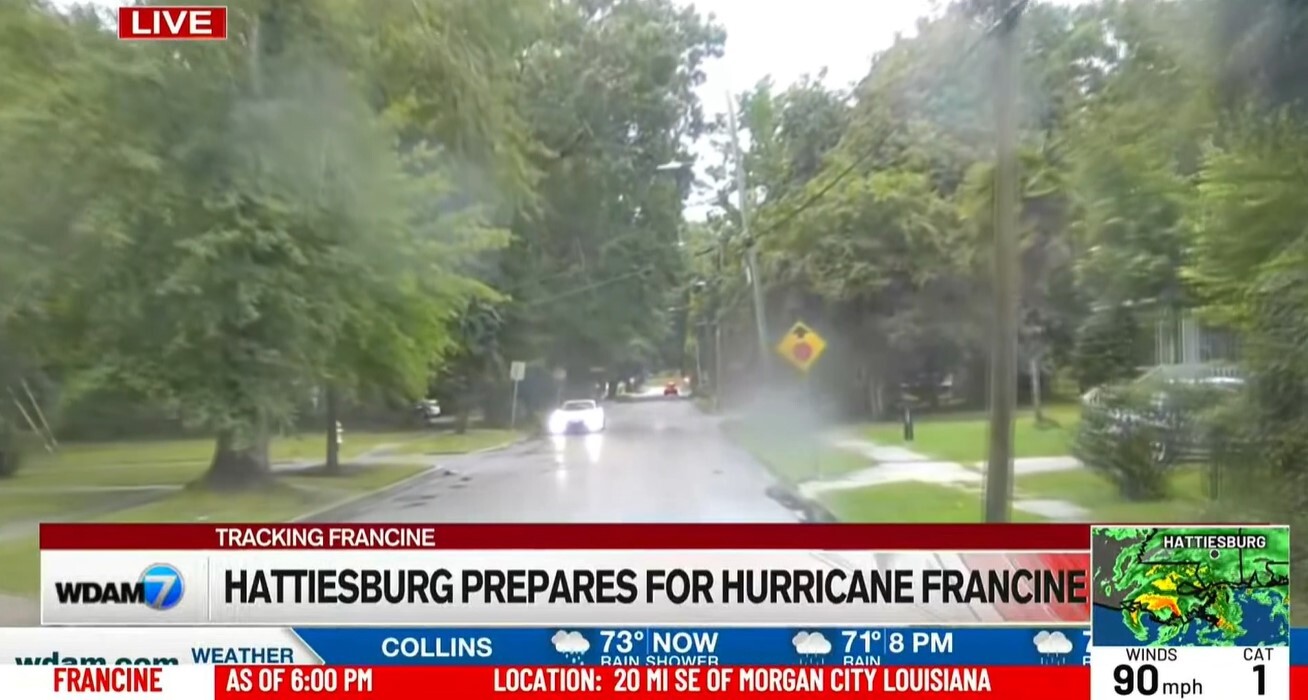
Example of on-screen alert with Max Alert Live
Teams can publish once and distribute alerts across all endpoints simultaneously, maintaining clarity and speed even as conditions shift.

See how WKRC-TV keeps viewers connected and safe in critical moments
Read case studyMax Velocity: Processing real-time weather radar
When seconds count, you can’t afford latency. Max Velocity acts as the high-speed engine for your real-time weather radar data. It allows meteorologists to ingest, process, and visualize storm cells with unprecedented speed. With this technology, your station can identify rotation or hail cores faster than legacy systems, providing the “why” and “where” with enough clarity for viewers to take immediate action.
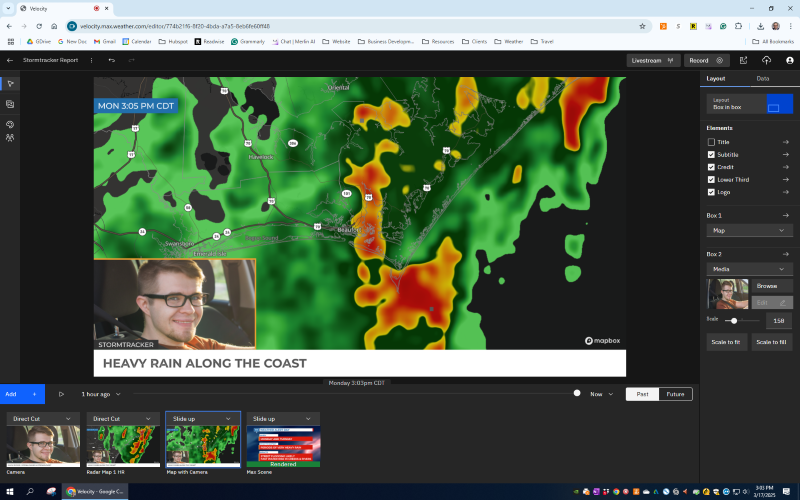
An example of how Max Velocity can be used to stream live to Facebook or YouTube to record quick updates for the station’s digital platforms
Max Studio: Dynamic interactivity and analysis
During a live break, the ability to “interrogate” the storm is what keeps viewers leaning in. Max Studio brings interactivity to your severe weather coverage, allowing talent to manipulate data on touchscreens or through gesture-based controls. It allows meteorologists to break down complex weather forecasting models into digestible, neighborhood-level insights that show exactly who is in the path of danger.
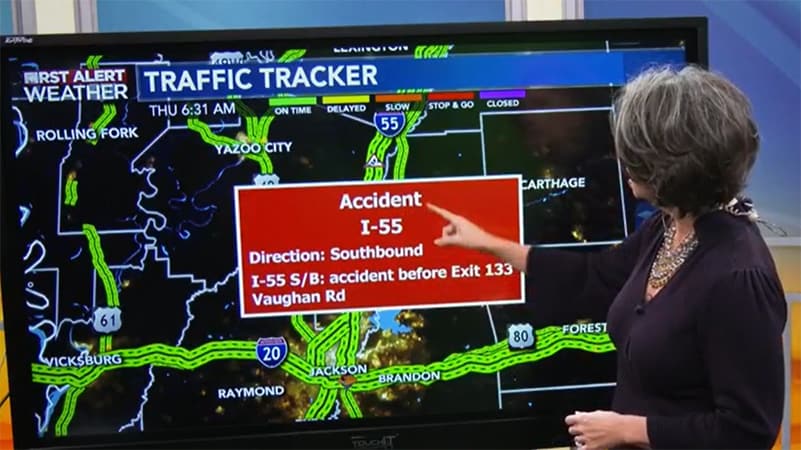
An example of touch-screen interaction using Max Studio during severe weather storytelling
Max Traffic: Visualizing impact on the ground
Integrating traffic into your severe weather coverage provides a unique utility that keeps audiences tuned in long after the initial severe weather alerts have expired. Max Traffic lets you own the “commute” narrative by combining real-time weather and traffic data into a single, compelling story.
When morning storms threaten visibility, you can show not only what’s happening but what it means for the drive. With live traffic camera integration and a new partnership with Total Traffic & Weather Network (TTWN), Max Traffic helps broadcasters bring deeper, more actionable insights to every screen.
- Reliable, audience-focused data: TTWN gathers real-time traffic conditions from trained reporters across the U.S., helping stations deliver high-impact incident updates that matter most to local viewers.
- Deeper incident insight: Sixteen regional operations centers provide 24/7 coverage of traffic incidents from inception to resolution, delivering greater accuracy and immediacy.
- Clearer visual storytelling: Max Traffic’s map design emphasizes key highways and commuting corridors, stripping out side-street clutter to keep the viewer focused on what’s relevant.
The Max advantage
In the race to be first and most accurate during a storm, the right tools make the difference. While others are catching up, Max is already there. Here are industry-exclusive features designed to help you own the storm and protect your viewers:
- Up to 12 individual streaming radar sites displayed simultaneously
- Interactive access to alternative visual storm data in a single display
- Support for Climavision radars to fill gaps where NWS coverage may be poor
- Time-lapse video automatically displayed in time with radar data
- GOES mesoscale sectors for real-time analysis updated every minute
- Manual tracking of a point storm by speed or time
- Wide variety of severe-weather-analysis data per identified storm cell (off-air query)
- On-air alerting
- Hazard type auto-query displayed based on camera range
- Informative branding automatically changed based on event type
- Automatic surfacing and posting of content to TV, CTV, web, social and/or mobile based on the hazard
- Automatic surfacing and posting of content to TV, CTV, web, social and/or mobile based on tropical updates
- Ice/rain/snow precipitation accumulation analysis tools
- Proprietary global high-resolution model with precipitation output at 5-minute timesteps and new model runs up to every hour
- Wide array of natively included model data in base offering (HRRR/NAM/GFS/ECMWF/GEM/NDFD/GRAF)
- Automatic simultaneous display of all tropical storms from a particular basin
The science of speed: Next-gen weather forecasting models
The science behind weather forecasting models has reached a tipping point. To stay ahead of a rapidly changing cell, “hourly” updates are no longer enough.
Our proprietary Global High-Resolution Atmospheric Forecasting (GRAF) model is the engine behind the next generation of coverage. Built on a GPU-accelerated supercomputer in partnership with NVIDIA, GRAF provides a level of precision that legacy weather forecasting models simply can’t match:
- Hyper-local precision: 3.5km resolution allows you to see weather impacts at the neighborhood level.
- Unmatched frequency: Updates hourly with 5-minute forecast intervals.
- The competitive edge: GRAF delivers insights 6x faster and at 3x the resolution of leading global models.
As the world’s most accurate forecaster,2 we don’t just help you deliver severe weather coverage. We help you deliver it better, faster, and at scale.
Trust is earned the hour before the storm
In moments of chaos, the station that stays calm and clear earns lifetime loyalty. Reliable severe weather alerts, combined with critical human insight, reinforce your reputation as the source people turn to first. That’s just one reason over 80% of North American broadcasters trust the Max platform.3
The next generation of severe weather alerts is more personalized, proactive, and precise. The Weather Company brings decades of experience, proven technology, and a commitment to accuracy to every solution we offer. From weather forecasting models to real-time weather radar, your newsroom can stop reacting to the weather and start leading the conversation.
Don’t let a legacy workflow slow down your response. Book a demo of the Max platform today.
Let's talk
Want to strengthen your severe weather coverage across every screen? Discover how The Weather Company’s Max platform can help your team deliver faster, clearer, and more trusted alerts when every second counts.
Contact usFrequently asked questions
Our weather forecasting models utilize a multi-model approach, combining over 100 government and proprietary sources, including GRAF, enhanced by AI and guided by human expertise. This allows us to deliver hyperlocal, on-demand forecasts that are continually refreshed. According to ForecastWatch, The Weather Company is nearly four times more likely than other providers to be the most accurate across all global regions and metrics.4
Max Alert Live simplifies and accelerates the process of creating, localizing, and distributing severe weather alerts across TV, mobile, streaming, and digital platforms. Automating this workflow reduces lag time and helps broadcasters deliver consistent, clear, and timely alerts, reinforcing trust when speed matters most.
GRAF (Global High-Resolution Atmospheric Forecasting) is The Weather Company’s proprietary physics-based model. It delivers 5-minute forecast data at 3.5km resolution, updates hourly, and runs on a GPU-accelerated supercomputer in partnership with NVIDIA. Compared to leading models, GRAF operates 6x faster and at 3x the resolution, enabling more accurate and earlier predictions of high-impact weather events.
Yes. Max Traffic combines traffic and weather data into a unified visual format that shows how storms, road closures, or visibility issues will affect viewer commutes. It’s especially effective for morning broadcasts and can help stations build stronger viewer loyalty – and even increase ROI through traffic-related sponsorships.
Our weather solutions are designed to scale across all delivery platforms. Whether you’re reaching viewers via live TV, mobile apps, OTT, or social, we help make sure your severe weather coverage is consistent, accurate, and visually engaging on every screen.
Related resources
1 Nielsen, Understanding Local Media Reach During Extreme Weather Events, February 2024
2 4 ForecastWatch, Global and Regional Weather Forecast Accuracy Overview, 2021-2024, commissioned by The Weather Company
3 Internal data as of December 31, 2025
Key takeaways
- The future of TV is no longer tied to the living room – it’s wherever your audience is watching.
- From AI to cloud tools, broadcasting technology trends are making storytelling faster, smarter, and more flexible.
- Viewers still turn to local meteorologists when it matters most, even in a digital-first world.
- Hispanic audiences are shaping the next era of content with their strong presence on streaming and mobile platforms.
As more viewers turn to digital platforms for news and content, TV broadcasting is changing fast to stay relevant in a mobile, on-demand world. The next chapter of the future of TV belongs to those who can blend emerging broadcasting technology trends with what has always made television essential: accurate information, local trust, and timely delivery.
1) From linear decline to digital-first dominance
Audiences are continuing to shift toward digital platforms – and the data is clear. According to Nielsen, streaming accounted for 44.8% of U.S. TV viewing in May 2025,1 slightly surpassing combined linear TV (broadcast + cable), which fell to 44.2%. This marks a symbolic turning point: For the first time, digital viewing has eclipsed traditional TV on the biggest screen in the home.
Meanwhile, more than 77% of the U.S. population is forecast to watch OTT video in 2025,2 according to eMarketer. That figure includes YouTube, free ad-supported TV (FAST), and subscription services, reflecting the growing momentum toward digital-first platforms.
Broadcasters are no longer just TV stations – they’re evolving into multi-platform media organizations. From mobile apps to TikTok to 24/7 streaming news services like CBS News Boston, the industry is reorienting around where viewers actually are.
And this is just the beginning. Linear TV’s share of video time on TV screens dropped from 72.2% in 2020 to just 56.5% by the end of 20243 – a dramatic shift in just four years.
“The most successful media outlets will be those that can deliver accurate, local, and up-to-the-minute updates,” says Terry Eliasen of WBZ-TV. That means building the infrastructure for streaming, mobile, and real-time content delivery.
Within the next few years, digital-first workflows will lead, and linear TV will be viewed more as a supplement.
2) Immersive tech: AR/VR and the rise of the virtual studio
Gone are the days of elaborate physical sets. Many newsrooms are now green-screen studios powered by AR/VR tools that create virtual environments with a few keystrokes. This shift has enabled dynamic storytelling, especially in weather coverage. Smaller-market stations are often down a person, with larger station meteorologists filling in – where storm systems can appear beside the presenter in real time.
Many broadcasters now have the ability to transform their entire look with just a few keystrokes, thanks to virtual sets and AR/VR tools. But there’s growing concern that too much visual spectacle can distract from the core mission. While immersive graphics enhance storytelling, the priority must remain on delivering essential information.
“We must be certain that we still are delivering the information that people need and not just giving them eye candy,” Eliasen cautions. Smaller-market stations are often down a person, with larger station meteorologists filling in, rather than just high-tech visuals. Despite having instant access to forecasts via mobile apps, viewers still rely on their local TV meteorologists when safety is on the line.
3) AI in broadcasting: Automation, personalization, and precision
Artificial intelligence has become the engine room of modern broadcasting. AI now supports:
- Automating newsroom workflows
- Generating real-time weather models and graphics
- Localizing content for individual viewers
- Powering voice-activated tools in studios
At The Weather Company, AI-enhanced forecasts integrate over 100 data models in real time, personalized for every location, moment, and platform.
“As we all know, AI has so many layers and possible uses,” says Lelan Statom, Senior Meteorologist at News Channel 5 Nashville. “We use it with our voice-activated prompter in the studio. For weather, it’s already being used to produce models and help improve workflows.”
4) Expanding Hispanic audiences and content localization
The rapid growth of Hispanic digital audiences is shaping the future of broadcast television. This demographic leads in streaming adoption and digital media consumption, prompting networks to invest in bilingual content and AI-driven translation tools.
“Over the next few years, the television industry will be profoundly transformed by the convergence of AI, the growing influence of the Hispanic market, and advances in meteorology,” says Albert Martinez, founder of Canal Meteo. “Spanish-language content and digital platforms will be critical as viewing preferences shift.”
5) The cloud era: Collaborative production, streamlined workflows
Cloud-based production is now central to broadcast operations. Centralized graphics systems and shared storage environments allow for:
- Real-time collaboration across markets
- Streamlined branding
- Faster content updates
But there are downsides. “Broadcasters will deepen their reliance on cloud storage and shared graphic spaces… but [this] will also be used to forestall hiring decisions,” warns Brandon Butcher. “Smaller-market stations are often down a person, with larger station meteorologists filling in – unpaid”.
That pressure is felt daily in the field. “While there may be a variety of new features broadcast groups are rolling out in their apps and streaming platforms, the bottom line remains meteorologists have to do more with less time,” notes Betsy Kling, Chief Meteorologist and Anchor at WKYC-TV. “This means finding ways to multitask and leverage technology. Thinking outside the box and devoting time to deepen knowledge of our weather systems is key.”
The challenge for 2026? Balancing broadcast media innovation with human bandwidth and local authenticity.
6) The rise of independent meteorologists and new monetization paths
The broadcast media vs. digital media conversation isn’t just about networks. More meteorologists are leveraging technology at home to launch their own YouTube channels, livestreams, and subchannels – reaching loyal audiences directly and keeping the profits.

Brandon Butcher forecasts a future where “individual meteorologists…realize they are the face of the revenue stream and audience relationship” and may break away to build solo brands. “The early adopters will be successful, claiming large territorial markets, but as more jump in, competition will shrink the pie.”
7) Trust, accuracy, and the power of local connection
In a media world full of noise, one thing hasn’t changed: Accurate, local content still wins.
Tools like The Weather Company’s Max Engage allow broadcasters to push content across TV, mobile, and social simultaneously. “There are few programs that allow for multi-platform distribution with one click,” says Jordan Evans of ABC7. “Max is ahead of the game with its Engage and Social products.”
And in markets where real-time alerts save lives, the value is even clearer: “Max Engage allows us to quickly and effectively deliver life-saving alerts…while maintaining uninterrupted on-air coverage,” says Danielle Breezy from WKRN-TV.
Looking ahead: Broadcasting in 2026 and beyond
The future of the television industry will be defined by how well broadcasters balance technology with trust. As AI, AR/VR, and cloud production reshape workflows, success will belong to those who:
- Stay digital-first
- Serve diverse, mobile audiences
- Prioritize real-time, accurate forecasting
- Maintain deep community relevance
In other words, the networks that thrive will not just keep up with television trends; they’ll shape them.
The Weather Company, as the world’s most accurate forecaster,4 is helping broadcasters lead this transformation – bridging next-gen technology with the trust that local audiences rely on.
Let's talk
To learn more about our professional weather and traffic software solutions for the media industry, contact our media experts today.
Contact usRelated resources
1 Nielsen, Streaming Reaches Historic TV Milestone, Eclipses Combined Broadcast and Cable Viewing for First Time, June 2025.
2 eMarketer, US OTT, Pay TV, and YouTube Viewers Forecast 2025, May 2025.
3 eMarketer, Video Evolution: Linear Decline Makes Way for Livestreaming, January 2025.
4 ForecastWatch, Global and Regional Weather Forecast Accuracy Overview, 2021-2024, commissioned by The Weather Company
Key takeaways
- The Weather Company believes in the power of client collaboration to continuously improve our technology.
- The proprietary Global Resolution Atmospheric Forecasting (GRAF®) system updates hourly and provides high-resolution forecasts down to 4 kilometers, enabling prediction of small-scale events like thunderstorms.
- Collaborative GRAF task force meetings turn client reports from real-world scenarios into tangible fixes and model enhancements.
- Client input has led to notable, specific enhancements, including better prediction of wind gusts in Southern California, improved visibility forecasts in Louisiana, and corrected snowfall parameters in the Columbia River Basin.
For decades, advancements in weather forecasting have been driven by increasingly sophisticated technology and the relentless pursuit of more accurate data. But at The Weather Company, we’ve found that the most powerful engine for progress isn’t just technology – it’s people. Specifically, a dedicated group of meteorologists and scientists who have been meeting monthly for the past four years to refine and enhance the Global Resolution Atmospheric Forecasting (GRAF) modeling system.
But first, a closer look at GRAF.
What is GRAF? High-resolution atmospheric forecasting explained
The GRAF modeling system is a proprietary, physics-based, high-resolution, rapidly updating global weather forecasting system. Unlike conventional global models that update every six or more hours and operate at a resolution too wide to capture many weather phenomena, GRAF updates hourly and offers high-resolution forecasts down to 4 kilometers. This enables it to predict something as small as a thunderstorm, making it a critical tool for everything from daily planning to severe weather preparedness.
Behind the forecast: The GRAF task force in action
This isn’t your typical corporate task force. The GRAF team is a dynamic forum where The Weather Company technical experts, who build and maintain the model, directly engage with clients around the country who use it every single day on the front lines of forecasting. This collaborative approach has become a cornerstone of our commitment to excellence, so that the weather model data we provide meets the real-world needs of broadcast meteorologists, news stations, and, most importantly, the communities they serve.
In a recent meeting, the conversation covered everything from the finer points of radiational cooling to the nuances of tropical storm modeling. Friendly dialog is based on mutual respect and candid feedback. The Weather Company weather science team shares what they’re working on and what challenges they’re facing, while clients offer crucial, boots-on-the-ground insights as they work with GRAF data in their Max platform.
Direct impact: How client feedback shapes our technology
This unique and collaborative partnership is truly a “two-way street.” It’s not about top-down directives; it’s a living dialogue where every piece of feedback, whether a bug report or a suggestion for a new parameter, is heard and considered.
Our clients’ input is invaluable. They are the ones seeing how GRAF performs in a wide variety of real-world scenarios, from snow in Portland to tornadoes in Mississippi. This direct feedback loop results in targeted improvements which – along with our advanced models, techniques, and meteorological expertise – helps secure our title as the world’s most accurate forecaster.¹
From report to resolution
The results of this collaboration are already evident. Task force members have seen firsthand how their feedback has led to direct improvements in the model. Patrick Bigbie, a meteorologist and task force member, recalled a specific instance where a bug in an ice parameter was fixed after he reported it. “There was a very noted difference once he put in the correction for it,” he said.
Another member, Mark Nelsen, a broadcast meteorologist in Portland, Oregon, shared how the group’s discussions helped him understand why a snow forecast was too high during a specific event. “The model was actually seeing ice pellets, too,” Nelsen explained. “I was able to spread that around and put it in my blog so others in Portland would be aware of that too.” This kind of information sharing extends beyond the meeting, directly benefiting a broader audience.
In addition, notable enhancements have also included:
- Improvements to the forecasting of shallow cold air and snowfall across the Columbia River Basin. Other models were picking up on upcoming snowfall in that area up to a few days faster than GRAF. Using The Weather Company’s lab environment of high-performance compute resources, a few weeks of research and development allowed for improvements to the PBL and orographic wave drag physics. These changes had a positive impact not only for the Columbia River Basin, but also across other parts of GRAF’s global domain. This was a great example of one GRAF user’s observation impacting GRAF development beyond a local use case.
- Better prediction of wind gusts across southern California. The GRAF model had overpredicted wind speeds in that area by as much as 40 mph at certain times. The Weather Company added new wind gust algorithms that significantly improved GRAF’s wind gust forecasts.
- Improvements to visibility forecasts across Louisiana. GRAF’s forecast visibility was too low during radiational cooling events. The Weather Company implemented new algorithms and improved the visibility product across a wide range of atmospheric conditions.
- Better prediction of freezing rain and snowfall across Mississippi. GRAF users reported excessive freezing rain and snow forecasts. This was quickly resolved in three days with land surface model updates.
More than a meeting: A commitment to continuous improvement
These exchanges are not just about fixing problems – they’re about innovating and looking ahead. The team is consistently exploring how to incorporate new data, new visualization capabilities, and new forecast parameters that make the product more useful and powerful. The conversation often touches on emerging technologies like AI and machine learning to keep the GRAF modeling system evolving with the industry.
“It’s a testament to our team’s deep commitment to customer-centric innovation,” said Sheri Bachstein, President of The Weather Company. “By bridging the gap between our weather science experts and the broadcast meteorologists who rely on our products daily, we are not only building more robust and reliable forecasting tools but also fostering a community of shared knowledge and continuous improvement. This collaboration is a core part of our continued efforts to deliver the most trusted and reliable weather information in the world.”
Innovating through shared expertise
In a world where weather events are becoming more frequent and more severe, the need for accurate, timely, and hyper-local forecasts has never been greater. The GRAF task force is a testament to how the best technology is only as good as the collaboration behind it. By empowering our clients to be partners in our product’s evolution, we’re not just building a better model – we’re helping to create a safer, more informed world.
Let's talk
To learn more about our professional weather and traffic software solutions for the media industry, contact our media experts today.
Contact usRelated resources
1 ForecastWatch, Global and Regional Weather Forecast Accuracy Overview, 2021-2024, commissioned by The Weather Company
Key takeaways
- Personalized weather content provides FAST platforms with highly relevant, monetizable video tailored to audience demand.
- FAST revenue is projected to grow from $8 billion in 2023 to $17 billion by 2029, creating a greater need for scalable content strategies.
- 98% of advertisers express interest in sponsoring weather content, positioning it as a reliable revenue driver for FAST channels.
- ReelSphere enables broadcasters to scale digital output with automation while maintaining freshness and hyper-local relevance.
When it comes to the growth of the FAST industry, the numbers don’t lie. They’re telling a story of rapid expansion, and frankly, they’re starting to look a little unbelievable – but in the best possible way. Revenue is projected to climb from $8 billion in 2023 to $17 billion by 2029,1 and by 2028, streaming ad spend will overtake linear television.2 Today, more than 115 million FAST users in the U.S. watch an average of three hours per day, generating over two billion ad impressions annually.3
At the same time, 48% of U.S. adults now prefer digital as their primary source for local news, and 89% of online weather content is outdated.4 FAST has even revitalized linear TV, with personalization expected to accelerate that growth further.5
Personalized weather content provides the missing link for FAST platforms. As one of the most habitually consumed information categories, weather offers the perfect solution to fill FAST’s demand for fresh, relevant, and monetizable stories. But first, let’s clear up a few common myths.
Myth #1: Repurposing linear weather segments is enough to attract digital audiences
Reality: FAST audiences expect content that’s hyper-local, on-demand, and visually dynamic. Linear weather clips don’t translate well into a digital-first environment due to font colors and sizes, and map graphics. Studies also confirm the issue: nearly 9 in 10 online weather updates are stale.6
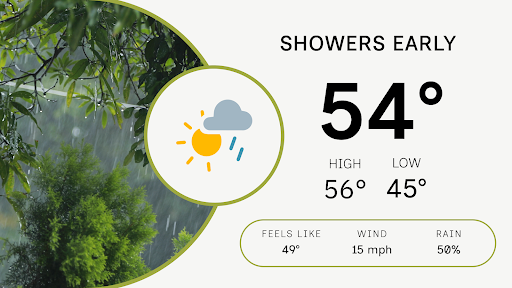
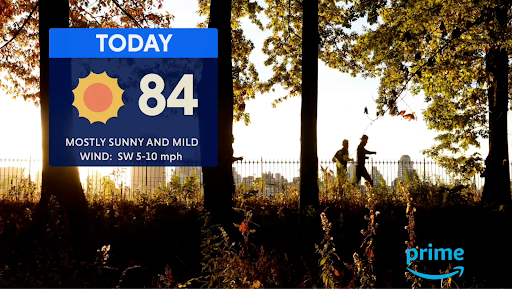
Solution: ReelSphere from The Weather Company automates the creation of digital-first, snackable video. Each segment is updated in real time, visually engaging, and tailored to the viewer’s specific location, exactly what FAST consumers expect. Audiences increasingly expect weather content to be designed for digital platforms.7
Myth #2: Filling content gaps is too expensive and requires a huge team
Reality: Producing fresh digital content manually is costly and inefficient. A recent study found that 73% of online weather coverage is clipped content and just 27% is recorded content,8 which shows how heavily broadcasters still rely on repurposing rather than creating digital-first material.
Solution: ReelSphere delivers digital content automation that scales output without increasing staff. Broadcasters can keep their teams focused on high-impact weather days while ReelSphere generates an ongoing stream of ready-to-air digital segments.
Myth #3: Weather content is a commodity; it’s hard to make it a revenue driver
Reality: Weather is one of the most habitually checked content categories. In fact, 98% of advertisers are interested in sponsoring weather content9 and recognize its power to deliver contextually relevant ads at scale.
Solution: We designed ReelSphere with advertising in mind. Customizable, sponsor-ready segments enable platforms to pair weather updates with relevant promotions, from travel offers to retail campaigns, unlocking new revenue streams.
Myth #4: You can’t get hyper-local content without a local team
Reality: Audiences want forecasts that matter to their exact location, not just the nearest city. Traditional models are limited in scope, leaving them less relevant.
Solution: ReelSphere scales hyper-local coverage without needing meteorologists on staff. For example, ReachTV uses ReelSphere to deliver location-specific forecasts across 2,400+ airport gates,10 keeping travelers informed with accurate updates for both departure and destination. Audiences are also demanding more hyper-localized streaming content.
Myth #5: FAST is a “set it and forget it” content model
Reality: FAST thrives on fresh, snackable content. Outdated material erodes loyalty, while timely, relevant updates keep audiences engaged. Given that the vast majority of online weather content is outdated, maintaining freshness is critical. Success in streaming depends on constant evolution, not a “set it and forget it” strategy.
Solution: ReelSphere enables an always-on strategy. With automated updates and scalable video production, platforms can keep content fresh around the clock to make sure they stay competitive in the crowded FAST ecosystem.
The forecast for FAST
The myths around FAST content keep platforms from tapping into their full potential. The reality is that weather is one of the most trusted, most consumed, and most monetizable verticals in streaming. With personalized weather content powered by The Weather Company, the world’s most accurate forecaster,11 ReelSphere helps broadcasters and platforms fill content gaps, engage audiences, and unlock new revenue opportunities.
Frequently asked questions
Personalized weather content delivers localized, real-time forecasts designed for free ad-supported streaming television, keeping audiences engaged with timely, relevant video.
With advertising automation, sponsors can align ads with weather updates, making content both useful for viewers and profitable for platforms.
Linear clips are often outdated and lack a digital-first design. Digital content automation creates snackable, hyper-local video that better fits the FAST ad model.
Personalized weather content delivers contextually relevant placements to help sponsors reach engaged viewers at scale.
ReelSphere automates video creation, empowering broadcasters to scale personalized weather content while still delivering fresh, hyper-local coverage – all without hiring more staff.
Let's talk
To learn more about automated, digital weather streaming content with ReelSphere, contact our media experts today.
Contact usRelated resources
1 5 Nielsen, “FAST has made linear TV cool again; personalization will make it cooler,” April 2024
2 Cross Screen Media, “The Streaming Media in Four Steps”
3 One Touch Intelligence
7 9 10 SmithGeiger, “ReelSphere: The Future of Weather Forecasting,” February 2024
4 6 8 HellerWeather, “Producing Relevant Digital Weather Content,” 2025
11 ForecastWatch, Global and Regional Weather Forecast Accuracy Overview, 2021-2024, commissioned by The Weather Company
Weather forecasts shape critical decisions daily. From planning your morning commute to optimizing global supply chains — forecast accuracy isn’t just preferred, it’s essential.
But what does better accuracy actually mean for those who depend on it? Let’s look at the real-world impact across industries and why The Weather Company continues to earn recognition from business leaders for its proven accuracy1, technological innovation, and scalable solutions.
Advertising: Turning weather science into marketing ROI
 Consciously or subconsciously, weather influences every aspect and decision of people’s lives – how we feel, what we try, and what we buy. Even a 1 °C increase in temperature can boost consumer spending by 1.2%.2
And it adds up: The National Retail Federation estimates that weather affects about $1 trillion in global sales annually.3 When it comes to delivering a brand message in the right moment, to the right people, the precision and accuracy of weather-targeted advertising isn’t just a nice-to-have, it’s a must have.
In today’s cluttered ad environment, where every touchpoint counts, marketers can’t afford to waste budget or an opportunity to drive an action. Take it from Ryan Oliver, Head of Communications at EcoFlow — an emerging leader in portable power solutions: “The Weather Company’s credibility and accuracy helped us reach a highly engaged audience actively seeking solutions for weather-related outages, boosting awareness and interest in EcoFlow’s backup power solutions.”
Aviation: Better forecasts, safer flights
 In aviation, forecast accuracy directly impacts safety, customer satisfaction, and profitability. Weather causes approximately 75% of all flight delays4, costing airlines an estimated $60 billion annually.5 Further, weather conditions are the source of more than 65% of injuries to passengers and crew due to turbulence.
With accurate, probabilistic forecasts, airlines can better anticipate disruptions before they happen — not just react to them. This leads to better, more efficient route planning, reduced fuel consumption, and happier passengers flying smoother skies. Take it firsthand from Nathan Polderman, Sr. Manager of Meteorology, United Airlines: “United Airlines’ operations are greatly enhanced from the accuracy of The Weather Company forecast data and the ability for their meteorologists — embedded in the United Network Operations Center — to quickly adjust and communicate nuances and uncertainties in the forecast. Precise and accurate weather forecasts are critical to United’s efforts to maintain safe and efficient operations and keep customers satisfied.”
Media: Building viewer trust
 For broadcasters, forecast accuracy isn’t just about ratings — it’s the trust currency that makes viewers reach for their channel first. And in the highly competitive media landscape, trusted weather forecasts directly impact station credibility.
Consistent, accurate forecasts strengthen viewer loyalty and position the broadcast team as the authoritative weather source, whether nationally or locally. As Patrick Bigbie, Chief Meteorologist, WDAM-TV, puts it: “The Weather Company’s GRAF model is the first one I check each day when building my forecasts and presentations. I find it very reliable and trustworthy enough to share with my viewers.” Mark Nelsen, Chief Meteorologist at KPTV & KPDX Television, adds: “We’ve been using The Weather Company’s GRAF model for over five years now. Its accuracy is remarkable and I’ve learned not to second-guess it since it usually proves me wrong.” GRAF, a proprietary global weather modeling system, is just one of the many forecasting technologies built and used at The Weather Company to drive the accuracy of our weather forecast portfolio.
Government & defense: When missions and lives are at stake
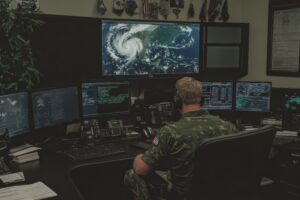 In defense operations, even minor deviations in weather forecasts can compromise asset deployment, technological capabilities, and personnel safety.
With weather intelligence that accurately predicts weather conditions on the ground and in the air, military personnel teams can better prepare for the operating conditions they’ll face in the field. This preparation allows for tactical adjustments that create strategic advantage. When adversaries rely on less accurate or incomplete information, your enhanced weather awareness becomes a decisive operational edge.
Not all forecasts are created equal
Many claim it, but only one forecaster can prove it: The Weather Company is the world’s most accurate forecaster.6 Delivering this level of accuracy doesn’t happen by chance. It requires a unique approach to weather forecasting that only The Weather Company has pioneered and continues to perfect.
Since our inception nearly five decades ago, we’ve combined human, meteorological expertise with proprietary, state-of-the-science technologies and AI to provide accurate forecasts and scalable solutions for people and businesses alike. And with that accuracy comes trust – trust that has earned us the distinction of being the most trusted weather provider and one of the top 15 most trusted brands among all adults in 2025.7
Solutions to thrive in the face of impactful weather
Accurate weather data helps instill confidence, drive decision-making, and propel the world forward. That’s why we’re committed to continuous innovation of current and future solutions, including:
- Weather Data APIs: We deliver real-time and historical weather data that provides high-resolution, continuously-updated, and hyper-local intelligence.
- Consumer experiences: Consumer experiences: We’re trusted by more than 330 million people each month across all digital properties, including weather.com and The Weather Channel app.8 The Weather Channel app stands as the #1 most downloaded weather app in the U.S, a daily habit for over 50 million people.9
- Enterprise solutions: Our solutions power decisions for 2,000+ enterprise customers across media (600+ broadcast stations), aviation (25,000+ flights per day), government, defense, agriculture, insurance, automotive, retail, CPG, pharma, energy, and beyond.
The best of both worlds: Human expertise + AI precision
We combine human meteorological expertise with advanced AI to create forecasting capabilities that neither could achieve alone:
- Human-guided, AI-powered approach: 100+ meteorologists collaborate with our AI systems through a “human over the loop” model, combining decades of expertise with cutting-edge technology to deliver fresh, precise, more accurate, and actionable forecasts.
- Scientific collaboration: Our ongoing work and dialogue with the broader scientific community includes NCAR, UCAR, and NOAA, accelerating our innovation while advancing capabilities for everyone.
- Technological rigor: We process 75+ billion terabytes of data daily across 100+ forecast models to create 25+ billion personalized, on-demand forecasts for 2.2 billion global locations. As part of that technology stack, our proprietary, high-precision weather modeling system, GRAF, provides hourly updates that can predict events as small as a thunderstorm virtually anywhere on the planet.
When weather shapes decisions, accuracy is the only option
For decisions that affect people and businesses everywhere, you need forecasts you can count on every time.
The question isn’t whether you can afford accurate weather intelligence, but whether you can afford to be without it. It’s your turn: Discover how our unmatched forecast accuracy can transform your business outcomes.
Let's talk
To learn more about harnessing the power of weather to make better, more informed decisions across industries, contact our experts today.
Contact usRelated resources




1 6 ForecastWatch, Global and Regional Weather Forecast Accuracy Overview, 2021-2024, commissioned by The Weather Company
2 3 LinkedIn: Raja Rajamannar, Weather Wizards: How Marketers Can Harness the Elements for Unprecedented Success, September, 17, 2024
4 FAA: FAQ Weather Delay
5 Cosmos, The Cost of Delays, Feb. 2025
7 According to a 2025 Morning Consult “Most Trusted Brands” survey
8 Based on the average of the total monthly (non-unique) users for Jan. – Dec. 2024 across The Weather Company digital properties and consumer products, according to internal, global data
9 According to Top Downloadable Weather Apps in 2024 in the US (by Downloads), from Sensor Tower (Jan. 1 – Dec. 31, 2024)
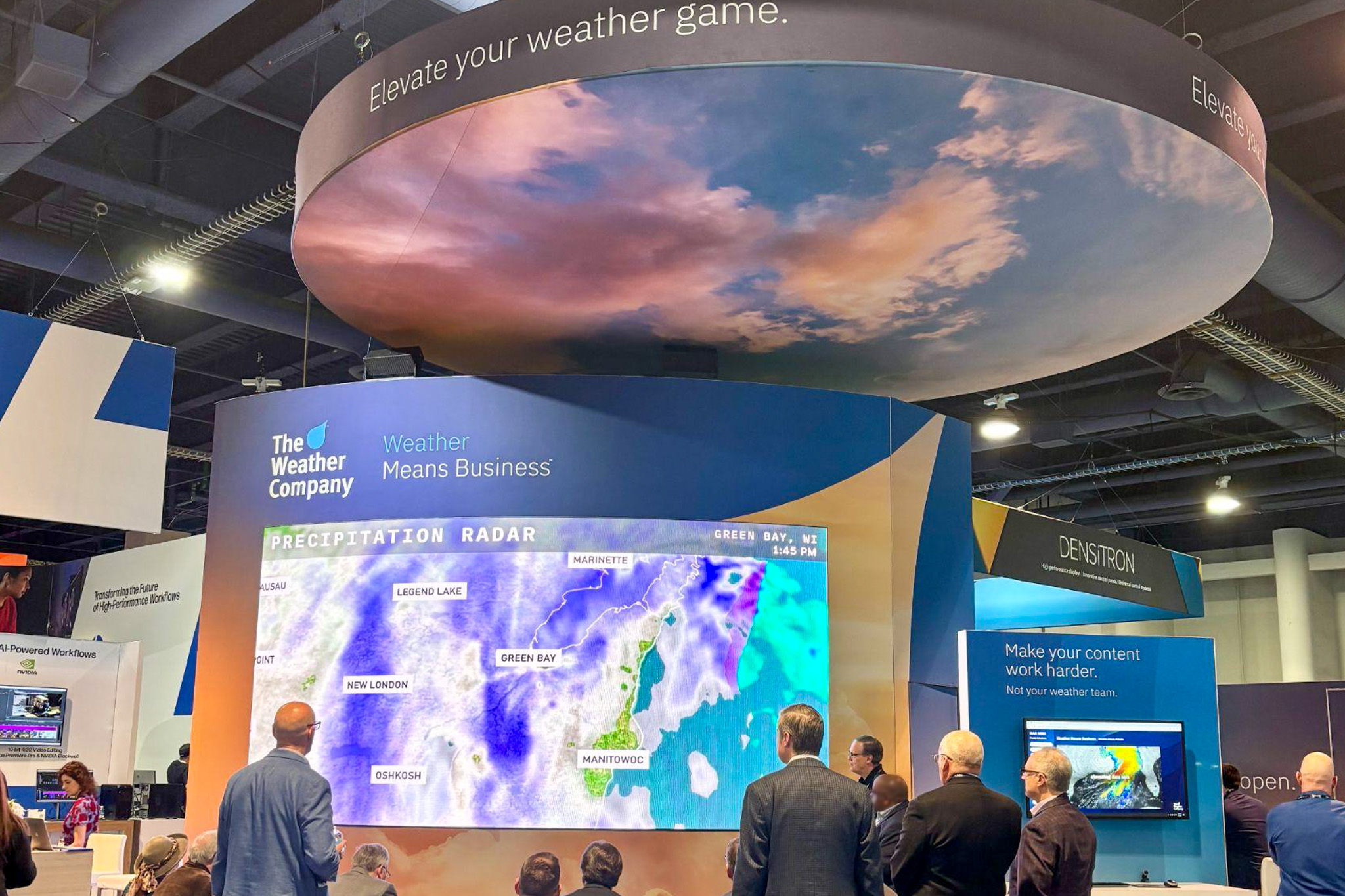
Following the energizing NAB Show (April 6-9, 2025) in Las Vegas, The Weather Company team sat down with Therese DeMatteo, Senior Director of Enterprise Marketing, to discuss our broadcast partner support and key takeaways from the event:
Q: What emerging technology trends generated the most buzz on the show floor, and how do they align with The Weather Company’s current product roadmap?
Therese: This year marked a notable shift in broadcasters’ attitudes toward AI. Unlike last year, when most were firmly against it, we observed a new openness to exploring how AI might streamline workflows. While the approach remains conservative, there’s genuine interest in leveraging these technologies. This evolution aligns perfectly with our roadmap, focusing on:
- Advanced forecasting: We’ve integrated AI with weather science for decades — like Forecast on Demand — unlike competitors who rely solely on mathematical models. By analyzing 100+ global simulations, including proprietary ones, we deliver the most precise, actionable forecasts available. Now, we’re partnering with NVIDIA to develop a groundbreaking kilometer-scale AI model launching in 2025.
- ReelSphere: Our newest offering leverages AI to generate voiceover narration from stock voice libraries for concise, adaptive weather videos. ReelSphere technology empowers meteorologists to focus on impactful storytelling while efficiently meeting the growing demand for weather content across platforms.
- Mercury: Behind the scenes, our dedicated team is applying various LLM models across our entire business through our Mercury initiative. And for ReelSphere, we’re currently developing generative AI capabilities for longer-form regional forecast scripts.
- Max Alert Live: We’re applying AI technology within Max Alert Live to help stations meet the FCC mandate for audio map descriptions, making weather information more accessible.
Q: What specific pain points or challenges did you hear directly from attendees during conversations at your booth or in meetings?
Therese: Our conversations revealed several consistent challenges across stations and groups:
- Hardware hesitancy: There’s a strong preference against purchasing additional hardware. Cloud-based solutions are increasingly attractive for their flexibility and lower capital investment.
- Collaboration needs: Meteorologists across station groups need better tools to work together seamlessly—another opportunity where our cloud solutions shine.
- Digital automation: Particularly in smaller markets, there’s high demand for solutions like ReelSphere that can automate digital weather content creation.
- Digital revenue struggles: Many broadcasters continue to search for effective ways to monetize digital content, particularly on mobile platforms.
- Smaller footprint solutions: We met several meteorologists looking for solutions to launch their own digital weather channels on platforms like YouTube.
Q: Which demos or product announcements received the strongest positive reactions, and why do you think they resonated so well?
Therese: ReelSphere clearly stole the show this year. The enthusiastic response stemmed from its direct address of a critical pain point: Meteorologists being stretched thin trying to produce weather content across multiple platforms 24/7.
With many stations operating with reduced staff, ReelSphere’s ability to automate high-quality weather content creation for various platforms makes it a game-changer. The flexibility of its application particularly impressed visitors to our theater presentation.
Q: Based on your conversations with industry leaders and customers, what content consumption or creation workflows are evolving fastest, and how should that influence your go-to-market priorities?
Therese: The clearest trend we observed is the industry-wide shift away from hardware dependency toward cloud-based solutions. Broadcasters are actively seeking ways to reduce hardware costs while maintaining or enhancing their weather presentation capabilities.
This aligns perfectly with our strategic direction of cloud-first solutions that provide flexibility, scalability, and collaboration capabilities without substantial upfront investment in physical infrastructure.
Navigating media evolution with a trusted weather ally
As the media landscape continues to evolve, The Weather Company remains committed to being more than just a vendor – we’re a trusted weather partner. Our innovations in AI, cloud technology, and automated content creation are designed with one purpose: helping broadcasters remain essential to their audiences and successful in an increasingly competitive environment.
More perspectives on NAB 2025
Hear more from leaders at The Weather Company and other featured guests who stopped by our booth.
Sheri Bachstein, President | The Weather Company
Watch Sheri's interviewMatthew Drooker, CTO | The Weather Company
Watch Matthew's interviewTim Heller | Heller Weather
Watch Tim's interviewTracey Rogers | Nexstar Media Group
Watch Tracey's interviewLet's talk
To learn more about how The Weather Company can help your station navigate the future of storytelling, contact a media expert today.
Contact usRelated resources
Key takeaways
- ReelSphere empowers broadcasters to create hyperlocal weather content tailored to specific audiences across OTT, FAST, and linear TV platforms.
- AI-driven automation allows ReelSphere to deliver scalable, personalized weather videos while reducing production workloads.
- Advertisers value ReelSphere’s ability to integrate sponsor-ready content into weather videos, tapping into a brand-safe and highly engaging medium.
- Lifestyle-focused weather updates, such as activity-specific forecasts, improve viewer engagement and open new monetization opportunities.
Remember when weather forecasts were mostly one-size-fits-all? That’s because meteorologists had to create them by hand, aiming to reach as many viewers as possible. This approach made sense when we all watched traditional TV, but times have changed.
These days, with broadcast streaming platforms like Connected TV (CTV) and Free Ad-Supported Streaming TV (FAST) channels becoming more popular and smarter, viewers want accurate weather content that speaks directly to them – their neighborhood, their weekend plans, their specific interests.
It’s putting broadcasters in a tough spot, though. They need to create more personalized content to keep up with viewer expectations and broadcast technology trends, but they can’t just hire more people to make it happen. The big question is: How do they scale to deliver this customized experience without breaking the bank?
Meeting the challenges of modern broadcasting
ReelSphere from The Weather Company meets this demand head-on with automated, scalable technology, empowering broadcasters to deliver unmatched engagement, operational efficiency, and new revenue opportunities. Not to mention, the world’s most accurate forecast.1
With ReelSphere, broadcasters can now deliver detailed, geo-targeted weather content across all their channels without having to hire more people or invest in expensive equipment. It’s like having an entire weather production team working 24/7, but powered by automation and AI.
Their forecast, their way
What makes ReelSphere really special is how it easily creates accurate weather content that feels like it’s made just for the viewer. ReelSphere customizes forecasts based on viewer location, what the weather is doing, and even what time it is. For example, a viewer in Miami might get updates about beach conditions and UV levels, while someone in Denver might see the latest ski conditions or hiking trail forecasts. This personal touch really matters to viewers.
In fact, studies show that most people (about 6 out of 10) strongly prefer weather forecasts specific to their area,2 and even more (63%) want updates tailored to exactly where they are.3 In today’s world, where everyone’s competing for viewers’ attention, this kind of personalized content helps build real connections with audiences.
Here’s another great feature – ReelSphere can also adjust content based on when people need it most. Planning for the weekend? It’ll automatically push out weekend forecasts on Thursday or Friday to help viewers plan ahead. And when rain or snow is coming, it can overlay radar maps to show exactly where and when it’ll hit. It’s like having a weather expert who knows exactly what your viewers need, when they need it.
Enhancing engagement through lifestyle weather content
While location-based personalization is powerful, it’s just the beginning of what ReelSphere can do for viewer engagement. ReelSphere does more than display the local forecast – it helps broadcasters create weather content with a personal twist. Yes, personal. Thanks to geo-targeting and metadata decisioning capabilities, ReelSphere can deliver highly relevant messaging. This approach is especially powerful on streaming platforms like FAST channels, where viewers love snackable, useful updates.
 The numbers tell an interesting story: FAST channels are booming, with revenue expected to jump from $8 billion in 2023 to $17 billion by 2029.4 This explosion in streaming means there’s never been a better time to revolutionize how weather content is delivered.
Picture this: in the morning, a fisherman can check if conditions are perfect for hooking a prize trout, while a golfer might get tips on perfecting their swing on a windy day. By delivering weather content that feels this personal and relevant, broadcast streaming services aren’t just sharing forecasts – they’re becoming part of viewers’ daily routines. Plus, it opens up some great opportunities for targeted sponsorships that feel authentic. And authenticity connects.
Monetization opportunities: Turning forecasts into revenue

This deeply personalized approach doesn’t just engage viewers – it creates valuable opportunities for advertisers. If you think about it, weather content is like the Swiss Army knife of broadcasting – everyone uses it, and advertisers know it. In fact, almost every advertiser out there (98%) is eager to put their name on weather segments in the streaming world.5 Why? Because weather is always relevant, always safe for brands, and connects with just about everyone.
ReelSphere makes it easy for broadcasters to turn this interest into ad product revenue. A summer forecast could feature a sunscreen brand’s message while winter storm updates might showcase ads for four-wheel-drive vehicles. The best part? The system automatically does the hard work for you – adding voiceovers that turn viewers into customers. It’s a premium advertising opportunity for brands that’s an easy sell.
Empty ad slots? Instead of showing a blank screen or recycling the same promo, broadcasters can pop in a personalized weather update with sponsor branding. It’s a win-win – viewers get useful information, and broadcasters turn what used to be dead air into profitable airtime.
Doing more with less: A solution that grows with you
The real power of ReelSphere lies in its flexibility: Whether you’re running a small local station or managing a national network, it’s scalable technology that fits your needs. It’s like having an extra set of hands (or maybe a whole team) working behind the scenes. By tackling the repetitive tasks automatically, it frees up your weather team to focus on what they do best – like tracking major storms or diving deeper into weather patterns.
Plus, if you’re already using weather platforms such as Max media solutions, there’s more good news. ReelSphere works seamlessly with your existing graphics and visuals, so you’re not starting from scratch or wasting your previous investment. Serving diverse demographics? Here’s a bonus: ReelSphere can also deliver weather updates in multiple languages.
Next-gen weather: Reshaping broadcast content
This scalability and efficiency are crucial because they’re powering what’s next in weather broadcasting. The media world is changing fast, and ReelSphere is helping broadcasters scale to stay ahead of the game. It’s not just about showing temperatures anymore – it’s about delivering weather content that feels personal, local, and valuable to each viewer, while helping broadcasters turn these connections into revenue.
By combining automation, AI, and hyperlocal precision, ReelSphere elevates weather content from a routine segment to a powerful strategic asset. If you’re ready to take your weather content to the next level, engage viewers in exciting new ways, and tap into fresh revenue streams, ReelSphere might be exactly what you’re looking for.
Let's talk
To learn more about automated, digital weather streaming content with ReelSphere, contact our media experts today.
Contact usRelated resources
1 ForecastWatch, Global and Regional Weather Forecast Accuracy Overview, 2021-2024, commissioned by The Weather Company
2 3 5 SmithGeiger, ReelSphere Research Study, First Quarter 2024
4 Nielsen, “FAST has made linear TV cool again; personalization will make it cooler,” April 2024.
Key takeaways
- FAST channel revenue is projected to grow to $17 billion by 2029, creating significant opportunities for weather-driven content in the ad-supported streaming landscape.
- Hyperlocal weather content increases engagement on FAST channels by meeting audience demands for personalized forecasts.
- A remarkable 98% of advertisers see value in sponsoring weather content on ad-supported streaming platforms, showcasing its role in boosting revenue.
- ReelSphere helps broadcasters turn unsold ad inventory into sponsor-ready weather segments that generate revenue.
Free Ad-Supported Streaming TV (FAST) channels are dominating the media landscape. Consequently, this dynamic and competitive market creates new challenges for broadcasters looking to captivate audiences and maximize ad revenue. Enter ReelSphere, The Weather Company’s innovative weather content creation solution.
The ReelSphere platform delivers hyperlocal, geo-targeted, personalized weather forecasts 24/7 at scale backed by the most accurate weather data available. By transforming ad inventory into relevant, sponsor-ready weather content, ReelSphere creates a perfect alignment between what viewers want and what advertisers need.
It’s no secret that the FAST channel industry is experiencing rapid growth with revenue projected to surge from $8 billion in 2023 to $17 billion by 2029.1 How do you plan to reap those rewards? For broadcasters, ReelSphere isn’t just another tool – it’s an essential component of a successful monetization strategy.
0
will see streaming TV surpass linear TV in ad spend2
Using AI to engage viewers with hyperlocal and relevant content
Weather remains one of the most consistently consumed types of content, especially when it’s produced by one of America’s most trusted brands. According to research:
%
of adults use a weekly weather platform3
%
of viewers express interest in watching local weather streaming platforms4
ReelSphere capitalizes on this demand by filling air time with snackable, hyperlocal forecasts that align with viewer interests. For example, a golf enthusiast might see a weather segment that highlights ideal tee times for their region, while families planning a weekend outing could view a tailored forecast featuring the best times for outdoor activities. Undeniably, personalization at this level makes sure viewers remain engaged with the content, resulting in longer watch times and increased ad impressions.
Turning unsold ad inventory into revenue
We’re all too familiar with seeing unsold ad inventory filled with placeholder messages such as “We’ll be right back” or repetitive promotional material. What do these messages really say? Lost revenue. Roughly 35% or 750M impressions go unsold each year.5 Let’s do the math:
- 115 million FAST channel users in the U.S.6
- Average of three viewing hours per day7
- Approximately 18 ads served per hour = 2.2B annual impressions8
ReelSphere monetizes slate by replacing it with sponsor-ready weather segments and alerts audiences crave. Sponsors can seamlessly incorporate their messaging, such as a logo overlay or a short call-to-action, choosing among various placement options:
- Integrated within the weather segment
- Pre-roll
- Post-roll
- Standalone ads
New York City running forecast: by ReelSphere
Within these placements, ReelSphere can deliver timely messages that correlate with the real-time forecast. For instance, a sunscreen brand might sponsor a summer weekend weather update, while a car manufacturer could highlight all-weather vehicle features during a winter storm.
Callaway sponsor ad embedded within a ReelSphere video.
Incorporating contextualized, ad-supported streaming weather content helps sponsors reach their target audience with relevant messaging at the right time.
%
of consumers highly value forecasts personalized for their specific location or activities9
%
of advertisers are interested in sponsoring weather content10
Local trust, network-wide reach: The ReelSphere advantage
ReelSphere not only offers broadcasters dynamic, on-demand weather streaming content, it leverages modern AI to help them produce this content at scale.
Broadcasters can train the ReelSphere AI to replicate voices of their own on-air talent, preserving the familiarity and trust their audience expects. Or, choose built-in narration by The Weather Company talent.
%
of viewers trust AI voiceovers modeled after their favorite meteorologist11
ReelSphere also scales across multiple streaming platforms, including OTT, FAST, and CTV. This means broadcasters can generate sponsor-ready weather content customized for different regions, conditions, and audiences while maintaining consistency.
Why ReelSphere is a must-have for FAST channel operators
ReelSphere offers broadcasters a seamless way to easily integrate local weather streaming into their programming, all but guaranteeing a better viewing experience while maximizing ad revenue. By transforming unsold ad inventory into engaging weather segments, ReelSphere helps turn a problem into profit.
Let's talk
To learn more about automated, digital weather streaming content with ReelSphere, contact our media experts today.
Contact usRelated resources
1 Nielsen, “FAST has made linear TV cool again; personalization will make it cooler,” April 2024
2 Cross Screen Media, “The Streaming Media in Four Steps”
3 9 11 SmithGeiger, “ReelSphere: The Future of Weather Forecasting,” February 2024
4 10 Magid, “The Weather Company Advertiser Research,” March 2023
5 6 7 8 One Touch Intelligence