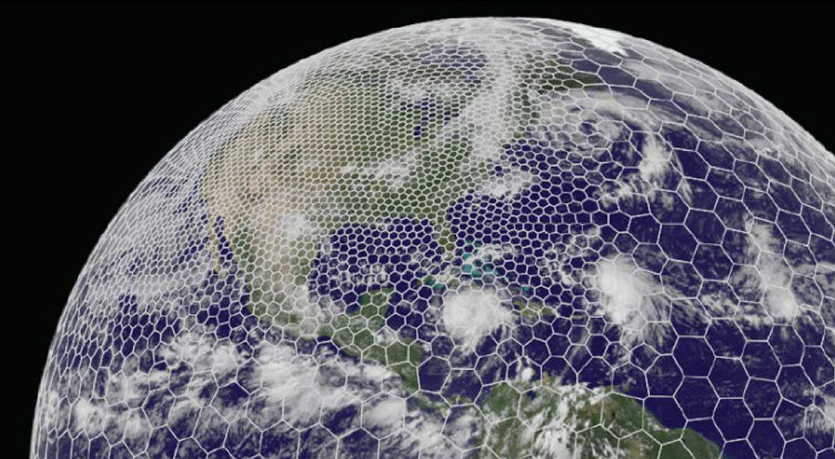
The latest GRAF® weather model improvements
Continue reading

(Episode 9)
Episode overview: Turning a forecast into a decision
For eight episodes, we’ve taken apart one hazard at a time — turbulence, volcanic ash, convection, lightning on the ramp, hurricanes. Episode 9 does the opposite. Recorded live at The Weather Company’s own aviation conference, it steps back and asks what the next decade actually requires.
The answer three TheWeather Company SVPs land on isn’t more data, and it isn’t a better dashboard — it’s both, inseparably. Peter Neilley (SVP, Weather Science and Forecasting), Ravi Vanmali (SVP, Aviation), and Mark Edwards (SVP, Software Engineering) each bring a different lens — the science, the industry, the platform — to the same question: what does it actually take to turn a forecast into a decision an operation can run on?
More episodes
(Episode 8)
Episode overview: Forecasting the storm the models cannot place
Air mass thunderstorms are the toughest scale in convective forecasting — not because they’re the strongest, but because they are small, short-lived, and smaller than the grid boxes numerical models use to represent the atmosphere. A morning briefing calling for a 30% chance of afternoon storms can be entirely accurate and still leave an operation caught. At 2:00 p.m. the radar is clean. By 3:15 p.m. a single cell is parked over the field, the ramp is closed, and aircraft on final approach are reporting significant windshear.
In this episode, our embedded meteorologists explain how they close that gap. Because weak steering flow leaves these storms pulsing and decaying in place rather than moving, forecasters lean on local station knowledge, surface and instability analysis, visible satellite, and rapid-refresh guidance to narrow where and when convection will initiate — then stay in constant contact with airline decision makers as outflow boundaries from the first round become the trigger for the next. We also examine why these storms turn genuinely dangerous over the desert Southwest and mountainous terrain, where dry microbursts can arrive with almost no visual warning and a haboob can take an airport from VFR to below IFR minimums in a matter of minutes.
More episodes
(Episode 7)
Episode overview: Outsmarting tropical disruptions with global visibility and trust
In this episode, we tackle the unique operational and psychological challenges that tropical cyclones (hurricanes) present to global aviation networks. While seasonal forecasts may predict a quieter El Niño year, our experts explain why the total number of storms matters far less than where a single storm tracks and when it hits — because historically, it only takes one.
We take a deep dive into how our forecasting teams deliver actionable insights up to 3 to 4 days before a storm impacts a location, giving airlines a 24-to-36-hour head start before government watches are even issued. From providing critical wind tables for terminal closures to guiding dispatchers around the Central Dense Overcast zone of a hurricane core, learn how tailored weather intelligence helps airlines manage both the initial storm threat and the complex recovery phase.
More episodes
(Episode 6)
Episode overview: Decoding lightning risks and mastering ramp recovery
Lightning doesn’t just halt ground operations; it triggers a costly chain reaction across an airline’s entire network. When a ramp closes, fueling stops, bags go unloaded, arriving planes sit stranded on taxiways, and a brief, 20-minute thunderstorm quickly snowballs into network-wide gridlock.
In this episode, we look at the complex atmospheric ingredients that drive severe lightning events — from the breaking of an atmospheric “cap” to the hidden dangers of high-current positive lightning striking miles away from the storm core. Learn how tailored weather intelligence helps airlines safely transition from reactive scrambling to proactive certainty.
More episodes
(Episode 5)
Episode overview: Navigating convection with proactive data and expertise
Thunderstorms do more than block runways; they create airspace chaos by closing arrival and departure fixes and inflating fuel costs. This episode examines how The Weather Company’s embedded experts work within airline operations centers to turn “Irregular Operations” (IROPS) into a manageable strategic playbook.
We explore why confidence is the most important metric a meteorologist can provide when an airline is deciding whether to be aggressive with flight planning or prepare for diversions. By looking beyond the TAF and into the recovery phase, our experts explain how identifying the right alternates and predicting exact gate-reopening times protects the operational integrity of the airline.
More episodes
(Episode 4)
Episode overview: Precision avoidance and routing for volcanic hazards
Volcanic ash is one of the few weather events that demands total avoidance, but it doesn’t have to mean total disruption. This episode explores the sophisticated technology and forecaster expertise that has turned volcanic events from unpredictable crises into manageable operational playbooks.
Our experts break down the difference between standard government SIGMETs and the granular data layers used by The Weather Company’s meteorologists to help airlines “thread the needle” around volcanic plumes. We examine the critical role of summit-height wind modeling and real-time webcam streams in protecting terminal operations. Discover how the industry has moved from the panic of the 2010 E15 eruption to a future of proactive, 24-hour strategic planning.
More episodes
(Episode 3)
Episode overview: Proactive fog mitigation for cargo operations
In this episode, we explore the specialized strategies used to keep cargo airlines moving when visibility drops. The core philosophy is simple: move from reactive scrambling to proactive decision-making.
We take a deep dive into the unique operational flexibility of cargo carriers, discussing how contingency plans—such as splitting flights or rerouting around fog banks—can significantly minimize fuel costs and logistical delays. From leveraging advanced predictive alerts to managing unforecasted fog events, learn how tailored weather intelligence keeps the supply chain on track even when the clouds roll in.
Let's talk
To learn more about our advanced aviation weather solutions, contact our aviation experts today.
Contact usMore episodes
(Episode 2)
Episode overview: Advancing turbulence safety and communication
In this episode, we explore the cutting-edge tools currently reshaping the aviation weather landscape, including the high-resolution MPAS model and the new turbulence nowcast.
The team shares how these advanced systems are making the “unpredictable” manageable. More importantly, we highlight the indispensable role of the human forecaster in filtering this overabundance of data to provide rapid, actionable insights that keep flight attendants safe and cabins secure before the first bump occurs.
Let's talk
To learn more about our advanced aviation weather solutions, contact our aviation experts today.
Contact usMore episodes
(Episode 1)
Episode overview: The human-machine edge in aviation forecasting
In this episode, we dive into what sets The Weather Company apart in the competitive landscape of aviation weather services. While government and private data sources are plentiful, the true “secret sauce” for airlines lies in the synergy between technology and talent.
Join us as we discuss the powerful combination of our high-quality FOD (Forecast on Demand) data and the specialized expertise of our human meteorologists. You’ll learn how this hybrid approach transforms raw data into actionable, high-fidelity forecasts, helping airlines make faster, more confident decisions in an increasingly complex airspace.
Let's talk
To learn more about our advanced aviation weather solutions, contact our aviation experts today.
Contact us