
Weather intelligence for the future: Crafting a strategic enterprise approach to changing environmental conditions
Continue reading


Key takeaways
- At Boeing Field, The Weather Company’s embedded meteorologists (METs) identified a 50-mile cloud deck that would lift fog visibility, turning vague fog forecast probabilities into actionable timing windows.
- A 20-minute fog visibility window saved 30,000 customer commitments when four UPS aircraft needed to land during rapidly changing conditions.
- Embedded METs turn uncertainty into operational advantage, providing context and explaining timing, severity, and impact so decision-makers can act proactively instead of reactively.
- Standard TAFs and TCFs miss critical nuances in fog forecasts — like impact likelihood and timing significance — that embedded METs offer through real-time human expertise and operational context.
Dense fog doesn’t negotiate. When it rolls in, it obscures runways, and forces operational decisions worth millions — in mere minutes.
At King County International Airport (BFI) — better known as Boeing Field — just south of downtown Seattle, UPS flies four aircraft every morning within a tight 40-minute arrival window. Standard TAF and TCF outlooks miss the critical nuances that a human can provide. Examples include understanding impact likelihood, timing significance, and offering assurance for decision making. This gateway location demonstrates how integrated weather experts can help transform uncertainty into actionable intelligence for critical, micro-scale decisions.
High-stakes hub operations: The 30,000 package equation
The fog threatened more than just visibility; it threatened the entire daily operation.
UPS flies four 767 aircraft into Boeing Field most mornings within a tight 40-minute arrival window. Here is what was at stake in that narrow operational window:
- Inbound impact: 10,000 UPS Next Day Air packages, plus additional cargo
- Outbound impact: 20,000 UPS Next Day packages scheduled for departure on the turn
- Total disruption: 30,000 commitments hanging in the balance
The operational constraint: Why timing is everything
Once an aircraft lands, packages immediately flow to specific gates based on each plane’s destination. That routing is locked — packages are coming out, and the destination sequence cannot be changed.
Realizing an aircraft has a Minimum Equipment List (MEL) before it reaches its gate is critical. Early, accurate forecasting allows operations to reposition pilots and aircraft before landing. This maximizes the chances of maintaining next-day service commitments across the entire network.
The embedded expert: Transforming uncertainty into actionable intelligence
The Boeing Field case study is yet another example of why The Weather Company’s FAA-compliant, EWINS Weather Forecast Services positions meteorologists where decisions happen — side-by-side in operations centers alongside dispatchers and air traffic coordinators. Having the right expert in the room separates anticipation from reaction.
The initial conditions were dire:
- Fog forecast: 300 feet overcast, one mile fog visibility, light mist
- UPS minimums at BFI: 290 feet ceiling decision height, 4,000 feet RVR
- Morning fog risk: Moderate (30–50%), then upgraded to High (51%+) after 12Z
Fog covers the terminal airspace at Boeing Field, diminishing visibility.
Crisis inbound: When the fog forecast hits minimums
With four planes already inbound, the 1053Z METAR observation: half-mile visibility with an overcast cloud layer 200 feet above the ground.
ATC permitted the first aircraft to make an approach, and it descended through the fog layer to decision height. The pilot searched for runway lights that should have appeared through the mist — they weren’t visible.
The plane entered a low-level holding pattern, burning precious fuel with each orbit. After discussion with Flight Ops, the three other aircraft — which were minutes behind — were given a critical call: Hold at 25,000 to 28,000 feet.
This decision maximized their fuel endurance and bought time. The embedded meteorologist (MET) proceeded to find a solution that didn’t exist in any TAF.
A 50-mile wide cloud and a 20-minute chance
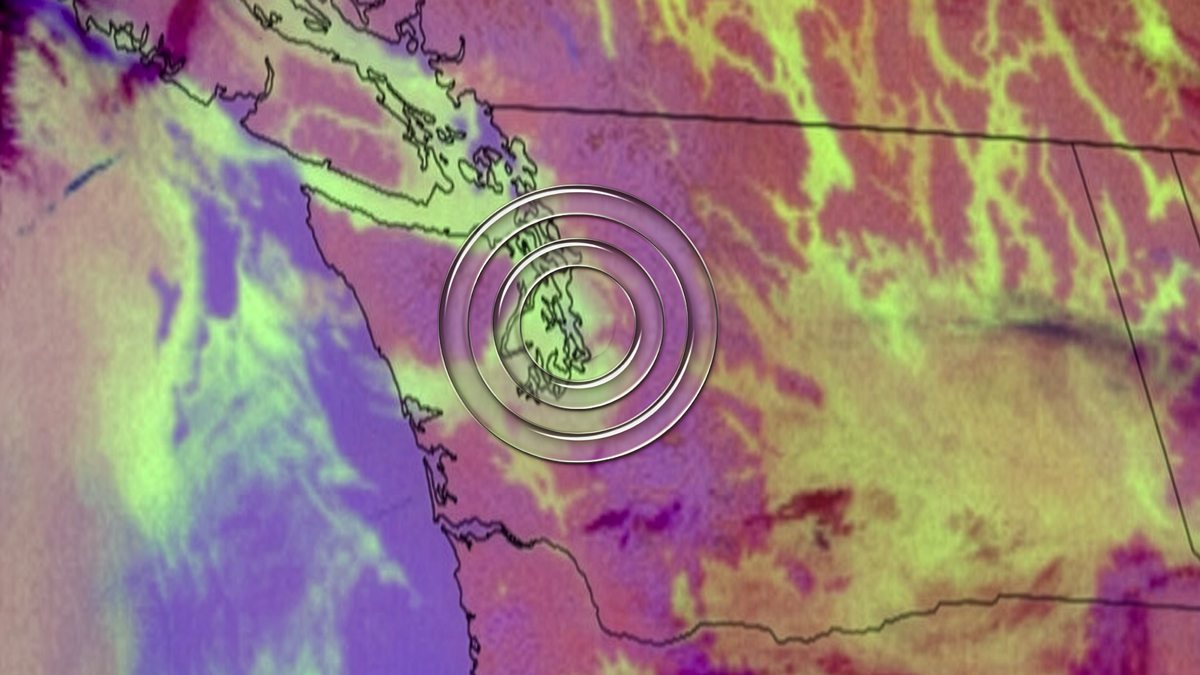
Concerns mounted about diverting all four aircraft and collapsing the entire operation. But the MET saw something in the satellite imagery.
Managers gathered urgently in the Meteorology office, and the briefing from the MET was direct. A narrow cloud deck, only 50 miles wide at 4,000 feet, was moving directly toward Boeing Field. This wasn’t speculation or probability ranges — this was observable atmospheric physics in motion.
Real-time weather intelligence from the world’s most accurate forecaster1 revealed a critical solution. The cloud would temporarily lift the fog deck, for perhaps 20 to 25 minutes. This one window was also the only chance to land all four aircraft on time.
Precision forecasting meets operational reality
The airline managers faced a decision with little to no safety net. Bring three aircraft down from holding altitude based on a 20-minute fog forecast window, or divert and accept that 30,000 customers would miss their service commitments.
They made the high-stakes call, pulling all three holding planes down to 10,000 feet. The cloud moved over Boeing Field exactly as forecast. The fog deck lifted, and all four aircraft landed within the window — one after another.
Then, just as the MET predicted, the cloud moved out. Fog returned immediately, dropping visibility back below minimums. It stayed that way until 17Z — five hours later.
Critical insights saving the day
Every inbound package made its service window. Crews stayed within duty limits. The 20,000 outbound packages departed on schedule. Thirty thousand customers received their deliveries because of a 20-minute forecast window that most meteorological products would never capture.
Without that hyper-specific guidance, the outcome writes itself: no inbound packages make service, crews time out, outbound operations collapse. The entire 30,000-customer chain breaks. Jeff Sarver, Meteorologist-In-Charge (MIC), The Weather Company, stated it clearly afterward: “The confidence level and demeanor of the meteorology team gave them the assurance they needed to make that high-stakes call. Not just the forecast — the confidence behind it, delivered by people who understood both the atmosphere and the operation it was about to disrupt.”
When weather intelligence matters: Confidence vs. the coin flip
Uncertainty makes aviation professionals uncomfortable. Pilots make tactical decisions in real-time with zero margin for error. But perfect forecasts don’t exist — a reality that creates tension between meteorological science and operational necessity.
Pilots make tactical decisions in real time with zero margin for error. But perfect automated forecasts don’t exist — a reality that creates tension between technology and operational necessity.
Consider the dreaded 50% probability (‘PROB 50’) forecast. Meteorologists see the challenge in issuing it, because it feels like a coin flip. But, context transforms that number completely. A 50% chance of freezing drizzle in Atlanta is alarming and operationally disruptive. But the same forecast in Minneapolis is just another winter day.
How confidence changes the game
This is where embedded meteorologists bridge the gap. At Boeing Field that morning, the fog forecast wasn’t about percentages — it was about a 50-mile-wide cloud deck arriving in 20 minutes. That specificity turned uncertainty into actionable intelligence.
Confidence doesn’t eliminate uncertainty. But it can help clarify what to do with it. Airlines with embedded meteorologists make more informed decisions than ever before, particularly when confidence is high in significantly disruptive events. This allows them to proactively cancel flights, reroute passenger connections, and position staff accordingly — sometimes days in advance.
The human element: Embedded expertise changes high-stakes decisions
Embedded meteorologists enhance communication capabilities in ways standard forecasts simply cannot. They discuss scenarios with dispatchers and operational managers, explaining not just the confidence level but the “why” behind it: timing windows, severity thresholds, geographic variability, and more.
One wrong decision coupled with vague intelligence can impact operations for the rest of the day, and domino fast. For example, one airline partner describes embedded meteorologists as their “early warning system.” They added, “A ‘PROB 30’ TAF entry, for example, isn’t enough information to make hub decisions.”
Transitioning from uncertainty to confidence — from “maybe” to “here’s your window” — produces outcomes that cascade through entire networks. That level of operational meteorology goes far beyond what any standard format, like a “PROB30” TAF entry, can communicate.
Let's talk
To learn more about our trusted, real-time aviation weather forecasts, contact our aviation experts today.
Contact usRelated resources





1 ForecastWatch, Global and Regional Weather Forecast Accuracy Overview, 2021-2024, commissioned by The Weather Company.