
The latest GRAF® weather model improvements
Continue reading


Key takeaways:
- Clear-air turbulence causes over a third of major airline accidents and costs the industry hundreds of millions annually in injuries, delays, and disruptions.
- Traditional turbulence management relies on delayed, subjective pilot reports — real-time data is essential for proactive avoidance.
- Maverick WXAlertTM delivers timely turbulence updates via ACARS directly to cockpits, even when connectivity is limited.
- Integrated, real-time, high-resolution turbulence data across dispatch and flight operations creates a connected ecosystem that enhances safety and efficiency.
Recent headlines have put a sharp focus on a critical industry challenge: aviation turbulence. The tragic Singapore Airlines incident is a stark reminder of the risks. But these aren’t isolated events; they’re part of a scientifically documented trend. An increase in clear-air turbulence (CAT), driven by a changing climate, demands that we evolve our approach to turbulence mitigation. For airlines, the key to enhancing safety and operational efficiency lies in shifting from reactive reporting to proactive, data-driven avoidance.
Let’s face it: Weather-related challenges aren’t only an operational headache for airlines; they are a massive financial burden. Turbulence encounters, crosswind complications, and conditions that trigger irregular operations (IROPs) cost the industry hundreds of millions each year globally. We’re talking injury claims, operational delays, aircraft repairs, cargo damage, and revenue losses that cascade through entire flight networks. Airlines need to stop playing defense and start getting ahead of these challenges.
The growing threat of clear-air turbulence
For decades, the industry has managed turbulence with turbulence forecasts and pilot reports. But these traditional methods are being challenged by clear-air turbulence. This invisible threat occurs in cloudless skies. It often catches flight crews by surprise, giving them no time to react.
Limited connectivity in the cockpit leads to uncertainty about the location, extent, and severity of enroute impacts. In turn, this exposes flights to the risks of crosswinds and IROPs scenarios leading to costly disruptions. Weather challenges demand real-time awareness.
Science confirms: Turbulence on the rise
A landmark 2023 study found that severe CAT has already increased by 55% over the North Atlantic in the past 40 years due to a changing climate,1 with further significant increases projected. And according to the Federal Aviation Administration (FAA), turbulence accounts for more than a third of all major airline accidents.2 The vast majority result in serious injuries to passengers or crew. This isn’t just a safety and comfort issue; the operational costs — from diversions to structural inspections and reputational damage — are also significant.
From reactive reports to proactive turbulence mitigation
The fundamental weakness of traditional turbulence management is data lag. For example, pilots often lack real-time data — especially when connectivity is limited. A manual Pilot Report (PIREP) is a subjective snapshot of the past. By the time it’s relayed to an aircraft, the atmospheric conditions may have already changed.
Weather challenges demand real-time awareness. So the future of flight safety may depend on your ability to shift from reactive to proactive. We must move from isolated, subjective turbulence reports to a comprehensive, real-time, and objective view of the atmosphere.
It’s not what a pilot felt — it’s what the atmosphere is doing right now. The Weather Company’s approach is built on a unique synthesis of real-time EDR (Eddy Dissipation Rate) data, high-resolution weather modeling, and the combined expertise of aviation meteorologists. Automated alerts can be relayed via ACARS to pilots when other avenues fail. This works even in limited or non-connected cockpit scenarios. Pilots can have confidence these alerts are founded in weather intelligence from the world’s most accurate forecaster.3
Maverick WXAlert: Reducing enroute weather challenges through timely, direct cockpit alerting
On the ground or in the air, real-time data provides the detailed atmospheric intelligence pilots and dispatchers need. Maverick WXAlert combines multiple data sources into a single, proprietary system that keeps pilots informed — even when connectivity is limited. This workflow-integrated solution helps teams operate proactively with:
- Resilient ACARS cockpit communication: Delivers real-time, moderate or higher turbulence EDR updates directly to the cockpit via ACARS — even when in-flight connectivity is limited
- Tactical enroute decision-making: Assists in managing IROPs and guiding pilots on optimal diversion alternates
- Improved safety and efficiency: Shares synchronized alerts to both dispatchers and pilots the moment a flight is forecast to encounter an enroute weather hazard
Turbulence forecasting: Where experience and innovation converge
The Weather Company meteorologists — with an average of over 10 years of experience in aviation forecasting — don’t just rely on standard global weather models. They also leverage a proprietary Global High-Resolution Atmospheric Forecasting System (GRAFTM) that updates rapidly. It captures turbulence-prone areas with far greater precision than conventional models. Better resolution means more accurate predictions of where atmospheric hazards are most likely to develop. This proven, reliable weather intelligence helps pilots to optimize routes that prioritize safety, efficiency, and passenger comfort.
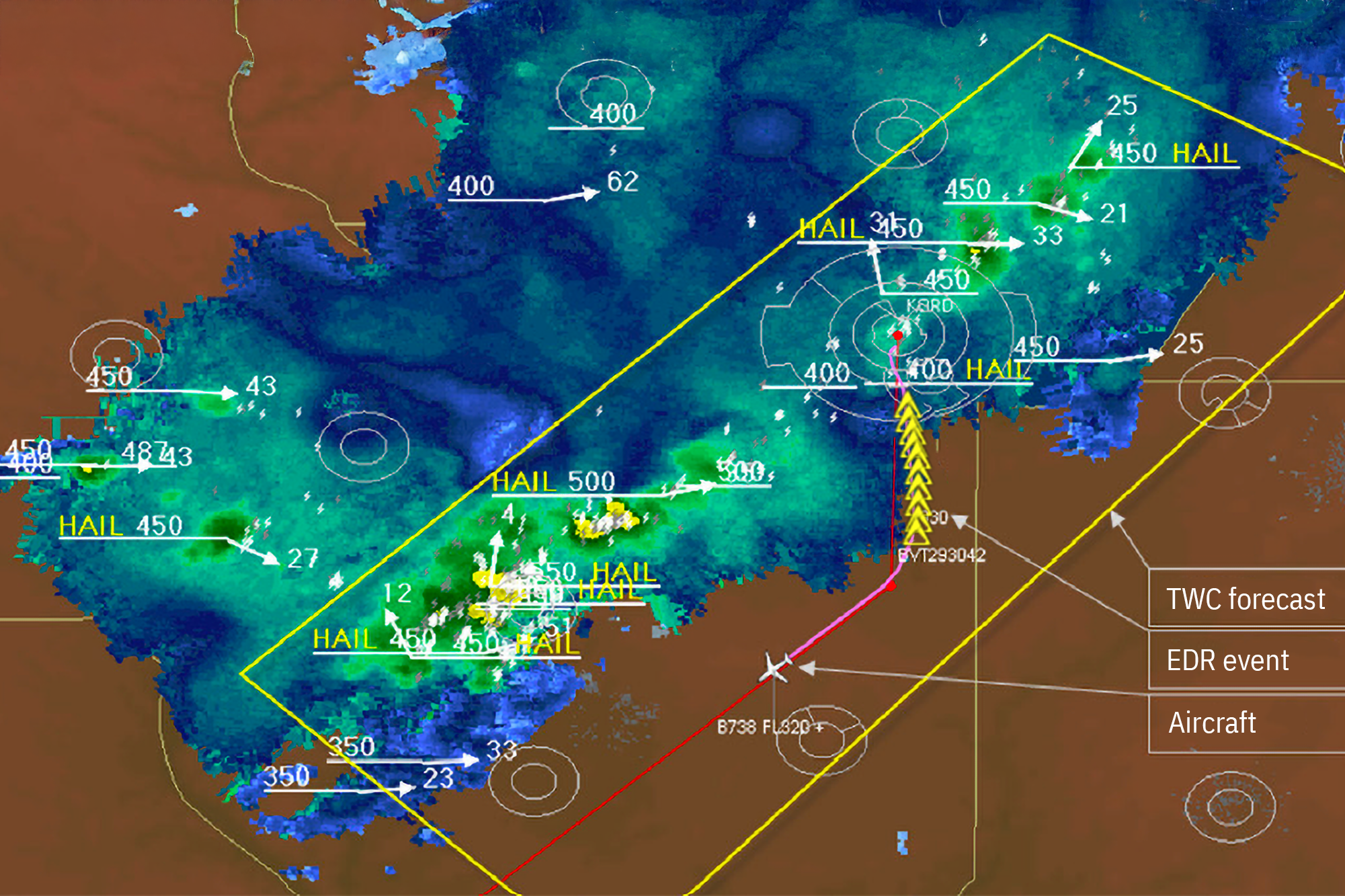
Alert messages are generated when a flight is projected to intersect an enroute hazard.
Turbulence intelligence straight to the cockpit
Real-time, crowdsourced turbulence data becomes exponentially more powerful when it is integrated across the entire operational workflow. This creates a connected ecosystem to enhance safety. The Weather Company is strengthening our turbulence avoidance solutions with the new integration of EDR data.
Maverick WXAlert is more than just a turbulence alerting system. Operation teams can take advantage of the ability to deliver timely, precise, and actionable alerts and other features directly to the cockpit in limited or non-connected scenarios via ACARS, including:
Enroute Hazard SIGMETS (proprietary) and Flight Plan Guidance (FPGs)
Get an incisive, actionable view of:
- Turbulence, crosswinds, proprietary SIGMETs, IROPs, and other impacts; monitored, redefined, and verified continuously by expert aviation meteorologists 24/7 x 365
- Route plan and altitude optimization powered by proprietary modeling
Decision support integration
Help stakeholders operate on the same page with:
- Flight-following solutions: Dispatcher workflows integrated with AI-driven weather awareness for faster, safer decision-making from ground to air
- Fusion Replay: On-demand post-event analysis
- PilotbriefⓇ: Collaborative preflight and in-flight crew awareness
- Aviation APIs: Enterprise data services curated and formatted to specific airline needs
Turbulence advisory
Fill critical information gaps and operational blind spots with:
- Moderate or higher turbulence reports, including EDR, PIREPs, or TAPS – prior to SIGMET or FPG amendments
- Timely alerting to mitigate impacts of emerging significant hazards
- Severity and 3D airspace impacts
Smarter decisions across every phase from preflight to landing
Build confidence, collaboration, and sharpen decision making from flight planning to post-review. Enable a wider range of weather alerts for turbulence and beyond with the Maverick platform’s condition manager, like:
- Expanded hazard alerting: Includes alerts for crosswinds, proprietary SIGMETs and FPGs, as well as official government-issued SIGMETs and AIRMETs
- Deeper intelligence for critical IROP scenarios: Provides real-time context on what’s causing holdings and go-arounds, diversion information, or what weather conditions exist at alternate airports
Clarity and confidence across every flight phase
The recent turbulence events are a clear call to action. As an industry, we have a shared responsibility to meet this evolving challenge with the best technology and most collaborative strategies available. At The Weather Company, our commitment is solid: delivering proven, accurate data and comprehensive flight turbulence solutions that transform atmospheric data into decisive, life-saving actions.
The skies keep changing, but together we have the tools and commitment to keep flying them as safely as possible.
Let's talk
To learn more about our advanced aviation weather solutions, contact our aviation experts today.
Contact us1 AGU: Geophysical Research Letters; Evidence for Large Increases in Clear-Air Turbulence Over the Past Four Decades; June 2023
2 FAA Article: Aviation Weather Research Program: Turbulence
3 ForecastWatch, Global and Regional Weather Forecast Accuracy Overview, 2021-2024, commissioned by The Weather Company