The latest GRAF® weather model improvements
Continue reading


Subscribe
We’re glad you’re here! Subscribe today to receive expert insights, event details, and product news by email.By signing up, you consent to receiving communications from The Weather Company. You can unsubscribe anytime here or by clicking the unsubscribe link in each email. To learn more about how we handle your data, visit our privacy policy.
Key takeaways
- Precision weather intelligence helps utilities make faster, more informed decisions around grid reliability, renewable integration, and outage response.
- Small shifts in temperature, wind, or precipitation forecasts can materially affect energy demand, outage/restoration planning, and grid-balancing operations.
- Probabilistic forecasting provides greater visibility into potential weather risks several days before disruptive conditions impact the grid.
- Advanced forecasting helps utilities better coordinate crew staging, variable renewable energy forecasting, and distribution outage response during extreme weather.
A forecast high of 102°F versus 105°F may seem trivial to an average consumer checking the weather. For an enterprise operator managing real-time demand across a power grid, that tiny three-degree variance changes everything. It dictates load forecasting, alters grid-balancing operations, and significantly elevates localized outage risks.
Because ambient environmental conditions impact everything from renewable energy thresholds to crew mobilization and physical restoration timelines, modern utilities can no longer afford to simply consume basic weather data — they must actively operationalize weather intelligence. By treating precision forecasting as a core asset, utilities can effectively bridge the gap between grid resilience and community expectations.
The rising cost of extreme weather on grid reliability
NOAA data reveals that billion-dollar extreme weather events are occurring roughly three times more frequently than in the 1980s, placing unprecedented pressure on grid reliability forecasting and distribution outage response planning.1
That pressure is increasingly visible across daily operations. Weather-related events caused 80% of major U.S. power outages reported between 2000 and 2023, with outages occurring twice as often over the last decade compared to the early 2000s.2 Additionally, the average annual number of weather-related power outages has increased by nearly 80% since 2011.3
Key drivers of weather-related disruptions
- Severe weather (58%): High winds, heavy rain, and severe thunderstorms cause the majority of disruptions.4
- Winter weather (23%): Snow, ice, and freezing rain cause prolonged physical grid strain.5
- Tropical cyclones (14%): Hurricanes drive some of the longest-lasting regional outages nationwide.6
To mitigate these risks, The Weather Company delivers actionable insights through an integrated ecosystem of Weather Data APIs, Forecasts on Demand™ (FOD) technology, and a centralized briefing desk model. Together, these capabilities can help utilities move past static, reactive forecasts to protect power grid reliability proactively.
How weather intelligence supports grid reliability forecasting
Grid reliability forecasting requires more than a single deterministic forecast value. Operators need to visualize the full spectrum of possible outcomes associated with an approaching weather front.
This is why probabilistic forecasting has become essential. Rather than relying on a single baseline metric, utilities evaluate multiple simulated scenarios to calculate statistical likelihoods.
What is probabilistic forecasting?
Traditional forecasting delivers a single, definitive answer (e.g., “It will rain at 3 p.m.”). Probabilistic forecasting embraces atmospheric chaos. Meteorologists run advanced computer models dozens of times, slightly tweaking initial conditions each run.
The result is a range of possible weather scenarios and the statistical probability of each. It shifts the conversation from “Will it happen?” to “What is our risk?”. This empowers utilities to make data-driven decisions tailored to their unique risk tolerances.
Understanding these operational risk windows helps utilities make smarter decisions around:
- Crew mobilization and equipment staging.
- Energy purchasing and load balancing.
- Variable renewable energy forecasting and storage management.
Instead of reacting to disruptive weather in real time, utilities can prepare for multiple operational scenarios up to five days in advance.
Inside the briefing desk: Turning forecasts into operational decisions
At the core of these workflows is The Weather Company’s briefing desk — a centralized forecasting team providing enterprise-grade support during high-impact weather events like hurricanes, freezing rain, and extreme heat.
Case study: Mitigating risk on independent grids
For one major utility serving millions of customers across Texas, this briefing desk support has anchored storm operations for nearly a decade. The stakes are uniquely high here: Texas experienced the highest number of reported weather-related outages between 2000 and 2023, followed by Michigan and California.7
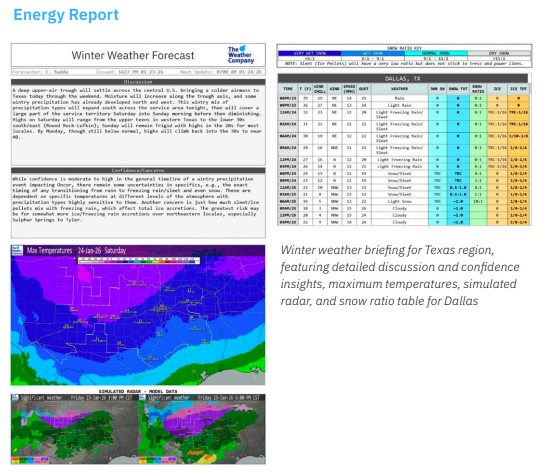 Because Texas operates an independent electric grid, local utilities can’t easily draw power from neighboring interconnections during peak demand or major outages — making forecast accuracy paramount. When severe weather threatens, the decision to mobilize out-of-state mutual aid crews can cost millions of dollars. Those commitments must be made two to five days before conditions deteriorate.
The power of Human-Over-The-Loop (HOTL) oversight
Within our briefing desk model, meteorologists review data before it reaches the client, adding a vital layer of human interpretation. This weather forecasting solutions grid-balancing operations approach combines AI-enhanced forecast modeling with experienced meteorologists who “nudge” outputs based on hyper-local conditions or historical model biases.
For example, adjusting a wind speed forecast by just 3–5 mph based on local terrain variables can shift a utility’s outlook from standard operations to an elevated mobilization posture. For the Texas utility, the briefing desk delivers daily forecast discussions, color-coded risk matrices, 48-hour planning tables, and 5-day wind and thunderstorm probability graphs to enable complete operational readiness.
Balancing the grid with variable renewable energy forecasting
Unlike traditional baseload generation, renewable energy is highly sensitive to rapid weather shifts. For solar operations, utilities must track cloud cover percentages, irradiance, and short-term cloud advection. For wind assets, accurate forecasts are required at both the surface level and turbine hub height, where wind shear creates additional complexity.
Advanced weather forecasting solutions supporting grid-balancing operations help utilities anticipate fluctuations in renewable generation across diverse geographic footprints. If a cloud bank impacts one solar array, operators can see precisely when a nearby asset will pick up the load.
As renewable generation and Battery Energy Storage Systems (BESS) integrate deeply into the grid, precision forecasting dictates market participation. Recent studies show that accurate solar forecasting combined with optimized battery storage allows hybrid systems to supply roughly 60% of commercial load demand, drastically lowering dependence on traditional grid power.⁸
Improving distribution outage response and financial resilience
The financial stakes of grid disruption are immense. The U.S. Department of Energy estimates that power outages cost the U.S. economy $150 billion annually, with weather causing the lion’s share.⁹ Hyper-local weather intelligence gives dispatchers early visibility into where and when conditions will break, enabling faster staging decisions and reducing unplanned downtime.
Precision data also optimizes distribution outage response by helping utilities:
- Mobilize and position mutual aid resources cost-effectively.
- Prioritize critical restoration workflows.
- Manage customer expectations (utilities providing timely outage alerts score 52 points higher in J.D. Power customer satisfaction indexes).10
During elevated-risk events, the briefing desk increases its cadence, issuing real-time updates on utility-specific hazards like ice accumulation, lightning frequency, and wind gust thresholds.
Emerging weather challenges across the energy sector
As the energy landscape decentralizes, weather forecasting demands are expanding beyond traditional utility boundaries:
- EV charging infrastructure: Cold snaps reduce EV battery range and spike charging demand, while extreme heat shifts charging patterns across metro areas. Granular forecasts help utilities anticipate these localized grid strains.
- Battery storage optimization: BESS operators rely on hyper-local forecasts to execute charge/discharge cycles and maximize energy arbitrage opportunities.
- Green hydrogen production: Electrolysis is most economical when powered by surplus renewable energy. Precise wind and solar forecasts directly influence production efficiency.
- Data center micro-climates: Cooling systems consume enormous amounts of data center energy. Tech companies require localized climate intelligence to model cooling load requirements and manage energy costs.
Operational weather intelligence for a resilient grid
The modern utility challenge is no longer about accessing weather data — it is about translating that data into operational actions. This shift toward grid resilience is mirrored in federal priorities, such as the Department of Energy’s $3.5 billion grid modernization funding initiative.11
By combining advanced Weather Data APIs, FOD technology, and HOTL meteorological expertise, The Weather Company empowers utilities to master grid-balancing operations, improve variable renewable energy forecasting, and execute flawless distribution outage response.
Let's talk
Contact our experts today to discover how Weather Data APIs can empower your decision-making and strengthen your business resilience. Let us help you transform weather data into a strategic asset.
Contact usFrequently asked questions about utility weather intelligence
Unlike traditional deterministic forecasts that provide a single weather value, probabilistic forecasting evaluates multiple atmospheric scenarios to calculate statistical likelihoods. Grid operators use these models to assess risk profiles for extreme events up to five days in advance, allowing them to make data-driven decisions on crew staging and energy procurement based on their specific risk tolerances.
Variable renewable energy forecasting requires hyper-local weather intelligence to manage wind and solar intermittency. Advanced forecasting solutions track cloud advection and wind shear at turbine hub height. This allows utilities to execute precise grid-balancing operations, optimize Battery Energy Storage Systems (BESS), and actively participate in energy markets by knowing exactly when and where green generation will fluctuate.
Precision weather forecasting gives dispatchers earlier visibility into the exact timing and location of severe weather footprints. By leveraging hyper-local data, utilities can optimize their distribution outage response by staging repair crews before conditions deteriorate, accurately prioritizing restoration workflows, and providing transparent, timely alerts that directly improve customer satisfaction.
1 NOAA National Centers for Environmental Information, U.S. Billion-Dollar Weather and Climate Disasters, 2026.
2 3 4 5 6 7 U.S. Department of Energy, Form OE-417, 2024.
8 Journal of Energy Storage, Optimal hybrid power dispatch through smart solar power forecasting and battery storage integration, 2024.
9 U.S. Department of Energy, Grid Reliability