
Weather intelligence for the future: Crafting a strategic enterprise approach to changing environmental conditions
Continue reading


Key takeaways
- Weather volatility puts $1 trillion in annual global retail revenue at risk. High-fidelity API integration transforms weather data into a primary hedge against these fluctuations.
- Beyond logistics and demand forecasting for retail planning, weather data helps optimize energy usage and costs, and more efficiently fastrack insurance claims due to weather.
- High-resolution APIs from The Weather Company move retailers from manual monitoring to automated, weather-aware systems.
- The Weather Company is consistently ranked the #1 most accurate forecaster globally by ForecastWatch.
For the world’s largest retailers, weather is no longer an “uncontrollable” factor — it’s a structured data asset that requires uncompromising precision. In a climate-volatile era, the difference between a record-breaking quarter and a supply chain disaster comes down to how a business integrates weather data for retail into its core logic.
For enterprise leaders, the mandate is clear: transition from manual checks to automated weather APIs for retail that feed directly into AI-driven decision engines.
%
of retail executives reported weather impacts on operating costs1
%
of CPG executives plan to increase or maintain their use of weather intelligence to improve supply chain efficiency and meet consumer demand2
How does weather data improve the accuracy of retail demand forecasting?
The financial stakes of atmospheric volatility are staggering. According to data from the National Retail Federation (NRF), weather impact on retail sales influences approximately $1 trillion in annual global retail revenue.3 When over 3% of total sales are tied directly to the weather,4 traditional historical models are no longer sufficient.
The use of The Weather Company weather APIs for retail allow retailers to move from descriptive data to prescriptive modeling. By treating weather as a primary financial variable, retailers can:
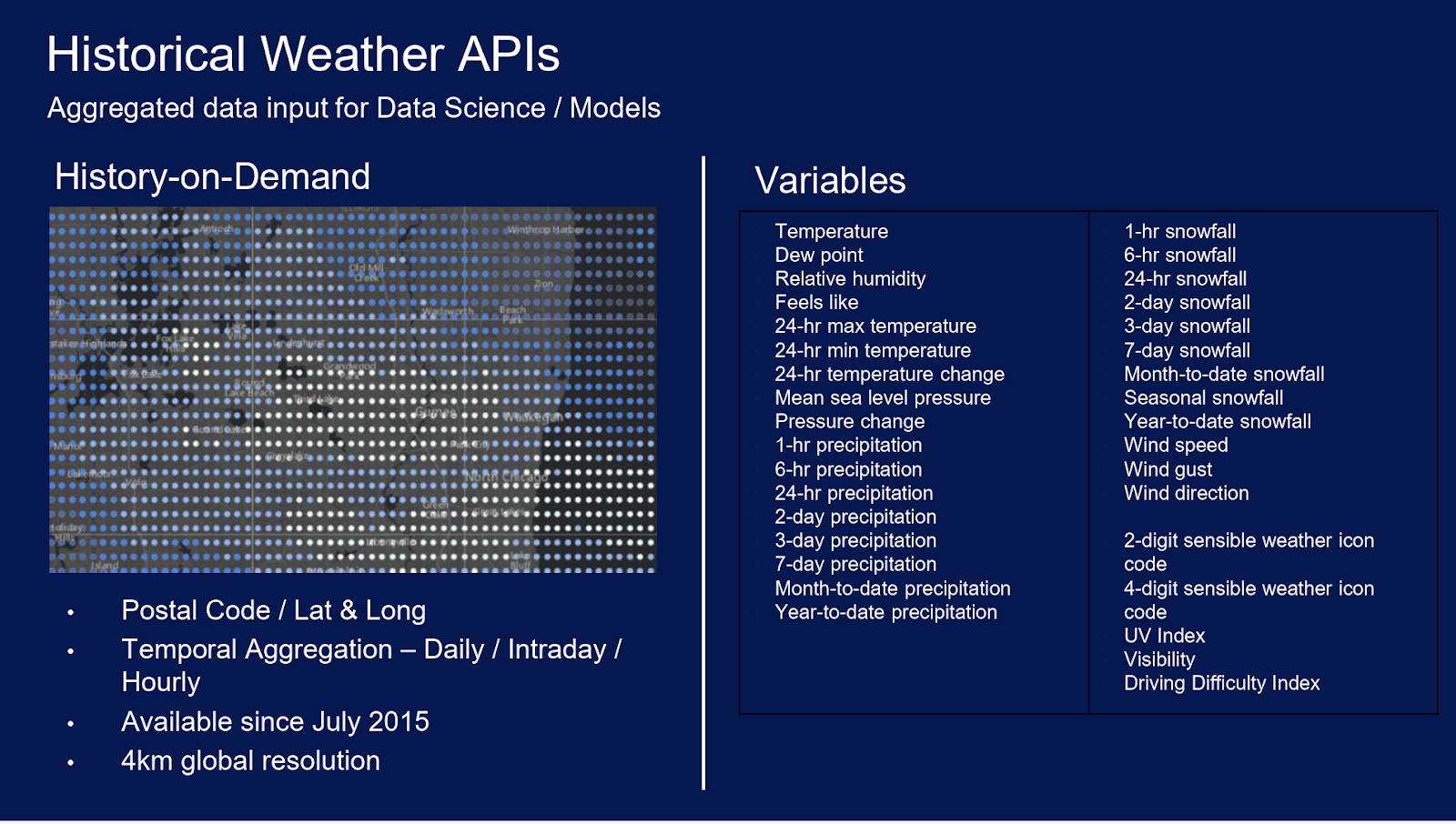
- Correlate history to sales: Use History-on-Demand (HoD) APIs to analyze retail weather trends (at a 4km resolution) to see how they impacted foot traffic and SKU performance in specific regions dating back to 2015.
- Predict demand peaks: Retail demand forecasting using weather data can predict how a 2-degree shift in a specific region can drive a double-digit spike in demand while cooling sales elsewhere.
- Trigger dynamic pricing: Use weather-based dynamic pricing retail strategies and lifestyle indices to delay markdowns on seasonal goods during a late-season chill, preserving millions in margin.
Mitigating impact through supply chain resilience
Logistics and weather-based inventory management are where weather volatility strikes the hardest. By integrating weather data into Enterprise Resource Planning (ERP) and Transportation Management Systems (TMS), companies can automate resilience at scale:
- Long-range merchandise ordering: Retailers use our 7-month seasonal probabilistic forecasts to inform production and ordering. By understanding the likelihood of temperature and precipitation anomalies half a year in advance, buyers can align seasonal stock with reality rather than guesswork.
- Autonomous rerouting: Logistics platforms can automatically divert freight from storm-impacted corridors to protect cold-chain integrity and prevent “dead-head” miles.
- Inventory pre-positioning: Use 15-day probabilistic models to shift stock to regional hubs before consumer demand peaks.
The “Hidden ROI”: Operational logic beyond the aisles
While logistics and demand are the pillars, weather intelligence provides a “multi-tool” for the broader C-suite:
Energy management & sustainability
For a retailer with thousands of locations, energy is a top “controllable” expense. By integrating weather APIs with Building Management Systems (BMS), retailers can pre-cool stores during off-peak hours based on upcoming heat spikes, reducing peak-load charges and meeting ESG goals.
Parametric insurance & risk mitigation
Modern retailers use Parametric Insurance, where high-fidelity weather APIs serve as the “ground truth” trigger for instant payouts following a weather event, providing immediate liquidity for repairs without the month-long wait for manual adjustments. For a $10B+ retailer, this isn’t just “insurance,” it’s capital management.
Why The Weather Company is the industry standard for retail weather data APIs
To be truly weather-ready, a retail data stack requires a foundation of precision. Free or public data often lacks the granularity and reliability required for enterprise weather data solutions. Retailers need a consistent, global dataset they can trust. We provide a consistent, global dataset of core weather parameters, all accessible through a single web API.
History-on-Demand (HoD)
Understanding weather’s historical impact is critical for training predictive analytics retail models. Our HoD capability provides:
- Global hourly data: 4km resolution covering the entire globe from July 2015 to the present.
- Ready-to-use datasets: One subscription provides access to all datasets, allowing retailers to pull the specific parameters most appropriate for their geography without rummaging through poorly organized public data.
Accuracy and AI modeling
- Ranked #1 in accuracy: For nearly a decade, ForecastWatch has named The Weather Company the most accurate forecaster globally—nearly 4x more often than the next-best competitor.5
- Proprietary GRAF™ modeling: Our Global High-Resolution Atmospheric Forecasting updates every hour at a 3km resolution, providing the low-latency weather data API inputs required for automated decisioning.
Ready to weatherproof your retail strategy?
Don’t let the forecast dictate your margins. Build a business that anticipates every atmospheric shift. Explore our weather API for retail solutions today or start a free trial to see how enterprise-grade weather data can transform your operations from reactive to resilient. Start making smarter, weather-informed decisions now.
Get started
Frequently asked questions
Weather intelligence for retail is the programmatic integration of high-fidelity, machine-readable weather APIs into business systems to automate demand forecasting, supply chain logistics, energy management, and workforce safety. It transforms raw atmospheric data into actionable business logic.
Retailers mitigate weather impact by integrating real-time weather data into Transportation Management Systems (TMS) and Enterprise Resource Planning (ERP) platforms. This enables automated freight rerouting to avoid storms, predictive inventory pre-positioning based on 15-day probabilistic models, and data-driven labor scheduling.
The primary benefits of weather APIs for retailers include reduction in stockouts, significantly lower energy costs through Building Management System (BMS) integration, optimized markdown strategies to preserve margins, and enhanced workforce safety via proactive weather alerts.
Weather data reduces retail operational costs by minimizing supply chain disruptions through automated rerouting, reducing perishable waste in the cold chain, and decreasing energy consumption. Furthermore, it helps avoid unnecessary markdowns by accurately predicting the duration of seasonal weather patterns.
Enterprise retailers choose The Weather Company APIs over free data because they offer 500-meter hyper-local granularity, sub-hourly update frequencies, and GDPR compliance. Free government data typically lacks the low latency and machine-readable JSON/RESTful architecture required for large-scale AI automation.
Weather intelligence is integrated into retail stacks via RESTful JSON APIs that connect seamlessly with cloud-native environments like SAP, Oracle, AWS, and Azure. This allows retail weather data to act as a real-time input for AI agents and predictive analytics engines across the enterprise.
Related resources





1 2 Magid, Weather Means Business: The role of weather intelligence to drive business resilience, growth, and a competitive advantage, October 2024. Commissioned by The Weather Company.
3 4 National Retail Federation, How retailers can stay ahead of weather-related challenges, August 2024
5 ForecastWatch, Global and Regional Weather Forecast Accuracy Overview, 2021-2024, commissioned by The Weather Company.