
The latest GRAF® weather model improvements
Continue reading

Subscribe
We’re glad you’re here! Subscribe today to receive expert insights, event details, and product news by email.By signing up, you consent to receiving communications from The Weather Company. You can unsubscribe anytime here or by clicking the unsubscribe link in each email. To learn more about how we handle your data, visit our privacy policy.
Key takeaways
- Advertisers need to understand the mindset of consumers and the why they behave in certain ways and in certain areas, tailoring their strategies to match the exact time and place to engage.
- Weather Targeting is not only for seasonal categories. Atmospheric shifts drive daily micro-decisions across nearly every industry, influencing everything from personal care routines to auto test drives.
- Consumers are proactive and respond to how weather feels relative to local and seasonal norms, making the planning phase the ideal time to engage with them.
Picture this: It’s a Tuesday afternoon in late spring, and the thermometer hits exactly 55 degrees. In Atlanta, that temperature drop could have locals pulling out their sweaters, switching their morning coffee orders from iced to hot, and moving their dinner plans indoors. Meanwhile, that 55-degree reading in Boston has residents putting away their parkas, ordering cold drinks, and fighting for a seat on an outdoor patio.
While the absolute data — the temperature outside — is identical, the consumer mindset is completely different in the two locations. To many, 55 degrees is just a number, but to us, it’s a signal for behavioral change.
How does weather actually change consumer behavior?
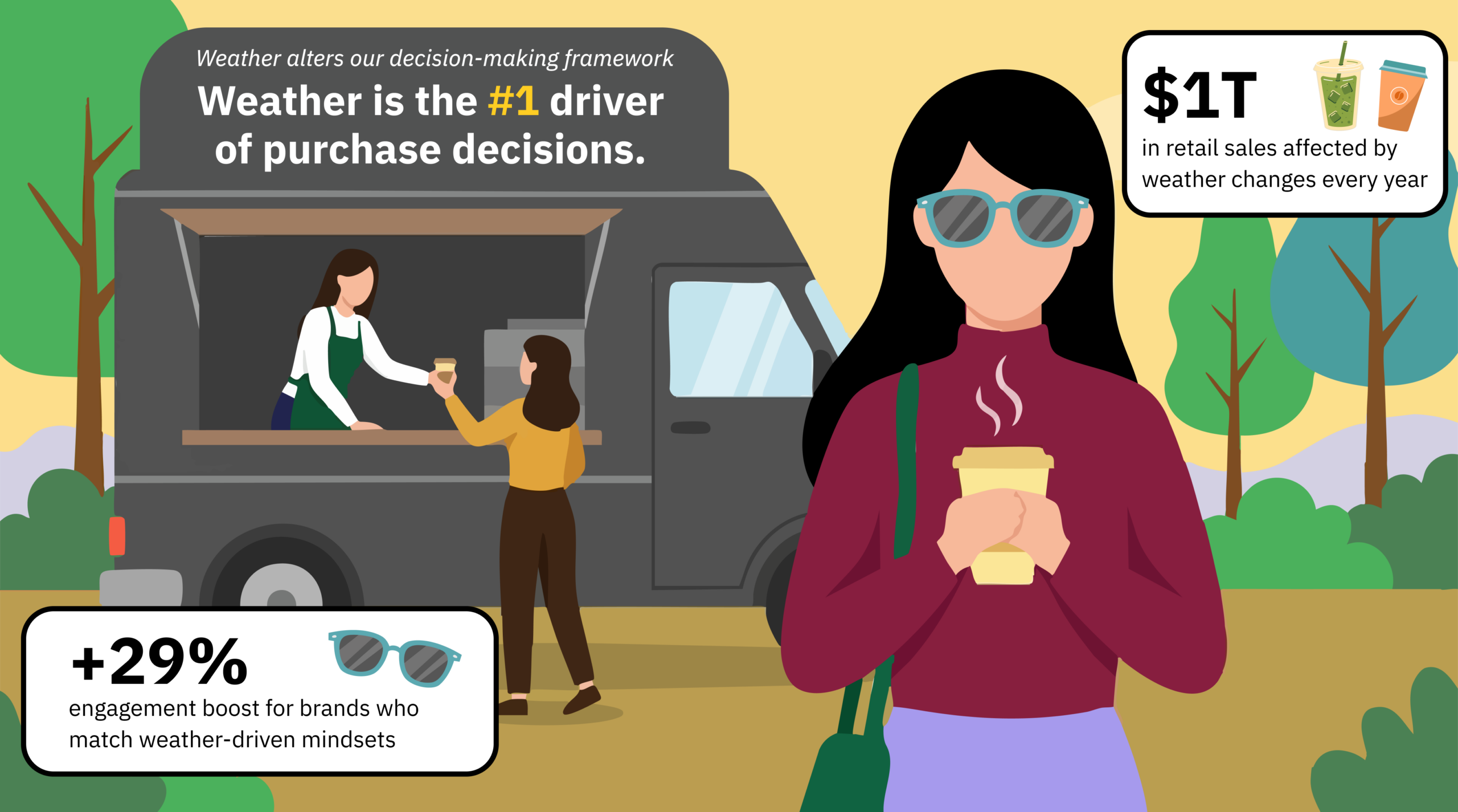
Weather is considered the biggest driver of purchase decisions. According to the National Retail Federation (NRF), over 3% of all retail sales are directly affected by changes in the weather each year, which amounts to about $1 trillion in retail sales annually. But the more useful question for marketers isn’t what people buy in a given set of conditions. It’s how and why their brains are working when your brand reaches them.
We partnered with Neuro-Insight to measure brain response across weather conditions, and that research proved weather impacts the subconscious, where 90% of all decisions are made. It shifts mood and price sensitivity, and it influences the core functions that determine brand memory, emotional intensity, and engagement.
For example:
- During stormy conditions, brands offering comfort or support can boost engagement 29% and global memory 25%.1
- When skies are clear, people are more likely to try new brands, start new routines, and make impulse purchases, and brands that capture that mindset can see a 10% boost in ROI.2
The breadth and depth of weather data available to brands is abundant, but the question is, how effectively are they using that data to tailor their strategies to best engage their audience? It’s time to discover how Weather Targeting enables brands to get in front of consumers at the right time and in the right place. Let’s take a look at three of the biggest myths about weather-targeted marketing.
Myth 1: Weather targeting is only about the temperature
“All we need for weather targeting are the real temperatures that we get for free.”
Temperature feeds are easy to come by, and they will tell you what the air is doing. However, absolute data alone ignores consumer behavior relative to seasonal norms that drive the purchasing shifts that brands should be trying to capture.
Going beyond absolute data, we account for relativity, how weather actually feels based on location and season, by layering years of historical conditions across multiple weather variables and third-party and proprietary behavioral data and use advanced AI modeling to turn all of it into a suite of more than 500 targeting signals across multiple families:
- Purchase signals built with third-party purchase data that enables brands to target by category, drill down to specific product demand signals, or create custom signals tailored to specific KPIs.
- Emotion and mindset signals combine neuroscience research with our proprietary AI and sophisticated targeting suite to anticipate intent and automate action before the consumer even realizes their needs have shifted.
- Health and wellness signals based on anonymized data from the CDC and Merative to identify conditions that are statistically proven to invoke certain health conditions like allergies or joint pain.
- Activity signals identify when weather conditions are prime for specific consumer behaviors and lifestyle events such as outdoor sports, home-related projects, and travel.
- Relative signals capture the “vibe” of the weather, like an unseasonably hot day in October or the perfect warm weekend, that drives brand memory, impulse purchases, and maintains off-season momentum.
Further, Weather Targeting signals work at the ZIP code level and refresh as often as every 15 minutes, ensuring that your message lands at the right time in the right place, whether that’s Tuesday morning in Charlotte or Thursday afternoon in Cleveland. And because we use contextual and behavioral data rather than user data, our signals respect privacy while remaining powerful drivers of performance.
Back-to-school is a prime example of how modeled signals catch what the thermometer misses. It’s a fixed window on every media plan, but the weather moves the money inside it. Our research shows:
- 1 in 5 shoppers delay clothing purchases until the weather actually cools down.3
- 25% buy hot-weather clothes for fall because late-summer temperatures persist.4
- 33% of consumers buy a second round of school supplies once it feels like fall.5
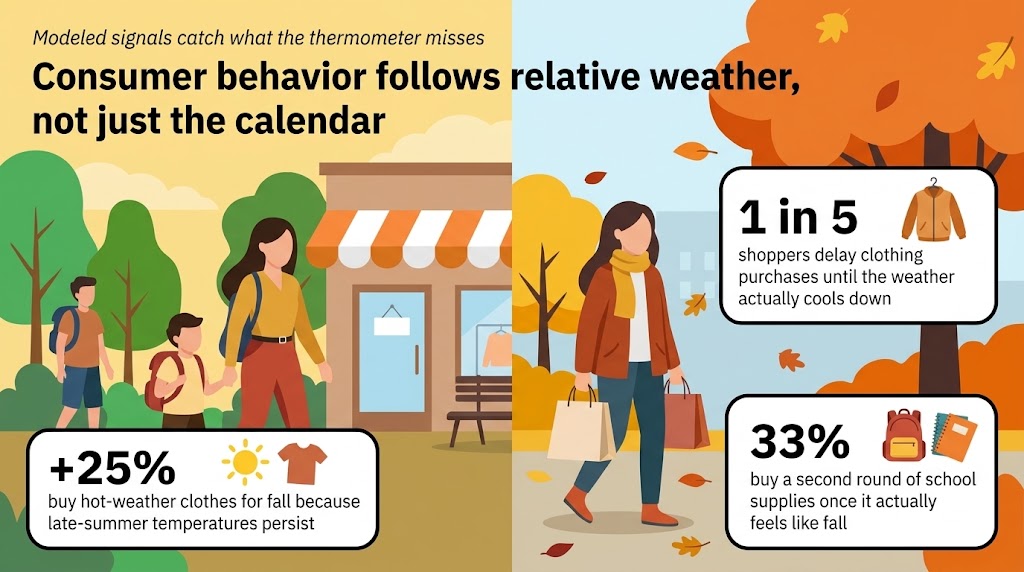
These examples exhibit how brands that focus only on absolute data are missing out on taking advantage of the relative weather changes that drive the behavioral and purchasing shifts that they should be trying to capture.
The bottom line is, a thermometer reading doesn’t change behavior as much as how the weather actually feels compared to what people are used to. And when the weather behaves unusually, consumer intent and behavior shift dramatically. Hyper-local weather intelligence looks beyond absolute numbers to align creative and messaging with real-time human psychology.
Myth 2: Weather-targeted marketing only works for obvious seasonal products
“I don’t need to use weather because my brand isn’t seasonal, like sunscreen and pumpkin-spiced coffees.”
When most media planners hear “weather targeting,” their minds immediately jump to endemic, reactive categories, treating weather as a strategy specific to seasonal products. While this is true, it’s a very limited understanding of the power of weather.
If you think that weather is just about coffee orders and SPF, you’re missing the bigger picture. With 91% of people saying weather influences their daily routines6 and decisions, impacting whether we prioritize price, how open we are to impulse buying, and when we decide to pull the trigger on major investments.
To see how category-agnostic weather truly is, look at how atmospheric shifts dictate broad consumer behavior across non-seasonal verticals:
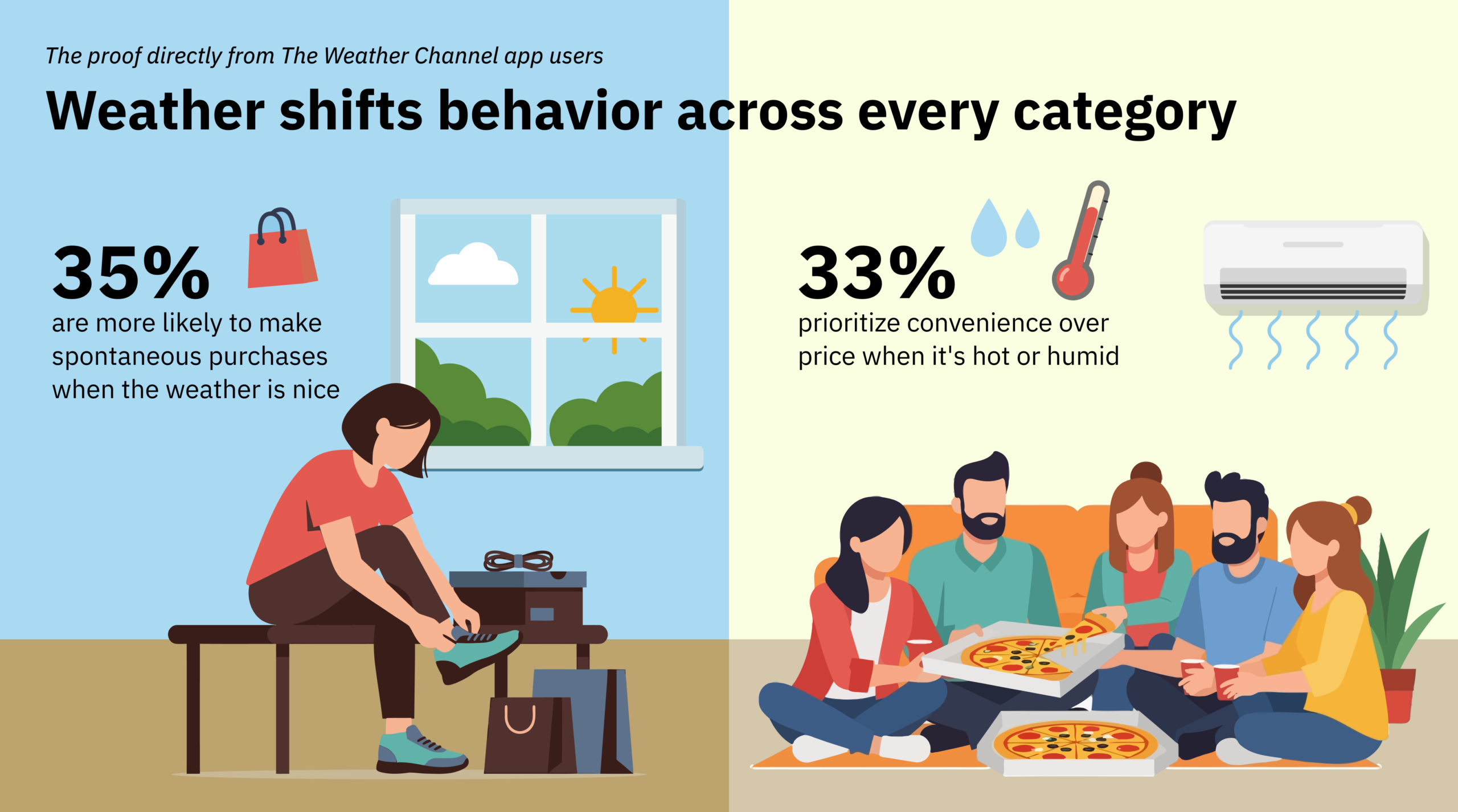
- It changes how we value convenience: 33% of people say hot or humid weather makes them prioritize convenience over price.7 This represents a massive opportunity for delivery services, QSRs, and frictionless e-commerce brands to capture market share when consumers are willing to pay a premium for ease.
- It acts as a catalyst for spontaneous spending: 35% of consumers report that nice weather makes them more likely to make spontaneous purchases.8 Non-endemic retail, apparel, and lifestyle brands can capitalize on this weather-driven optimism to drive incremental sales.
- It dictates the timeline for high-consideration purchases: While 68% of people use short-term forecasts to plan immediate needs like grocery shopping, 32% use the 10-day forecast specifically to plan major purchases.9 This proves weather influences big-ticket items like appliances, cars, or travel, shattering the myth that weather targeting is only for cheap, immediate fixes.
The point is that consumers don’t wait for the weather to happen to them. They are proactive. They plan. Your brand’s seasonality isn’t nearly as important as making sure your message lands when the weather-driven consumer mindset is ready for it. Weather-targeting technology with predictive signals enables all brands, from financial apps and restaurants to personal care and automotive, to engage audiences while they are still in that crucial planning phase, capturing both immediate needs and planned spending.
Myth 3: Audience targeting eliminates the need for weather targeting
“We built our campaign, and we already have our audience segments and our first-party data. We don’t need another targeting layer.”
First-party data and in-market segments are essential for building high-quality audiences, but on their own, they offer an incomplete picture. While your first-party data accurately answers who you should be targeting, it provides no insight into when or why real-time weather conditions dictate how consumers feel, try, and buy. Weather data serves as the complementary contextual layer that changes static audience segments into timely, real-world opportunities.
That’s why weather data works as an added layer to clarify and enhance audience segmentation. Layer Weather Targeting on top of your audience targeting, optimizations, and search bids — concentrating budget where conditions and mindset line up — and improve accuracy, relevance, and performance against whatever KPIs you’re managing.
It helps to remember that weather intelligence isn’t a placement you buy or a season you plan around, and none of it has to run inside a weather app. Weather targeting can drive search, social, and display and extend across CTV, DOOH, and audio. The same signal that raises a search bid in the morning can swap a social creative at midday and reweight a CTV or audio buy that evening, all without competing with the segments you’ve already built.
Let's talk
Reach out to learn more about Weather Targeting from The Weather Company can help you engage with consumers.
Contact usRelated resources






3 4 5 TWC Back to School Consumer Behavior Survey, Sept 2024
6 7 8 9 TWC Summer 2026 Consumer Behavior Survey, June 2026