
Weather intelligence for the future: Crafting a strategic enterprise approach to changing environmental conditions
Continue reading

Key takeaways
- The insurance industry is moving from reactive recovery to proactive risk mitigation through the use of hyperlocal weather intelligence.
- Effective risk management requires moving beyond “over-the-wall” raw data toward integrated, actionable insights at the property level.
- High-resolution “ground truth” data is enabling the rise of parametric insurance, which triggers automated payouts based on objective weather thresholds.
- Probabilistic forecasting and AI-driven ensemble modeling from The Weather Company allow insurers to turn climate uncertainty into measurable, manageable risk.
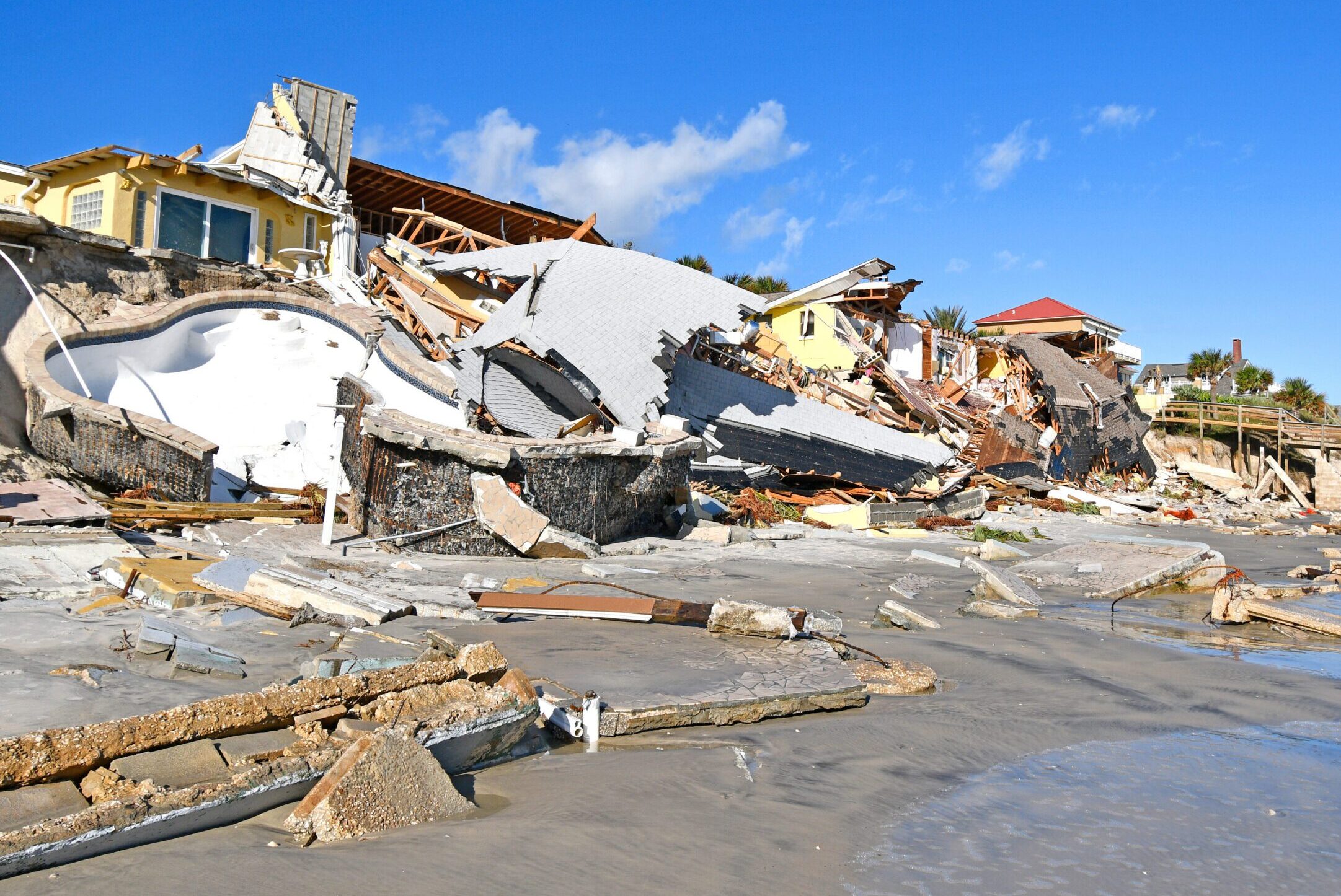
In the insurance world, the “once-in-a-century” storm has become a yearly occurrence. Global insured losses reached $127 billion in 2025,1 marking the sixth consecutive year that payouts exceeded the $100 billion threshold.2
Perhaps more striking is the frequency of these events. Last year saw 30 separate disasters causing over $1 billion in insured losses each3 — far exceeding the historical average of 17. Traditional risk models built on broad geographic averages are no longer sufficient to address this rising volatility.
Recently, The Weather Company experts Matt McCrary (Insurance Sales Lead) and Matthew Porcelli (Solutions Engineer) discussed this fundamental shift with Insurance Thought Leadership. Their core insight? The industry is reaching an inflection point where hyperlocal weather data must become a dynamic, strategic asset.
What is hyperlocal weather data in insurance?
Hyperlocal weather data in insurance refers to high-resolution atmospheric insights mapped to specific GPS coordinates (often down to a 500-meter to 1-kilometer grid) rather than broad ZIP codes. For insurers, this enables property-level risk assessments for specific perils like hail, wind, and wildfire.
Solving the “over-the-wall” data problem
For years, the primary challenge for carriers hasn’t been a lack of data, but a lack of clarity. Many insurers receive raw weather streams that are difficult to integrate into existing underwriting or claims workflows.
As Porcelli and McCrary highlighted, carriers must bridge the gap between meteorological science and operational strategy. By integrating high-resolution, timestamped data from lightning sensors, radar, and LiDAR, insurers can move from broad regional assumptions to surgical business decisions.
Turning uncertainty into measurable risk via probabilistic forecasting
A major takeaway from our recent discussion is the power of probabilistic forecasting. Unlike a standard deterministic forecast that predicts a general “chance of weather,” a probabilistic model quantifies the likelihood of specific outcomes — such as the exact probability of 2-inch hail hitting a specific cluster of assets.
This level of precision enables:
- Tailored underwriting: Pricing risk based on the true exposure of a specific home or commercial building.
- Claims volume prediction: Anticipating the “First notice of loss” (FNOL) surge before the storm even clears the area.
- Fraud detection: Utilizing forensic meteorology to verify if the weather conditions reported in a claim actually occurred at that specific timestamp and location.
The growth of parametric insurance and “ground truth”
The shift toward hyperlocal data is fueling the rapid growth of parametric (event-based) insurance. Unlike traditional policies that require physical damage inspections, parametric products are triggered by measurable thresholds — such as wind speeds exceeding a specific limit or rainfall totals.
This model offers three distinct advantages:
- Accelerated payouts: Provides liquidity to policyholders in hours or days, not weeks.
- Reduced loss adjustment expenses (LAE): Minimizes the need for on-the-ground adjusters for every event.
- Objective verification: Success depends on “ground truth”—verifiable data from mesonets, satellite, and synthetic aperture radar.
Powering the next generation of weather-resilient insurance
At The Weather Company, we don’t just observe the weather; we provide the programmatic infrastructure that allows insurers to operationalize it. Our suite of weather data APIs and intelligence platforms is designed to integrate seamlessly into existing core systems, from underwriting engines to claims management dashboards.
Our key offerings for the property and casualty sector include:
- Standard and enhanced weather APIs: Access real-time, historical, and forecast data for over 2 billion locations globally. Our APIs deliver 15-minute hyperlocal updates, allowing for precise “nowcasting” of severe events.
- Historical weather data and forensic services: Validate claims with 10+ years of archived atmospheric data. Our forensic tools provide the “ground truth” evidence needed to confirm hail size, wind gusts, and lightning strikes at exact GPS coordinates, helping reduce exposure to fraudulent claims.
- Probabilistic forecasting suite: Move beyond binary “rain or shine” forecasts. Our AI-driven ensemble modeling quantifies the likelihood of specific risk thresholds, providing the data confidence required to trigger parametric insurance payouts automatically.
- Weather alerts and notifications: Enhance policyholder loyalty by delivering targeted, automated alerts. By notifying customers to move assets before a storm hits, you can actively reduce claim frequency while improving your Net Promoter Score (NPS).
Through industry-leading accuracy and enterprise-grade reliability (99.95% uptime), we help carriers turn atmospheric uncertainty into a measurable competitive advantage.
Moving toward climate resilience
The convergence of AI, machine learning, and hyperlocal data is turning insurers into partners in safety. By sending proactive alerts — advising a policyholder to move a vehicle before a hail cell arrives — carriers are preventing claims before they happen.
As we navigate an increasingly volatile climate, the carriers that thrive will be those that treat weather intelligence as the backbone of their resilience strategy.
Key questions about hyperlocal weather intelligence
Hyperlocal data allows for property-specific risk pricing by analyzing atmospheric conditions at exact coordinates rather than regional averages.
In weather-related insurance, AI simulates millions of weather and loss scenarios, identifying patterns in “secondary perils” that human analysts might miss.
Forensic meteorology provides objective, third-party verification of weather events to accelerate claim validation and maintain fairness for both the carrier and the policyholder.
Let's get started
Contact our experts today to discover how Weather Data APIs can empower your decision-making and strengthen your business resilience. Let us help you transform weather data into a strategic asset.
Contact usRelated resources



1 2 3 Aon, Severe Convective Storms Now the Costliest Insured Peril of the 21st Century, Aon Reports, January 20, 2026