The latest GRAF® weather model improvements
Continue reading


Key takeaways
- The Weather Channel digital platforms reach 82 million travelers, including 40 million active monthly trip planners1 who spend significantly on travel and plan months in advance.
- Weather is a proven driver of travel decisions, with 92% of surveyed users saying that a forecast has changed their travel plans2.
- Marketers can easily activate high-impact sponsorships, audience/contextual targeting, and offsite weather data across the digital ecosystem without altering their existing buying workflows.
Is your travel media strategy missing the real moments of influence?
Most travel marketing focuses on consumers after they’ve already decided on a trip, fighting over search engine results, and booking engines where inventory is crowded and hyper-competitive. But the truth is, by the time someone is actively searching for flight times or hotel rates, the biggest decisions about the trip have already been made.
Meanwhile, a predictive intent signal is hiding in plain sight, impacting the final decision: the weather.
Weather determines when, where, and how we travel
A trip isn’t one purchase. It’s a string of decisions spread over months. To understand what really drives early choices, we surveyed real people actively planning trips within the next 12 months. What they told us reframes how brands should approach travel media: weather is not a background variable but a primary decision driver throughout the entire travel lifecycle.
Wanderlust and forecast-driven inspiration
Before someone books a flight and pulls out their suitcase, weather acts as an active motivational force. In fact, for The Weather Channel users, 70% use weather apps as their primary travel planning resource, outranking recommendations from family and friends (68%), travel booking sites (61%), and credit card rewards portals (43%)3.
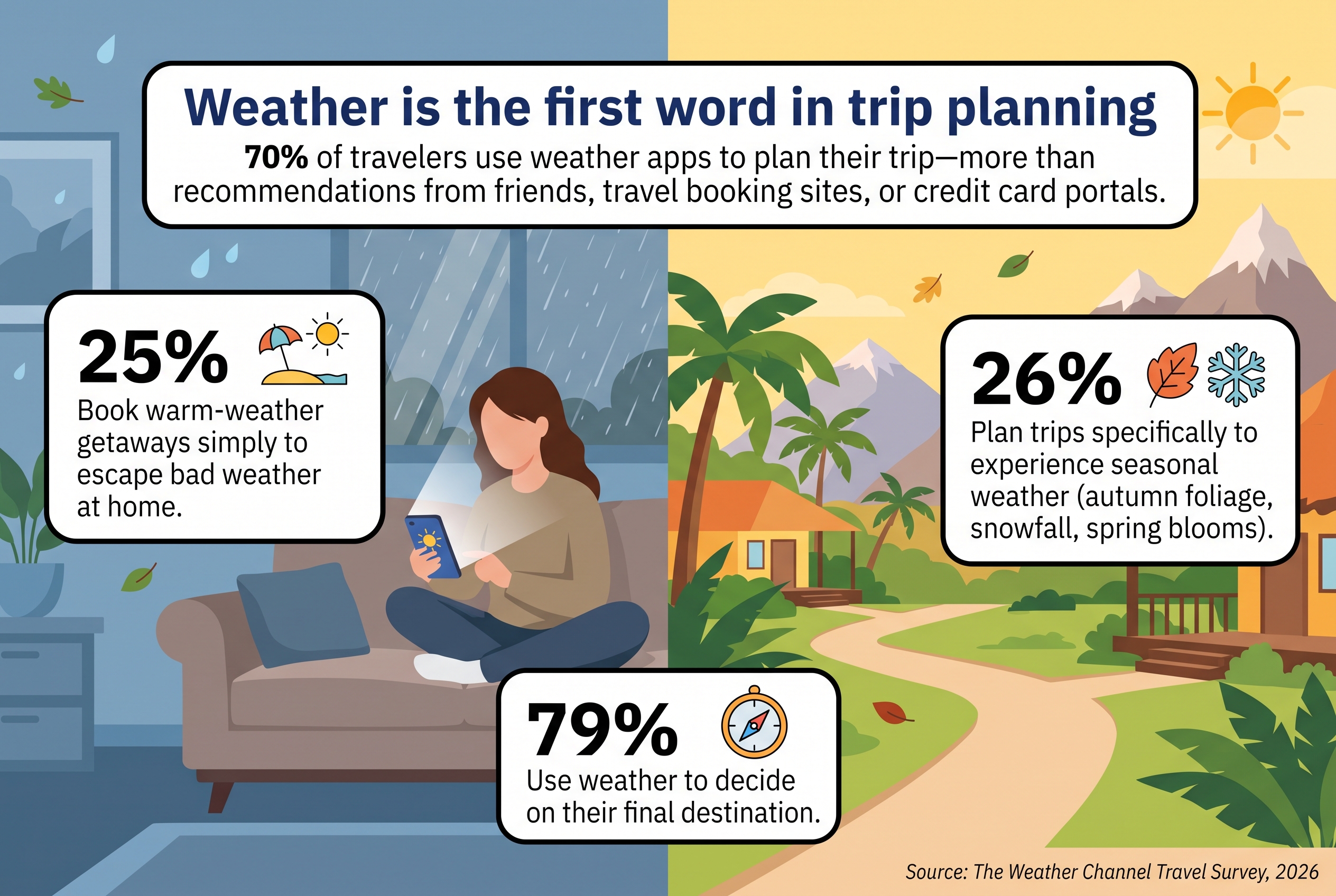
Whether planned for months or a spontaneous getaway, 79% of travelers use weather to decide on a destination4. For marketers, this means there is no single “weather moment” to buy against, but a real-time opportunity to influence travelers as they decide, book, pack, and act.
Weather as a travel transaction gatekeeper and in-trip guide
Forecast checking continues all the way through the travel planning decision process. 51% of travelers check again right before booking5, and once a trip is booked, it intensifies, climbing to 57% a week out from departure and 77% on the day of travel6.
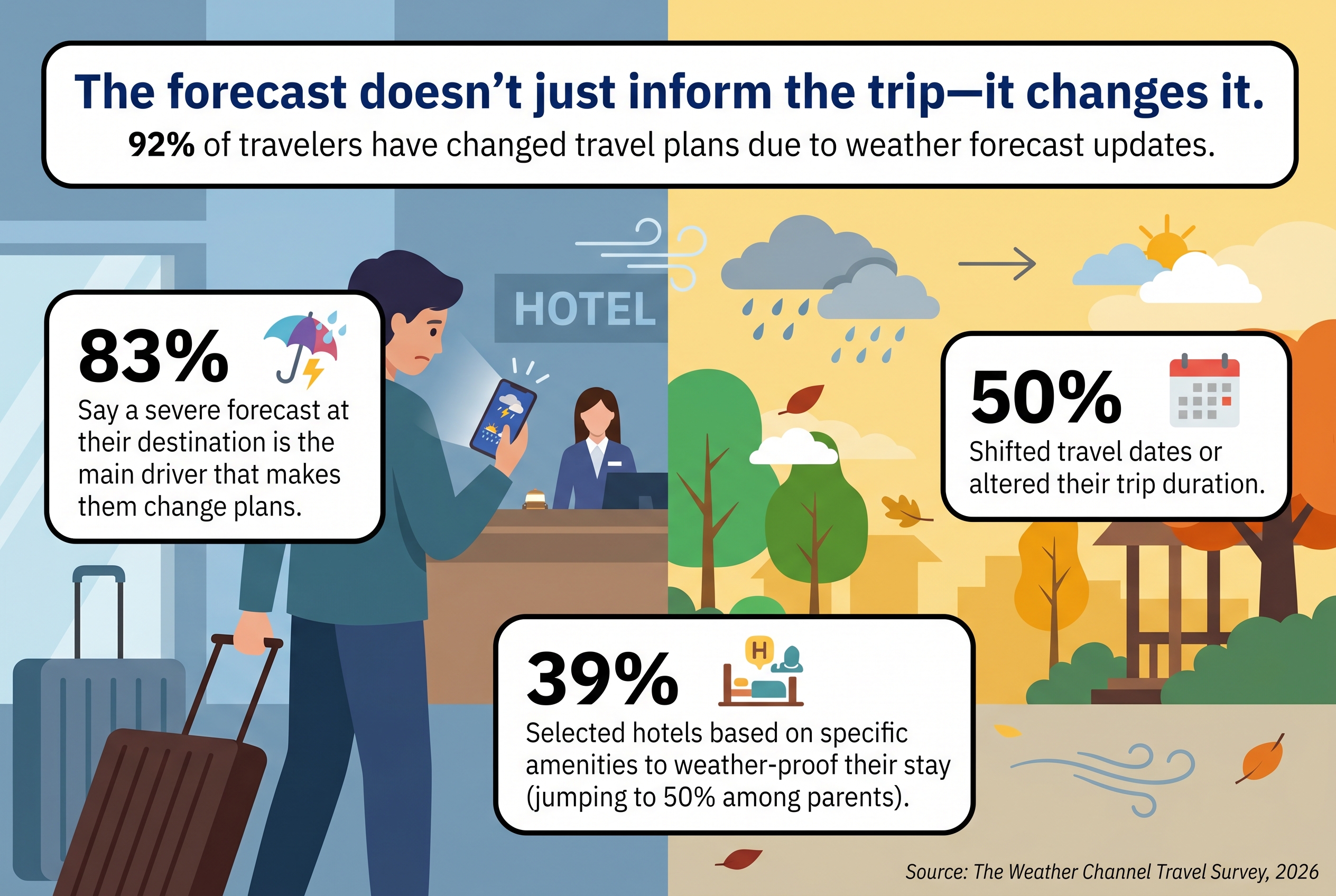
The pre-trip window is where the trip gets rebuilt and refined, opening up significant opportunities for additional purchases and brand discovery. An extraordinary 92% of users state that a forecast has changed their travel plans, 83% citing severe conditions at their destination as the deciding factor7.
Travel plan changes directly impact high-margin revenue streams:
- Trip Adjustments: 50% shifted their travel dates, and 44% altered their trip duration8.
- Ancillary Upgrades: Forecast information drove 34% of domestic and 1 in 2 international travelers to purchase travel insurance and 42% to upgrade to a flexible fare9.
- Targeted Accommodations: 39% selected hotels based on specific amenities to weather-proof their stay—a number that reaches 50% among parents10.
- Retail & Packing: 73% adjusted what they packed, and 66% changed their planned activities11.
Even in-destination, the story continues: 51% check the weather more frequently while on their trip, and 43% say the forecast dictates their overall trip enjoyment12. This gives local attractions, dining, and retail a dedicated channel to influence real-time foot traffic.
High-intent, high-spending: The Weather Channel travel audience
Our audience represents significant value for brands of all kinds, not just airlines and hotels. The Weather Channel app reaches 81.7 million personal and business travelers13, including 40 million active trip planners each month (35M planning 3-6 months in advance) who view travel as a deliberate, considered investment.
%
of households plan to spend over $1,000 on travel in the next 12 months14
%
are allocating over $2,500 to travel in the next 12 months15
%
plan to spend $5,000 or more on travel in the next 12 months16
We also discovered that most travel plans are road-first and long-haul. 71% travel by personal vehicle, with 41% embarking on cross-country road trips of 500 to 1,500 miles17. Nearly half (49%) take long weekends, and 47% take week-long journeys18. This creates an entry point for automotive, aftermarket, and retail brands to engage with consumers who are actively shopping for trips and open to brand discovery.
Real-world use case: The Weather Company and Steller launch contextual travel advertising experience on weather.com
To capture travelers at the earliest spark of intent, Steller partnered with The Weather Company to launch a contextual travel advertising experience across weather.com.
When travelers search local forecasts on weather.com, the integration automatically surfaces creator-led destination videos alongside city forecast pages. For travelers, it is a personalized, super-served experience. For destinations and travel brands, it represents a new form of contextual advertising that captures attention the moment intent is formed and action is close behind.
Boost travel-based campaign performance without changing your workflow
While most media partners can only make their own inventory work harder, weather data allows you to make your entire plan more efficient and effective.
By layering our first-party weather triggers, audience segments, and forecast-conditional creative directly into your existing channels, you can reach this audience across the digital ecosystem without rebuilding your tech stack, altering your buying workflows, or changing your preferred DSPs:
- High-impact sponsorships: Own the exact moment of decision via premium first-view takeovers, cultural or planning alignments, lifestyle outlooks, and health experiences across our properties.
- Audience & contextual campaigns: Reach targeted decision-makers—such as 87M travelers, 37M outdoor enthusiasts, or 43M parents—via Direct or PMP buys, matching rich first-party data with high-relevance contextual placement.
- Weather & behavioral data offsite: Extend over 500 first-party weather and behavioral signals across all digital channels (CTV, Social, Search, Audio, Display, and DOOH) to supercharge audience targeting, creative optimization, and bid accuracy.
Whether you are promoting flexible fares ahead of a stormy weekend, surfacing indoor dining options to in-destination travelers, or triggering tire checks before summer road trips, weather data turns unpredictable conditions into your most reliable driver of campaign yield. Learn how real-time weather triggers can increase intent across your current media channels, evaluate custom audience segments, and build forecast-conditional creative strategies for your upcoming travel campaigns.
Frequently Asked Questions
Weather targeting in travel advertising is a strategy that leverages real-time weather data, forecasts, and historical climate patterns to trigger relevant advertising messages to consumers. In travel, it helps brands align creative messaging with weather conditions that drive travel motivation (e.g., prompting beach getaways during local cold snaps or promoting indoor activities during rainy forecasts).
Unlike third-party cookies or static demographic profiles, weather data provides a real-time behavioral signal based on local conditions and location patterns. Combining first-party weather signals with audience data allows marketers to identify high-intent planners early in their buying cycle while respecting consumer privacy.
The Weather Company’s weather signals and first-party audience segments can be activated offsite across standard buying platforms (DSPs) via Direct or PMP buys. Marketers can layer weather data directly onto omnichannel campaigns—including CTV, Display, Paid Social, Search, DOOH, and Audio—without changing their buying workflows or technology stacks.
Related resources





1 13 MRI Simmons, Spring 2026
2 3 4 5 6 7 8 9 10 11 12 14 15 16 17 18 The Weather Channel Travel Survey, 2026