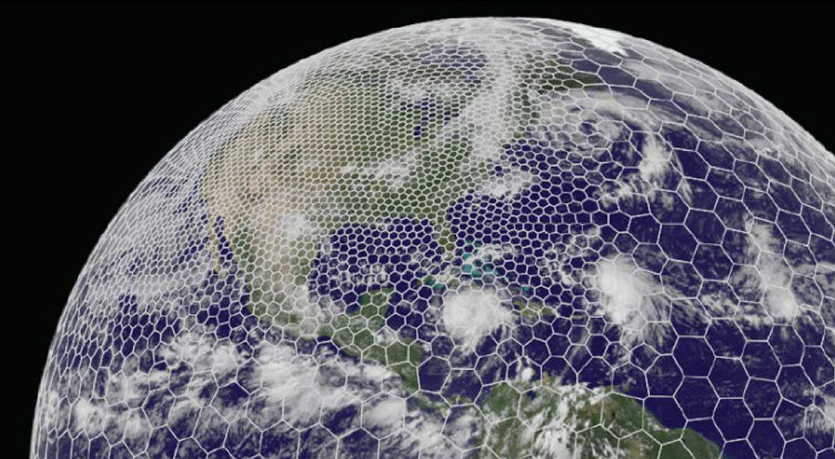
The latest GRAF® weather model improvements
Continue reading


Key takeaways
- A highly accurate forecast has no value on its own. Its value is created only when it changes what you do.1
- Translating weather forecast accuracy into context-aware, decision-ready intelligence for your specific activity, location, and moment is where real value is created.
- The Weather Company is building hyperlocal weather forecast experiences that go beyond raw data, connecting forecast precision to the decisions that matter most each day.
- Businesses that act on contextual weather intelligence, not just raw forecasts, are better positioned to protect revenue, improve customer experience, and operate with confidence.
Why the best forecast can still fall short
Here’s a thought experiment. A meteorologist delivers a perfect 10-day forecast: every temperature, every chance of rain, every gust of wind, called exactly right. Then no one looks at it.
Was it a good forecast?
Dr. Allan Murphy, one of the many influential researchers in the history of meteorology, argued that forecasts possess no intrinsic value. They acquire value only through their ability to influence decisions.2 Strip away the decision and you strip away the value entirely.
That idea has stuck with us at The Weather Company. It’s both a challenge and a north star.
For decades, the industry has largely focused on one question: How accurate is the forecast? That’s a necessary question, but on its own it’s not enough. The better question is: How much does the forecast actually change what someone does?
That shift in thinking is at the heart of everything we’re building.
The gap between accurate and useful
Think about the last time you checked a weather app before heading out. You probably noticed the temperature, a precipitation percentage, and maybe an icon of some clouds. Now ask yourself: did that answer what you actually needed to know?
If you were planning a morning run, you needed to know whether heading out at 7 a.m. or 9 a.m. gave a better window, not just that rain was “likely” at some point today. If you were deciding whether to water your garden, you needed to know if meaningful rain was coming in the next 24 hours or how much it rained recently, not the general weekly outlook. If you were commuting during a snowstorm, you needed to know when accumulation would begin and how quickly road conditions would change, not only how much snowfall would accumulate.
This is the gap. On one side sits weather forecast accuracy. On the other side sits forecast relevance: the translation of atmospheric data into personalized weather forecast guidance tied to your specific decision, at your specific location, at your specific moment.
That’s the difference between a weather company and The Weather Company – the one that doesn’t just tell you what the atmosphere is doing, but what you should do about it.
What it means to build weather for where you are
Here’s where it gets interesting.
Knowing that rain is coming to a hiking trail is useful. Knowing that rain will begin at 6:42 a.m. at the trailhead where you planned to start your hike and will end by 9:15 a.m. is actionable. Those are two very different things.
Consider a logistics coordinator trying to keep a supply chain moving. A generic regional forecast telling them it might rain doesn’t help them plan. But knowing that a line of severe thunderstorms will hit their primary Midwest distribution hub at exactly 3:00 p.m. allows them to proactively reroute delivery fleets, adjust worker shifts, and protect high-value cargo before the first drop falls.
This is the core of what we mean by weather for where you are, in the context you care about. The Weather Company, through weather.com, The Weather Channel app, and Storm Radar, is building experiences that connect highly precise, hyperlocal forecasts to the activities and choices that define a person’s day.
From raw data to real-life decisions
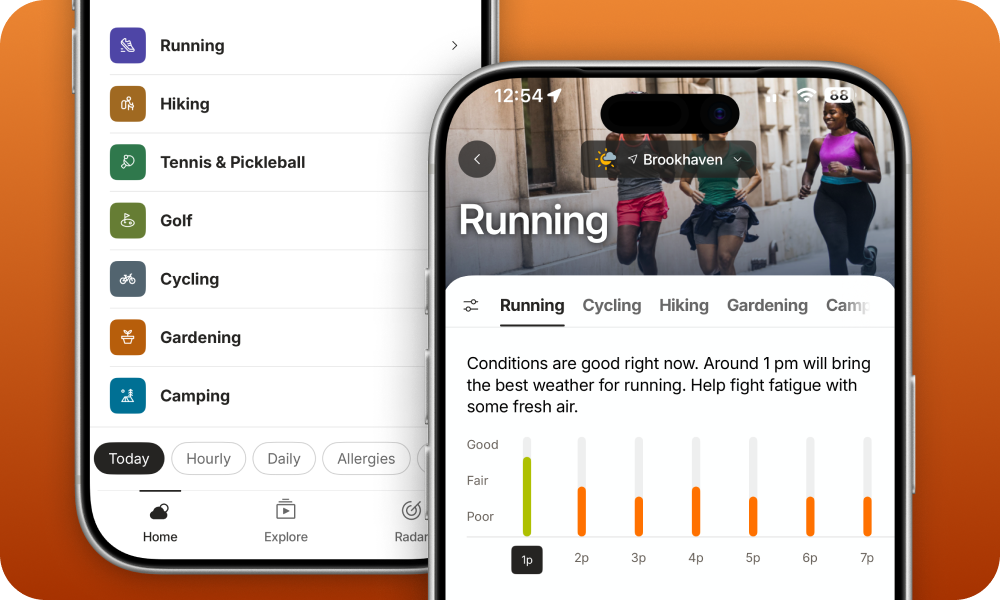
Explore activity-specific local forecasts within The Weather Channel app.
Here’s how contextually intelligent weather data changes the game in daily life:
Running or cycling: Seeing there’s a 70% chance of rain today tells you very little about whether it’s a safe time for an outdoor workout. A contextually intelligent forecast tells you that the window between 6 and 8 a.m. is dry, breezy, and 58°F, ideal conditions, before afternoon storms roll through. That’s the difference between a great morning workout and a miserable one.
Golfing: Every golfer knows what it means when the horn sounds on the 10th hole. Round over. Cart back. Day ruined. The best weather app for golfers tells you a storm is likely to arrive at 2:15 p.m., so you move your tee time to 8 a.m., finish all 18 holes, and are in the clubhouse with a cold drink before the first clap of thunder.
Gardening: The question isn’t “will it rain this week?” It’s “will it rain enough tomorrow that I don’t need to water today?” A weather forecast for gardeners, tied to soil moisture context and expected precipitation amounts, not just percentages, answers the question you’re actually asking.
Skiing and snowboarding: The difference between a powder day and an icy grind is a few degrees and a few hours. A hyperlocal weather forecast for skiing tells you when temperatures will drop, where new snow will fall, and how wind affects conditions at elevation – turning a forecast into a trip-planning tool.
Scaling context to the enterprise
This need for context doesn’t stop with recreation; it scales directly into enterprise operations. Take a tractor-trailer driver facing a winter storm: The single most valuable piece of information isn’t total accumulation, it’s when accumulation begins. Leaving 45 minutes earlier isn’t a disruption. Getting stuck on an icy highway is.
In each case — whether you’re saving a round of golf or protecting a multi-million dollar supply chain — the raw, highly-accurate data is the same. What changes is the context, the layer of intelligence that makes the data speak to your specific decision.
The road ahead
Dr. Murphy’s framework identified three dimensions of what makes a forecast “good”:
- Consistency: Does it reflect the forecaster’s best judgment?
- Quality: Does it correspond to what actually happened?
- Value: Does it produce incremental benefit for the decision-maker?
Most of the industry has spent 30 years focused on the first two. We think the next era belongs to the third.
That means continuing to invest in AI and machine learning that improve hyperlocal weather precision and everyday forecast accuracy alike. It means building personalized weather forecast experiences that go beyond the generic daily summary. It means developing weather intelligence that meets businesses and consumers where they are – mid-run, mid-flight, mid-commute – with exactly the information they need to make a better call.
Whether you’re leading a business or training for a marathon, weather shapes outcomes. The goal has never been to give you more weather data. It’s been to help you make better decisions. That’s what separates a weather company from The Weather Company, and it’s what we’re building towards every day.
Let's talk
To learn more about harnessing the power of weather to make better, more informed decisions across industries, contact our experts today.
Contact us1 2 Murphy, A.H. (1993). What is a good forecast? An essay on the nature of goodness in weather forecasting. Weather and Forecasting, 8(2), 281–293. American Meteorological Society.