
Weather intelligence for the future: Crafting a strategic enterprise approach to changing environmental conditions
Continue reading

Accurate weather forecasting fosters trust and enables better decision-making. Here’s how it works.
Key takeaways
- Accurate weather forecasting combines real-time data, advanced models, and expert interpretation.
- High-resolution models, such as GRAF®, multi-model ensembles like WxMix, and new AI methodologies are transforming forecast precision on a global scale.
- The Weather Company is nearly 4x more likely to be the most accurate forecaster, according to ForecastWatch.1
- Forecast accuracy directly impacts decision-making across various industries, including aviation, media, advertising, utilities, government sectors, and the daily lives of people everywhere.
Weather forecasts have been around since the beginning of civilization, when humans used recurring meteorological and astronomical events to better monitor weather patterns and plan for seasonal changes. Initially based on (mostly inaccurate) observations of the sky, wind, and temperature, these forecasts have thankfully evolved into more advanced and reliable ones.
Incorporating technology into weather forecasting began in the 1700s with the development of the barometer and thermometer. These basic yet advanced tools not only paved the way for more accurate weather predictions but also inspired generations of weather enthusiasts interested in advancing the science.
Today, individuals and businesses alike rely on accurate weather forecasting to anticipate severe weather and drive daily decision making. But how truly reliable are weather forecasts?
To understand the reliability, it’s crucial to first define what constitutes an accurate forecast.
What is accurate weather forecasting?
An accurate weather forecast is a measure of how closely the forecast matches reality. To produce an accurate forecast, scientists combine complex data analysis, modeling, and human expertise. Forecasts can range from short-term to long-range predictions, each with varying degrees of accuracy.
Short-range weather forecasts
Short-range forecasts (1–14 days) are typically generated by physics-driven models that ingest global weather data and simulate outcomes using advanced techniques, with AI increasingly contributing to the precision of these forecasts within this timeframe. These are considered more reliable due to their frequent model updates and high-resolution input data.
Long-range weather forecasts
Long-range forecasts (15+ days) are largely based on historical data and pattern recognition to predict what’s ahead. Forecasts beyond 15 days are inherently less precise because of how rapidly the atmosphere can change. This means accuracy is likely to decrease the further out the forecast goes.
How reliable are weather forecasts?
The answer largely depends on the forecast range. Generally, short-term forecasts demonstrate high accuracy:
- A 7-day forecast can accurately predict the weather about 80% of the time.2
- A five-day forecast can accurately predict the weather approximately 90% of the time.3
Accuracy drops as the forecast range increases, but advanced models and AI can help improve even long-range predictions.
Why are reliable weather forecasts important?
Weather significantly impacts people’s daily lives, and accurate weather forecasting enables communities to better prepare for the effects of changing weather conditions. Weather forecasting determines the likelihood of a severe weather event or strong storm. By leveraging this information, utilities can strengthen the grid, and schools can decide if it’s safe for parents to drive their children.
Why are reliable weather forecasts important?
In the past four years, the United States saw a total of 93 individual billion-plus-dollar weather and climate disasters (20 in 2021, 18 in 2022, 28 in 2023, and 27 in 2024). Prior to 2020, the highest number for a single year was 16.4. In 2024 alone, there were more than 150 unprecedented climate disasters globally, and $182.7 billion in U.S. weather-related damages – the fourth-highest year on record.5 As extreme weather events become more common, people and businesses rely on weather forecast accuracy more than ever to try to mitigate losses, influence safety measures, increase productivity, and improve business-related decisions.
It’s this critical need that underscores why accurate weather forecasting helps instill confidence, drive informed decisions, and propel the world forward. That’s why we’re committed to continuous innovation of current and future solutions. From rerouting flights to adjusting supply chains, better forecasts reduce risk and support operational confidence.
How do meteorologists predict the weather?
Weather forecasting is the process of combining scientific insights, data, and technology to assess future atmospheric conditions. Meteorologists observe, study, and predict changes in precipitation, temperature, wind, and more.
In today’s data-rich environment, meteorologists combine real-time observations, advanced modeling techniques, and expert interpretation to produce accurate forecasts. But how do weather forecasters predict the weather, and how are weather predictions made?
How a weather forecast is made
Fundamentally, the process begins with gathering data and using that information to feed forecasting models. These simulations help anticipate everything from temperature changes to the path of major storms.
At The Weather Company, we combine human meteorological expertise with advanced AI to create forecasting capabilities that neither could achieve on its own. Our team of over 100 expert meteorologists works in real-time with our AI systems, providing critical oversight and adding invaluable human intelligence to the process – without slowing things down.
Essentially, how to predict the weather is a four-pronged approach:
1. Observe
What is the weather like now? We ingest data from a collection of instruments to observe conditions on the surface and in the upper atmosphere, including:
- Weather radar: Detects precipitation and storm intensity.
- Weather balloons: Measure upper-atmosphere conditions.
- Barometers and thermometers: Monitor pressure and temperature.
- Satellites: Observe cloud cover and storm systems globally.
- Weather stations: Collect ground-level conditions.
- IoT sensors: Deliver hyperlocal temperature, humidity, and pressure data.
2. Model
How will the weather evolve? Numeric Weather Prediction (NWP) models take current atmospheric conditions as a starting point to project a forecast. There are many well-known models, such as the European Centre for Medium-Range Weather Forecasts (ECMWF), the Global Forecast System (GFS), and The Weather Company’s proprietary, hyperlocal Global High-Resolution Atmospheric Forecasting System (GRAF).
Instead of relying on a single model, our AI-driven, multi-model ensemble, WxMix, synthesizes and optimizes over 100 models, ensuring that we always leverage the best available science.
3. Produce
We translate model outputs into actionable insights, such as daily highs/lows, severe weather alerts, and turbulence maps.
4. Deliver
Forecasts are delivered instantly through apps and websites, such as The Weather Channel, Weather Underground, and Storm Radar, which feature APIs that provide real-time and historical data, aviation dashboards, broadcast media systems and displays, as well as mission planning and simulation tools.
Our strength lies in modeling, productization, and delivery – applying advanced modeling techniques, AI integration, and human oversight to produce timely, accurate forecasts.
The role of AI in accurate weather forecasting
AI is rapidly transforming weather forecasting, significantly enhancing its accuracy and speed. This rapid processing enables more frequent forecast updates, which is crucial for quickly evolving weather events, such as severe thunderstorms. In particular, new Deep Learning-based AI models (DL-NWP) are showing promise in improving the accuracy, granularity, and cost-effectiveness of traditional models, while also demonstrating an enhanced ability to depict the range and likelihood of potential weather outcomes, enabling better decision-making.
Long before “AI” became a buzzword, The Weather Company was harnessing the power of sophisticated algorithms, statistical models, and data-driven computational methods to improve weather forecasting and deliver actionable insights to consumers and businesses globally.
Today, we’re working with partners like NVIDIA to actively develop new deep learning approaches and incorporate the latest AI models into our forecasting processes to continuously improve forecast precision.
Who has the most accurate weather forecast?
According to the latest ForecastWatch study, The Weather Company is nearly 4x more likely to be the most accurate weather forecaster than the next closest competitor.6
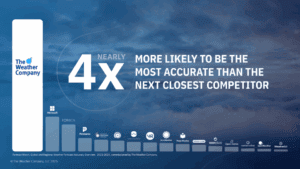
Building on our commitment to proven forecast accuracy, we continue to innovate and challenge ourselves to do even better.
- Consistent #1 finishes: The most 1st place finishes each year since ForecastWatch measurement began.7 8
- Regional accuracy dominance: The most accurate forecast provider is most often in 7 out of 8 regions.9
- Leading in longer-range forecasts: Nearly 6x more likely to be the most accurate when measuring a 14-day time horizon.10
Benefits of accurate weather forecasting
Weather affects nearly every sector — from supply chains and staffing to safety and customer engagement. It impacts an estimated $3 trillion of the U.S. economy annually and influences 30% of global GDP.11 Even a 1ºC temperature shift can cause a 1.2% swing in consumer spending.12
Simply, better accuracy means better decisions. Accurate weather forecasting can deliver measurable value across industries:
Aviation: For airlines, accurate forecasts are crucial for planning routes, minimizing delays, and enhancing safety. Weather is responsible for nearly 75% of flight delays,13 highlighting the importance of accurate, proactive forecasting for keeping flights on schedule and passengers safe. Turbulence prediction, wind shear detection, and runway condition forecasts enable flight crews to make informed decisions that protect passengers and optimize fuel consumption.
Advertising: Weather impacts consumer behavior, and accurate forecasts enable brands to align their messaging with what people are experiencing in the moment. The Weather Company’s advertising solutions use real-time weather and location insights to power smarter campaign delivery – reaching consumers when and where it matters most. These insights help brands anticipate shifts in mindset and purchase intent, such as promoting allergy relief ahead of high pollen days or iced coffee on a warmer-than-usual afternoon. With tools like Weather Targeting, advertisers can dynamically tailor messaging by region, season, or even zip code – improving performance while maintaining privacy-forward practices..
Media: Reliable forecasts built into broadcast media solutions keep viewers informed and engaged. Localized, timely forecasts build trust, improve viewer retention, and support higher ad revenue. Broadcasters can promote their accuracy, backed by The Weather Company, as a differentiator in competitive media markets.
Government & defense: From storm response to mission planning, government and defense agencies rely on accurate forecasts for operational readiness. Whether preparing for hurricanes or managing logistics during winter storms, accurate data helps leaders act decisively and allocate resources efficiently.
Given the ever-increasing reliance on precise weather insights, what’s next for forecasting?
What is the future of forecasting?
Forecasting is evolving to become faster, more personalized, and more precise. Key innovations include:
- Probabilistic forecasting: Instead of offering a single deterministic outcome, probabilistic forecasts show a range of possible scenarios and the likelihood of each one. This helps decision-makers understand risk and uncertainty more clearly – for example, while a deterministic forecast might indicate an expected snowfall amount of 5 inches in the next 24 hours, a probabilistic forecast reveals there’s also a chance of as little as 1 inch or as many as 10 inches of snowfall in that time, which might prompt a user to change plans or prepare alternatives accordingly.
- AI-powered modeling: Artificial intelligence and machine learning are increasingly playing a role in enhancing forecast accuracy. These systems can rapidly process massive volumes of historical and real-time data, identify subtle patterns, and provide a range of outcomes known as ensemble modeling, which supports probabilistic forecasting and gives a more complete picture of the weather’s nuances and variability. AI is particularly useful for refining forecasts in dynamic or hard-to-model environments.
- Street-level resolution: Forecasts are becoming hyperlocal, not just city-wide, but down to neighborhoods and even individual streets. This level of detail supports everything from route planning in logistics to micro-targeted alerts for consumers.
Precision, preparedness, and progress
Ultimately, accurate weather forecasting isn’t just about knowing if it will rain tomorrow; it’s about making smarter, more informed decisions that protect lives, livelihoods, and economies. The synergy of human meteorological insight and advanced AI is pushing the boundaries of what’s possible. Moving forward, our unwavering commitment to precision will continue to empower individuals and businesses to thrive in an ever-changing world.
Let's talk
To learn more about harnessing the power of weather to make better, more informed decisions across industries, contact our experts today.
Contact usRelated resources





1 2 3 6 7 9 10 ForecastWatch, Global and Regional Weather Forecast Accuracy Overview, 2021-2024, commissioned by The Weather Company
4 5 National Centers for Environmental Information, Billion Dollar Weather and Climate Disasters, 2024
8 ForecastWatch, Global and Regional Weather Forecast Accuracy Overview, 2017-2022, commissioned by The Weather Company
11 National Oceanic and Atmospheric Administration (NOAA)
12 Raja Rajamannar, Weather Wizards: How Marketers Can Harness the Elements for Unprecedented Success, September, 17, 2024
13 Federal Aviation Administration, FAQ: Weather Delay
Concerns over consumer privacy can be felt across the advertising ecosystem. As advertisers embark on a privacy-forward future, they must learn to leverage new technologies such as AI and machine learning to maximize ROI and deepen customer relationships.
An overview of data science and targeted advertising
Data science takes a scientific approach to obtain insights from structured and unstructured information. Targeted advertising leverages these insights to deliver the right ad to the right person at the right time.
Although companies face challenges when creating targeted advertisements, these ads are highly effective. In general, consumers like relevant messages and advertisements. Fifty-six percent of surveyed consumers expect all offers to be personalized.
In order to deliver these personalized experiences, advertisers must embrace new tools to connect with the right audience.
What are the advantages of targeted ads?
Targeted ads are a great strategy to ensure you maximize your advertising budget. Below are some benefits of this kind of advertisement.
More relevant messages
By leveraging data insights, your team can tailor messaging in real time, based on how consumers are engaging with your creative. By showcasing more relevant messages, you can better engage consumers, while improving your conversion rate.
Reach the right audience
Ensuring your advertisement reaches the right audience can be difficult in today’s advertising ecosystem. By using various data signals, your team can determine which users are more likely to convert, ensuring your ad reaches the right people.
Challenges in creating targeted ads
For marketers looking to create ads that reach the right audience at the right time, there are numerous challenges. These include the following:
Consumer concerns over privacy
Two out of three consumers want ads that are personalized to their interests. Yet, nearly half of consumers are uncomfortable with sharing their data to create personalized ads. Additionally, 65% of consumers worry that brands are collecting personal information without their permission. 74% also think that companies are collecting more information than they need.
What information consumers define as too personal can also vary across different customer groups and segments. For example: New parents are 70% more likely to share their income than the average consumer, but may find other forms of data collection invasive. Wealthy and retired people, on the other hand, are less likely to share how much money they have. Companies need to collect information to deliver a better experience, while respecting user’s preferences. If they fail to achieve this balance, ads can feel invasive and damage the customer relationship.
Inaccurate data
A company’s advertising efforts can only be as good as the information it is based on. Without a proper way to ensure that data is accurate and updated, organizations will suffer from poor targeting capabilities. In fact, 44% of study respondents estimated their company loses over 10% of their annual revenue due to poor quality CRM data.
If data isn’t reliable, it is difficult for teams to pivot their plan or determine which strategies are effective. For this reason, 91% of respondents from an Experian study noted that data quality is a necessary part of creating a data-driven culture in the workplace.
The team lacks the right skills
Data analysis is a skillset that often requires companies to hire new personnel or train existing staff. 84% of organizations think a lack of data skills in the business hampers agility and flexibility. In today’s competitive work environment, 85% of organizations are trying to fill positions focused on these roles, including data analysts and data engineers.
Regulations can make data collection difficult
There is no unifying law around data collection and these regulations can vary from country to country and state to state. For companies looking to leverage data, it’s important to understand what limits these regulations place on your efforts. Companies might have to store data in a specific way or may not be allowed to send unsolicited emails.
The amount of data collected can be difficult to maintain
Data needs to be continuously updated to ensure accuracy. For companies serious about taking a data-driven approach, there must be a process in place to validate existing information and to ensure the data is clean, correct and usable.
It can be difficult to combine different data sets
Data can be structured and unstructured, making it difficult to combine the information into a usable data set. Blending these sets of data can be a time-consuming and difficult process. However, it is often a necessary step to ensure the information can deliver the right insights.
Establishing a process for data integrity
The first step in beginning with a data-driven campaign is to establish a process to collect data, so that it is high-quality and accurate.
Outline steps and responsibilities
In order to maintain high-quality data, companies must ensure that they have individuals or teams in charge of maintaining this information. These roles can include the following:
- Data managers: These individuals are responsible for maintaining the quality of the given data set.
- Data stewards: These individuals ensure the integrity of the data set is maintained on a day-to-day basis.
- Data scientists: This role is responsible for finding insights from a particular data set.
Since many employees produce data in some form, there must also be steps for how each type of data is handled internally. For example: Sales and marketing teams should have clear instructions on how to implement leads into a CRM system. These steps should be consistent no matter the department or location.
Ensure your campaigns aren’t biased
Unconscious bias is prevalent in today’s advertising campaigns. Advertising bias can distance customers from the brand and create a negative experience for consumers. In fact, 62% of those surveyed are concerned about the prevalence of bias in AI and machine learning.
Campaign bias can be the result of bad data collection or the algorithms themselves. In order to mitigate bias, teams must understand how their advertising algorithms work and investigate results proactively.
Partner with companies that prioritize clean data
Organizations need to find technology solutions that can help them use data efficiently. 39% of respondents from a global data management research report from Experian are also looking for speedy, flexible access to data that can be scaled as needed. By partnering with The Weather Company, organizations can be sure that the information being used is accurate and up-to-date.
What data is needed in targeted advertising?
Targeted advertising can leverage a wide range of data to ensure that the right ads are served to the right people. These can include:
- The content of a web page
- Weather data
- Location data
- Behavioral signals
- Device
Companies should use a wide range of information and data to make decisions about their advertising budget and which strategies to invest in.
How is data science used in targeted advertising?
Data science, machine learning, and AI can be used in various ways to reach a target audience. These include:
Contextual ads
Contextual ads use various data signals, including the content of a page, weather signals and location to determine the right target audience. Instead of relying on third-party cookies, AI is able to leverage these factors to determine the best time to serve an ad to an end user.
Weather targeting
Weather plays a big role in decision-making because it has such a profound impact on the decisions people make. By leveraging accurate weather forecasting information, brands can reach consumers at the right time. Additionally, Weather Targeting can account for geographical differences. Fifty degrees in Massachusetts may feel different to a Bostonian than 50 degrees feels to someone local to Miami.
Dynamic creative optimization
Dynamic creative optimization (DCO) is able to determine which message will best engage users based on various information, including device, location, weather and date.
Final thoughts
Data science can be a great tool to deliver more targeted ads to end users without the use of cookies. By leveraging machine learning and AI, advertisers can ensure the right message is reaching the right audience at the right time. To learn more about our solution, contact us today.
Frequently asked questions
How do targeted ads actually work?
Targeted ads use insights from various sets of data to determine which user is most likely to take action on an ad. Targeted ads have traditionally relied heavily on cookies to showcase relevant messaging. However, due to increased concerns surrounding privacy, targeted advertising now leverages AI and machine learning to make accurate predictions.
How are targeted ads so accurate?
Targeted ads are accurate because the machine learning algorithms behind them constantly take in data. As new information is added, these algorithms are able to make better predictions on who to target and which message works best.
What technology is needed for targeted advertising?
AI and machine learning algorithms are used to deliver the right ad to the person at the right time. These algorithms incorporate a large amount of data sets to determine the best outcome. As campaigns run, these algorithms can leverage new insights and information to adjust the strategy automatically and at scale.
How is data science used in marketing?
Data science can be used across a wide variety of marketing functions, including targeting, creative, customer segmentation and conversational marketing.
Let's talk
What’s your weather strategy? To learn more about increasing campaign efficiencies and personalizing messages at the most relevant moments, contact our advertising experts today.
Contact usRelated resources





The performance data and client examples cited are presented for illustrative purposes only. Actual performance results may vary depending on specific configurations and operating conditions.
Generally, Weather Targeting in advertising uses current weather and forecasts of a given area to deliver more relevant advertisements. By using location data, weather-triggered advertising can create contextual and personalized messaging for users that elicit an emotional response and drive them to make purchases.
With weather targeted ads, advertisers can control where and when an ad is placed in front of a consumer depending on the forecast. For example, advertisers can choose only to show an ad when the sun is out or when it’s a cloudy day. Alternatively, they can only show an ad when it’s above a certain degree or when flurries and a snowstorm is approaching.
The link between weather and advertising
Weather impacts a person’s daily life and activities in many ways. It’s a huge driver of emotions and behavioral response. In fact, research shows that people are 3X more positive and excited on sunny days, and more than 2X as happy on sunny days compared to rainy ones.1 Their brains ignite in regions tied to engagement and detail memory, making them more open to new messages, including a 12% increase in the ability to remember your ad’s specific details when it matches the mindset.2 While we all know that emotions impact purchase behavior, the weather is often an overlooked factor regarding one’s mood and whether one feels excited about purchasing something.
Weather also influences what products a consumer needs. The simplest example is a coat in the wintertime or a bathing suit and flip-flops in the summer. As an advertiser, you want to be mindful of what area of the world you are placing advertisements in since it doesn’t make sense to advertise a winter coat in California year-round when it’s above 60 degrees most of the year. It also doesn’t make sense to advertise a winter coat in Massachusetts at 50 degrees, but it may make sense when consumers experience the same temperature in Miami. By using location data and relative, accurate weather information, you can create more relevant campaigns that turn into conversions.
How effective is weather-based advertising?
Weather is the original influencer. It affects all businesses and people globally and is an unbiased signal that impacts consumers’ feelings. As a result, leveraging weather insights is an effective way to connect with consumers in a personalized and scalable way.
The importance of weather targeting
Weather is an important but often overlooked component of the sales process. Here are some of the top reasons’ advertisers should start incorporating weather-based addressable advertising into their strategy.
Weather impacts buying patterns
To drive more effective advertising, you’ll want to account for various seasonal moments that actively influence buying behavior. For example, beer, suntan lotion, and deodorant sales increase in June. Knowing this, it’s probably a good idea to increase media budgets so companies can capitalize on this shopping behavior. On the other hand, companies specializing in baking mixes, warm apparel, or batteries should consider expanding their advertising efforts starting in November since this is when you can expect sales to increase for these items.
Weather impacts mood
Consumer mindsets change at the start of each new season. Generally, consumers feel a sense of optimism, leading to an increase in spending. In fact, 21% of those surveyed noted that the arrival of fall makes them excited to update their wardrobe. For Gen Z, this number is even higher (39%).3
Weather can affect whether consumers shop online or in-person
Weather also has a dramatic effect on how people choose to engage with your brand. For example, if it’s a particularly hot day in the summertime, shoppers may be more inclined to go to an air-conditioned mall to make a purchase. If it’s a snowy day in winter, though, shoppers may opt for online shopping to avoid inclement weather. Knowing this behavior, advertisers can adapt their strategy to align and boost sales in person or online.
Minimal changes in temperature can drive big results
It’s important to note that even small changes in weather can greatly impact sales. Just a small dip in temperature can get people in the mood to start putting on their coats and drinking hot cocoa. In some parts of the country, 60 degrees may feel quite warm after a long winter, and it wouldn’t be surprising if sales of ice cream could go up during springtime.
The benefits of using weather forecasting tools for advertising
Weather intelligence tools are a good way for advertisers to dive into weather-based advertising and start achieving their goals. Here are just some of the benefits.
Deliver more relevant messaging
Weather intelligence technology allows your team to access insightful weather data, which can be used to create more relevant ads for your target audience. With weather data, you can complement previous insights and trends that your team has derived to make better decisions. For example, you can see that in colder weather, soup and hot chocolate sales tend to increase.
Knowing this, you can target specific groups to increase engagement before a snowstorm or during a particularly cold week. Personalized content is becoming more important than ever to consumers. Brands that want to stay competitive utilize weather targeted ads to deliver more personalized content to end-users. Applying AI and dynamic creative optimization allows you to use weather intelligence to deliver the right message at scale across your advertising ecosystem based on the weather forecast.
Increase marketing ROI
Weather-triggered advertising can also be good for your company’s ROI. By better targeting customers based on what’s relevant to them, you can anticipate an increase in leads, conversions, and, eventually, the retention of customers. A recent neuroscience study in collaboration with Neuro-Insight found that when brands use weather as a contextual signal that predicts mindsets, ROI jumps by nearly 20%.4
Personalize your campaigns
Individualized ads are becoming increasingly important. Fifty-two percent of customers expect offers to always be personalized. Unfortunately, companies are falling short of these rising expectations. 66% of customers expect companies to understand their unique needs and expectations, but only 34% of companies generally treat customers as individuals.5 Neglecting to create personalized experiences can cause you to lose customers in the short term and tarnish your brand reputation in the long run.
The steps to incorporate weather ads into your strategy
Are you ready to begin implementing weather-triggered advertising into your strategy? Here are the steps to get started.
Leverage AI to make data-driven decisions
It’s easy to make assumptions when creating a strategy around the weather. However, conclusions should be based on data so that you can make the most informed decisions possible. For example, according to our Fall Seasonal Outlook study:
- 67% of those surveyed said fall made them crave richer and more comforting foods, especially when it is stormy6
- 69% agree that fall impacts their grocery purchases7
For food manufacturers and grocery stores, these insights can help determine which products to promote and when, based on the weather forecast. Because so many factors influence advertising decisions, concentrate on concrete data and machine learning.
Combined with AI, weather-based advertising can help by providing more insights. In any campaign, it’s important not to make assumptions about how a product performs in a specific climate. By using large amounts of data and artificial intelligence, you can spot trends to help determine how to create more impactful campaigns tailored to the weather conditions around them.
Consider your demographic
It’s also important to consider the demographic you’re targeting with weather-based ads. This is because the same weather can feel different to various groups of people based on the city in which they live. For example, while 50 degrees in Miami can feel chilly to locals and lead to an increase in sales for coats, 50 degrees in April in Boston would indicate springtime weather.
Use high-quality weather forecasting data
The insights you derive from your advertising solution can only be as accurate as the information on which it is based. Unfortunately, bad data quality is a problem for most organizations. According to a 2020 survey, less than half of respondents (46%) had a formal data governance strategy in place. For organizations that prioritize AI, clean, accurate data is fundamental.
This is why it is so important to use high-quality forecasting data. Some use forecasting data from the airport level. However, The Weather Company can leverage high-quality information from various sources, such as cell phone sensors, for higher resolution data that can derive more detailed insights.
Examples of weather-triggered advertising
Several examples of companies across industries have used weather-triggered advertising to aid their strategy and boost their revenue.
Industries that can benefit from weather-based advertising
Retail and sales
Retail has been a very volatile industry over the past year. In fact, 46% of US consumers surveyed by Periscope by McKinsey have made a switch of brands or retailers over the past few months. Therefore, having a strong advertising strategy is more important than ever. Tactics, such as weather-based advertising can fit well into this equation.
Retailers also need to consider how the weather will impact what products will be bought. This can help them decide which products to show in-store near the register for impulse buys (for example, mittens in the winter or umbrellas on a rainy day) and which products would be better to advertise.
Apparel manufacturers
Apparel manufacturers should also consider implementing weather ads into their advertising strategy. People need different kinds of clothes based on their region and the weather they are experiencing. For example, on a particularly cold week, you can advertise coats. For a warmer week in the winter, you may pause campaigns related to snow pants or gloves.
Grocery stores
People also change their grocery list and buying behavior based on what the weather will be like. Before a bad storm, people often buy in bulk and stock up on essential items like bread, eggs, and pasta. Additionally, when the weather is warm, people may be more likely to purchase watermelon or other summertime treats.
Insurance
Insurance companies must also be mindful of the weather and how it impacts the need for insurance. One way to do so is if data shows there will be an influx of severe weather. One way to do so is if data is showing there will be an influx of severe weather. Knowing this, insurance companies can time their advertisements with upcoming storms to remind people of the benefits of insuring their homes and properties.
Automotive
Automotive advertising campaigns can also leverage weather-triggered advertising to achieve powerful results. Automotive companies can leverage weather insights to determine which types of cars to promote and when consumers are most likely to buy. For instance, weather data can highlight ideal moments to encourage consumers to test drive a car or showcase EV charging stations. Subaru, a brand known for prioritizing safety, partnered with The Weather Company to reinforce its mission during severe weather conditions. Together they created the Driving Difficulty Index (DDI) Commuter Forecast Tool, leveraging accurate weather data and maps from The Weather Channel. This initiative allowed Subaru to reach drivers with real time updates on upcoming storms, resulting in impressive engagement and bolstering its safety-focused reputation.
Weather-based advertising case studies
Weather intelligence provides unique opportunities for brands to connect with consumers. Below are two examples of how weather data drives impactful campaigns:
Subaru’s safety-focused weather campaign
Subaru partnered with The Weather Company to enhance driver awareness during severe weather. The Driving Difficulty Index (DDI) Commuter Forecast Tool was formed to deliver real-time updates about storm conditions allowing Subaru to connect with drivers when it mattered most. This collaboration utilized The Weather Company’s accurate weather targeting data and maps to not only reach audiences during critical moments but also result in impressive engagement on The Weather Channel.
Two ice cream brands leverage weather data to drive sales
Two leading ice cream brands wanted to drive more sales during the summer season. The Weather Company leveraged the brands’ sales data and custom weather analysis to determine which conditions impacted product sales the most.
Leveraging these insights, the ice cream brands saw:
- 26% increase in sales8
- $1.23 overall ROI9
- 35% waste reduction10
- Adjusted delivery in real time (accounting for extreme weather events)
Why use Weather Targeting?
Weather Targeting uses AI and machine learning to analyze the most accurate weather forecast data available combined with trusted third-party data to help you create highly targeted advertising campaigns that don’t rely on third-party cookies. By better anticipating your customers’ needs and buying habits, you can improve your ad effectiveness, create more personalized experiences, and drive leads and conversions that boost your business.
Ready to learn more about weather-triggered advertising? Check out Weather Targeting, a contextual advertising solution, or contact us today.
Frequently asked questions
Weather impacts how consumers feel, giving it a strong influence over the decisions people make. As a byproduct, weather impacts how users convert and the messages they will respond to.
Yes, weather-specific advertising delivers a more personalized and relevant experience to your target demographic. Weather is the original influencer, since it impacts how consumers feel and businesses operate.
Let's talk
What’s your weather strategy? To learn more about increasing campaign efficiencies and personalizing messages at the most relevant moments, contact our advertising experts today.
Contact usRelated resources
1-2 Adweek, Humans are Wired for Weather: The Power of Mindset Marketing, September 2025
3 6-7 Fall Seasonal Outlook, by The Weather Company Advertising, 2021.
4 Impact of Weather study, Neuro-Insight on behalf of The Weather Company, April 2025. Metrics are based on calculations from the NI study and actual ROI metrics may vary.
5 State of the Connected Customer, Salesforce, 4th Edition—2020.
8-10 The Weather Company Internal Customer Reporting via GAM (Google Ad Manager)
Personalized advertising, formerly known as interest-based advertising, uses customer insights to increase the relevancy of an ad. With the increasing popularity of online advertising in recent years, personalized advertising can be a powerful tool to improve the relevance of an ad for users while increasing ROI for advertisers. Ad personalization can provide a better user experience and help brands connect with their target audience.
Insights leveraged for personalized campaigns include a wide range of indicators related to human wants and needs, online behavior, geolocation, and basic demographic information. This data can also be hyper-specific to your target audience, such as a niche interest or buying intent.
Are personalized ads effective?
Ad personalization is a highly effective form of advertising. 52% of customers expect offers always to be personalized—up from 49% in 2019. Additionally, 66% of customers expect companies to understand their unique needs. However, only 34% of companies are delivering on this expectation.
The advantages of customized advertising for consumers are invaluable, including increasing engagement, helping users discover new products, and making online searching faster.
What information can be used to personalize ad experiences?
A number of different data sources can be used to target users and create more personalized ads for them. Below are some of the data sources that are used by companies:
- Contextual signals, such as the content on a page
- Time on page
- Historical data
- Weather forecasting data
- Location data
- Purchase history
- Cookies and browser history
However, there is a push in advertising to ensure that users can control their privacy settings. As a result, tech companies are retiring cookies from their browsers. Companies must leverage new tactics, such as AI advertising, to continue delivering ad personalization.
Privacy and personalization
As noted above, users are concerned about privacy and how their information is being handled. With regulations like the EU’s GDPR evolving and becoming more stringent, brands need to learn how to deliver personalized experiences without being intrusive. Additionally, while there is no unifying law around digital data in the US, states such as California have passed regulations to protect users.
Not only are regulators addressing these concerns, but companies such as Google have already begun to phase out cookie targeting. Since Google Chrome accounts for about two-thirds of browser activity, this decision will greatly impact advertisers.
Solutions such as contextual advertising can help brands create relevant ads based on contextual signals instead of browsing history. Additionally, AI and machine learning can scale ad placements using algorithms to identify opportunities. As privacy becomes an increasing concern, using new methods to target users will become increasingly important for brands.
What’s the difference between personalized ads and non-personalized ads?
Non-personalized ads are not directly based on a user’s past behavior or interests. Their primary focus is often brand awareness and can include television commercials and billboards. Non-personalized ads frequently focus on reach rather than a personal message or experience. While an effective strategy to drive awareness, non-personalized ads are difficult to calculate regarding ROI and can lead to wasted dollars.
Personalized ads, on the other hand, use insights to improve the relevancy of ads, such as human wants and needs, geolocation, and basic demographic information. An example of a personalized ad is an ad for rain boots (based on the fact the consumer is in a rainy location), or an ad for running apparel as a consumer reads an article about marathon runners in her city.
The future of personalized ads
As the advertising industry prepares for a future without cookies and other personally identifiable information (PII), marketers must discover new strategies for reaching their audience. Even with the loss of cookies, AI can still recognize patterns in a target audience without needing to resort to identity-based advertising. With AI, advanced contextual advertising can be achieved by analyzing how people behave digitally to anticipate their needs and preferences.
As digital advertising evolves, the shift away from cookies is driving new approaches to personalization. While cookies have played a key role, challenges like data accuracy and privacy concerns are leading advertisers to explore alternatives. Advanced contextual advertising focuses less on past choices your customers and prospects have made and more on what matters to them at this very moment. Advertisers can rely on solutions that leverage AI and machine learning to reach the right audience through cookieless targeting.
Creating fair and unbiased ads will also be an important component of this shift in advertising. Advertising bias, which is the unintended consequence of programmatic advertising, poses another challenge to advertisers. When employing new technologies, it’s important to understand the ad tech being employed and to create a balance of both advantaged and disadvantaged groups. As brands embrace AI, they should be looking to improve their campaigns and mitigate bias that may have crept into past advertising efforts.
The benefits of personalized ads: How can AI help you deliver better creative?
Machine learning is changing how advertisers approach their efforts and creativity. There are several benefits to utilizing personalized ads powered by AI, including the following:
1. Effectively target specific audiences
The main benefit of personalized advertising is the capability to reach specific audiences. AI can analyze contextual signals to determine who would be most likely to convert during a campaign or who would be most receptive to a message from your organization.
2. Create more relevant content
Personalized advertising can also help you stand out from the crowd by creating more unique and targeted content to give customers a lasting impression. By delivering content and messaging that is more relevant, you can build customer confidence while leading prospects down the sales funnel.
3. Build deeper relationships with customers
Personalizing your ads can also help build stronger and more personal relationships with your customers. You can show how much you value each customer by sending an email wishing them a happy birthday or by sending a thank you email on the anniversary of joining your email list.
4. Stand out from the competition
Personalized experiences allow your company to stand out from the competition by engaging consumers with more relevant ads. The opportunity is even greater at a time when many companies might not yet have personalized experiences or the bandwidth to create them across channels.
5. Boost sales and conversions
Personalized advertising is not just about connecting with your audience. It’s also a great way to help your customers and grow your sales. A simple recommendation or a suggestion has the potential to bring in a qualified lead that turns into a long-time customer.
Personalized experiences can help you drive better results
At The Weather Company, we understand the benefits of personalized advertising and have designed AI-powered solutions that help you stand out from the competition and drive ROI.
- Weather Targeting and weather-based advertising: Weather Targeting combines the power of weather’s ability to drive emotion and action with AI capabilities to model and train algorithms.
For example, a forecast of 50 degrees in one city may not cause the same behavior in another. Rather than relying solely on temperature or other basic factors, each Weather Targeting trigger uses machine learning to improve resonance by recognizing what the weather “feels like” and how consumers in that specific area are likely to react.
- Conversational marketing: Conversations is an interactive solution that helps facilitate personalized AI conversations with consumers virtually anywhere online.
Powered by AI, this turnkey solution is designed to deliver more engaging and memorable ad experiences by using artificial intelligence to understand the user’s intent and provide answers, recommendations, or next steps. This helps ensure every consumer interaction is unique and effective while giving you valuable insights.
Personalization examples
Toyota uses conversational marketing to engage a tech-savvy audience
Toyota came to The Weather Company to launch an automotive advertising campaign with the goal of engaging auto-intenders in today’s environmentally conscious world. Their Prius Prime vehicle is more technologically advanced than the average car. For that reason, Conversations technology solution provided an exceptional way to engage and educate this tech-savvy audience.
Toyota Prius was able to have real-time conversations with clients and prospects. This interaction was a new way for users to engage with the brand, leading to the following results:3
- 6,000 total User Conversations
- 3x Google Rich Media interaction-time benchmark
- 20 percent increase in Purchase Consideration among M35-49
- 37 percent higher engagement with audience-based location targeting than other audience-based campaign targeting used
- 3 interactions per Session for Big Web
Final thoughts
At The Weather Company, we are dedicated to providing cutting-edge solutions that enable users to create personalized experiences for their customers. Powered by AI and designed to solve today’s marketing challenges without the use of cookies, personalized advertising can help target specific audiences better, build deeper relationships, and boost sales and conversions.
Ready to learn more about the benefits of personalized advertising? Contact us today.
Frequently asked questions
Personalized ads lead to the following benefits for brands:
- Higher conversion rates
- More relevant ads
- Higher engagement
- Better targeting
Some benefits of personalized ads include establishing brand awareness, streamlining marketing efforts, and increasing brand marketing ROI Since personalized ads help you connect more closely with your audience, it creates a sense of trust that can lead to higher conversion rates for your business.
Let's talk
What’s your weather strategy? To learn more about increasing campaign efficiencies and personalizing messages at the most relevant moments, contact our advertising experts today.
Contact usRelated resources
1-2 New Global Study Reveals Consumers Demand More Personalization in Marketing; 81% Ignore Irrelevant Messages, While Personalized Experiences Drive Loyalty and Sales, Attentive, April 10, 2025
3 The performance data and client example cited are presented for illustrative purposes only. Actual performance results may vary depending on specific configurations and operating conditions.