
Weather intelligence for the future: Crafting a strategic enterprise approach to changing environmental conditions
Continue reading

Key takeaways
- A Super El Niño is on the horizon for late 2026, and it could be a record-breaker for global heat.
- Weather isn’t just a data set; it’s a force multiplier. It influences mindset, purchase patterns, and daily decision-making.
- Traditional seasonal calendars are out. Real-time Weather Targeting and decision intelligence are in.
The Weather Company meteorologists have officially issued a Super El Niño watch for late 2026. In short: the 2026 forecast is essentially a massive heatwave that refuses to quit. For anyone in marketing, this isn’t just a weather update; it’s a signal that your usual game plan for the second half of the year needs a serious refresh.
At The Weather Company, we don’t just report the weather; we forecast intent. We’ve spent years studying how the environment acts as a core indicator of consumer behavior. When the weather shifts, so does the human brain. By leaning into neuroscience-backed Mindset Marketing, you can stop reacting to consumer behavior and start staying ahead of it — meeting your audience exactly where they are, both subconsciously and emotionally.
How does El Niño affect 2026 marketing?

The 2026 Super El Niño is expected to extend warm-weather purchasing windows into late autumn and could disrupt traditional winter retail cycles. Marketers should pivot to “weather-adaptive” strategies that use real-time data to trigger ads based on local conditions rather than the calendar.
The seasonal slide: Adapting to shifting consumer purchasing windows
With 2026 projected to be a hot one, the old-school retail windows are officially broken. If you’re trying to sell heavy coats in a 75-degree October, your ROI is going to take a hit. Instead, try using weather as a predictive intent signal across your current media mix, from CTV to search. It acts as a force multiplier for your spend, reducing waste and boosting performance by keeping your brand ahead of the consumer’s next move.
- Stretch the summer vibe: Demand for outdoor gear, cold beverages, and sun care will likely stay strong well past traditional summer months.
- Expect a winter delay: Consumers won’t be in the mood for winter sports or “cozy” home goods until the cold actually hits. This habitual behavior is why nearly half of our 330M global users start their day with us — they are looking for the “need-to-know” data that dictates their spend.
- Capture the “Seasonal Snap”: After months of heat, the first real break in temperature will trigger massive pent-up demand. Consumers will be primed and excited to finally pivot to cool weather rituals the second the mercury drops.
Navigating the “Cocooning” mindset
When that record-breaking heat and humidity settle in, people enter what we call the Cocooning Mindset. In plain English: it’s so hot that people’s brains actually struggle to focus on complex details and make decisions.

The marketing pivot: Keep your messaging simple and punchy. Use humor, bold visuals, and clear calls to action. By using our Weather Targeting tools, you can serve these “low-friction” ads only when the heat index hits that “too hot to think” threshold. It works: our mobile web ad units average a 2.8% CTR1, far exceeding typical industry performance.
The hurricane factor: Connecting during the “Enduring” mindset
A Super El Niño usually means fewer Atlantic storms, but we’re more likely to see activity super-charged by warm ocean waters in the Pacific. When the sky turns grey, consumers shift into the Enduring Mindset. Their focus narrows to safety, comfort, and preparation.

The marketing pivot: Brands that provide real value during these moments build massive long-term trust. We’ve seen a 25% boost in global memory2 and 22% boost in detail memory3 when companies offer comfort or utility in their campaigns during “Enduring” weather events. This is your opportunity to engage a highly attentive audience — nearly 50% of our users are Gen Z or Millennials who value brand authenticity during critical moments.
The Weather Targeting assist: Turning data into action
You can’t control the Super El Niño, but you can control how your brand reacts to it. We deliver predictable, incremental performance by fusing the world’s most accurate forecast data with our massive-scale and trusted inventory.
- Automated creative swaps: Use weather-triggered ad creative to drive real-time relevancy by dynamically delivering your ads in real-time. If a local heatwave hits, our tech automatically swaps your “Fall Preview” banner for an “Endless Summer” promo.
- Mindset alignment: Neuroscience proves that aligning an ad with the current weather mindset can boost ROI by up to 18%.4 We help you serve high-energy ads during the “Creating” mindset (sunny days) and comfort-focused ads during the “Enduring” mindset (stormy days).
- Predictable outcomes: We move beyond simple media placements to data-driven outcomes. Our solutions drive 3.4x the CPG benchmark5 in sales lift for major global brands. Whether you buy via Premium Direct, PMP, or Curated Performance Deals, our data is channel-agnostic and ready to activate.
Reimagine your 2026 weather strategy
To stay ahead of the El Niño curve, your 2026 plan should focus on three pillars:
- Mindset alignment: Match your message to the local weather. Sunny skies call for upbeat energy; stormy skies call for support and reliability.
- Dynamic automation: Move your budget into “flex” categories that can react to or anticipate the thermometer in real time.
- Contextual relevancy: Use our weather-triggered advertising tech to ensure your message makes sense for the weather outside your customer’s window.
The 2026 Super El Niño is coming. You can either be surprised by the heat, or you can be the brand that knows exactly how to keep its cool.
Start turning weather into revenue
Ready to see how Weather Targeting can deliver predictable performance for your braind?
Contact usFrequently asked questions
El Niño can shift purchasing windows by altering seasonal norms. Because weather has a neuroscientific impact on consumer mindsets, this means consumer behavior will be influenced by the weather they’re experiencing instead of a typical seasonal calendar.
Mindset Marketing is a neuroscience strategy that helps brand marketers and advertisers better understand and anticipate consumer behavior. Our research has shown a direct correlation between weather and consumer mindsets. We’ve identified four distinct mindsets — Creating, Relishing, Enduring, and Cocooning — that dictate how consumers process information. Aligning your ad with these mindsets can lift both engagement and memory.
Brands use Weather Targeting to automate and optimize media spend. Instead of a static calendar, AI-powered tools trigger specific ads based on real-time local conditions across any digital channel (CTV, Social, Display), ensuring your brand remains proactive rather than reactive.
The 2026 forecast suggests one of the strongest El Niño events in history. This creates a “market imperative” for data-driven outcomes. Because the weather anomalies will be persistent, marketers have a unique opportunity to use weather as a “force multiplier” to drive predictable incremental performance.
Related resources





1 Qlik Q1 2026
2 3 4 Impact of Weather study, Neuro-Insight on behalf of The Weather Company, April 2025. Metrics are based on calculations from the NI study and actual ROI metrics may vary.
5 DCM; Disqo, Q2-Q4 ‘24; Sales Effect Analysis, Q2-Q3 ‘24 and “How Weather Impacts Spring Allergies”, March 2022; 2. mFour, 2/12 – 6/20/24
Key takeaways
-
With the help of AI, The Weather Company is advancing beyond simple weather predictions and into decision recommendations to help individuals, businesses, and governments more confidently act on the data.
-
New Deep Learning techniques complement traditional physics to provide “super-resolution” forecasts down to the neighborhood level.
-
By running hundreds of simulations at once, AI provides probabilistic forecasts (ranges of risk) rather than a single “yes/no” answer.
-
AI handles the massive data processing, but 100+ expert meteorologists provide the essential judgment.
-
By bridging deep learning with human intuition, we’ve unlocked a new frontier of weather intelligence.
Weather affects nearly every decision we make, from what to wear tomorrow to how airlines route flights, how utilities manage demand, and how governments prepare for disasters. As weather becomes more volatile and its impacts more costly to society, the role of artificial intelligence (AI) in forecasting has never been more important.
At The Weather Company, AI weather prediction is not a trend or an experiment. It’s deeply embedded in how we build forecasts, translate uncertainty, and turn weather data into intelligence people and businesses can act on.
How is AI used in weather forecasting today?
Artificial intelligence refers to systems designed to perform tasks that typically require human intelligence.
Historically, the most relevant branch of AI in weather science has been machine learning, which involves using algorithms trained on vast amounts of atmospheric data to recognize patterns, optimize models, and improve predictions over time. Using AI in meteorology is not a new concept; organizations like The Weather Company have used simplified versions of AI, such as machine learning, for over 25 years. However, we are currently witnessing a generational technology shift.
Today, a new class of AI techniques (“Deep Learning Numerical Weather Prediction” a.k.a. DL-NWP) has emerged as a credible technology to augment traditional physical models. These new methods are driven by relationships in the data, not by the laws of physics. The impact goes beyond that of earlier techniques, bringing AI to the forefront of discussion in weather science.
AI doesn’t replace physics or meteorologists. Instead, it enhances both, helping scientists process more data, run more simulations, and surface insights that would be impossible to achieve with traditional methods alone.
How is AI improving weather forecasting?
AI has been part of operational weather forecasting for decades, but its role has accelerated dramatically in recent years. Today, AI is improving forecasts across several dimensions:
Accuracy and precision at scale
At The Weather Company, AI enables the intelligent combination and optimization of hundreds of global and regional weather models, continuously learning which models perform best under specific conditions. This approach consistently delivers more accurate forecasts than relying on any single model alone.
Speed and freshness
New, AI-driven, advanced radar processing techniques dramatically reduce forecast latency, shrinking update cycles from tens of minutes to just a few. That speed matters when storms are intensifying, conditions are changing rapidly, and decisions must be made in real time.
Resolution where it matters most
While there is lots of talk about the use of new AI techniques to create global models that help predict broad-scale weather patterns, AI also supports “super-resolution” forecasting, pushing weather prediction down to neighborhood-level detail. That means clearer insight into when and where impacts will occur – not just at a regional scale, but where people actually live and work.
What is DL-NWP, and why does it matter?
A new class of AI techniques known as Deep Learning Numerical Weather Prediction (DL-NWP) is reshaping the future of forecasting. These models learn directly from historical weather data and observations, offering a powerful complement to traditional physics-based models.
At The Weather Company, DL-NWP isn’t viewed as a replacement for existing models, but as an accelerant. By integrating deep learning models alongside physics-based systems and advanced weather prediction algorithms, we can:
- Improve forecast skill and spatial detail
- Reduce potential biases
- Run more simulations faster and more cost-effectively
- Explore probabilistic outcomes with greater confidence
While these models exhibit great possibility, they also have limitations: They don’t necessarily have all the variables a conventional model generates, nor are the variables physically consistent with each other in the way they are in a conventional model. Each has their strengths and are best used as complements to one another.
Our focus is on applying DL-NWP at high resolution and local scale, where better forecasts have the greatest impact on safety, operations, and daily life.
What is probabilistic forecasting and why is it important?
Weather will always involve uncertainty. AI allows us to embrace that uncertainty to provide a more complete understanding of what might happen. With the help of AI, the industry is moving away from deterministic forecasting (predicting a single outcome) toward probabilistic forecasting.
The atmosphere is a chaotic system; a single “correct” answer is often a scientific impossibility. AI enables “ensemble prediction” at a massive scale, running dozens to hundreds of simulations simultaneously to estimate a range of possible future weather scenarios. Instead of a forecast simply stating “it will rain,” a probabilistic approach provides a confidence interval: for example, a 70% chance of moderate rain and a 10% risk of a flash flood. This allows users to quantify their specific risk and make decisions based on their own tolerance for disruption.
This shift helps:
- Individuals make better personal decisions
- Businesses manage risk and optimize operations
- Governments plan for multiple scenarios instead of reacting to surprises
Probabilistic forecasting transforms weather forecasts from static predictions into decision-making tools.
How accurately can AI predict weather?
The accuracy of AI weather prediction depends on various factors, including the quality and quantity of data available, the sophistication of the AI model, and the specific weather phenomenon being predicted. For example, as in any weather forecast, short-term AI-powered predictions (up to a few days) tend to be more accurate than long-term ones (weeks or months). However, in some cases, DL-NWP forecasts are more accurate in predicting long-term metrics than traditional models. As the science continues to evolve, this is an area we will continue to research at The Weather Company.
Furthermore, because AI tools often rely on finding patterns in historical data, it remains difficult for them to predict rare or extreme weather events that don’t follow previous trends, which is part of why human meteorologists have such an important role to play.
Where do humans fit into an AI-driven forecast?
AI excels at speed, scale, and pattern recognition. Humans excel at judgment, accountability, and context. While AI plays a vital role in improving the accuracy and efficiency of weather prediction, humans remain essential for interpreting and communicating weather information effectively.
Human oversight is particularly vital during “black swan” events – rare weather scenarios that lack historical precedents in AI training sets. In these moments, the partnership between AI’s computational power and a meteorologist’s scientific intuition helps to ensure that the final intelligence is both accurate and trustworthy.
That’s why The Weather Company employs over 100 meteorologists and operates under a “Human Over the Loop” approach. AI and meteorologists work in parallel, with AI handling the computational heavy lifting, while human experts bring decades of expertise to apply scientific reasoning. This way, forecasts remain trustworthy and relevant – without slowing down the process.
How does AI change what forecasts mean for people and businesses?
Forecasts only matter if they help someone act. Beyond improving accuracy, speed, and efficiency, AI helps translate data into actionable decisions.
For individuals, AI enables personalized, contextual, and relevant forecasts, connecting weather to health, safety, travel, and daily routines.
For businesses and governments, AI-powered forecasting supports:
- Safer and more efficient aviation operations
- Smarter energy, supply chain, and staffing decisions
- Faster, more targeted responses to severe weather
By translating uncertainty into insight, AI helps people move from reacting to weather to planning around it.
What are the real world applications of AI in weather forecasting and decision making?
As mentioned above, AI translates complex atmospheric science into actionable insights across every major industry and lifestyle vertical. At The Weather Company, this comes to life in the following ways:
For individuals and households
- Health and wellbeing: Using AI, The Weather Channel digital properties can now correlate weather patterns with health impacts, providing alerts for migraine triggers, respiratory risks, and species-specific pollen counts.
- Safety: Our Storm Radar app uses AI to translate complex radar data into plain-language safety guidance.
- Lifestyle and activities: We go beyond the forecast to serve as a trusted companion that connects weather to how people actually live, work, and play. This means providing not just temperature and rain chance, but golf playability scores, ski powder probability, hiking summit conditions, sailing wind windows, and best running conditions.
For businesses and governments
- Aviation and logistics: AI processes thousands of NOTAMs (Notices to Air Missions) and real-time turbulence data to optimize flight paths for over 25,000 daily commercial flights, reducing fuel burn and increasing safety.
- Energy and utility management: Utilities companies can use AI-powered forecasts to predict demand spikes and renewable energy output (wind/solar) with high fidelity, ensuring grid stability during extreme temperature swings.
- Brands and agencies: The Weather Company’s advertising solutions provide key insights into weather-driven consumer behavior with the help of AI, enabling marketers to activate and optimize media and creative confidently.
- Supply chain optimization: Retailers can leverage probabilistic intelligence to automate inventory shifts; for instance, triggering shipments of emergency supplies to regions where a damaging wind event reaches a certain probability threshold.
- Broadcast media innovation: Broadcasters can take advantage of AI capabilities that customize and automate content production to improve efficiency and speed to market while capturing audience attention.
- Government and defense applications: With global weather events becoming more volatile and intense, AI forecasting provides an opportunity to improve planning, operations, process decisions and outcomes for government and defense agencies.
What’s next for AI in weather forecasting?
The future of forecasting is not just about predicting the weather; it is about anticipating and advising on decisions that will be affected by it.
As AI continues to evolve, forecasts and the weather intelligence they enable will increasingly:
- Integrate directly into digital tools, workflows, and planning systems
- Adapt dynamically to individual needs and behaviors
- Provide scenario-based guidance instead of static outputs
- Make more accurate predictions down to the thunderstorm level
The science is advancing. The technology is scaling. And with AI and human expertise working together, the forecast is becoming something more powerful than ever: a guide for better decisions in an increasingly weather-driven world.
Let's talk
To learn more about harnessing the power of weather to make better, more informed decisions across industries, contact our experts today.
Contact usFrequently Asked Questions
AI has long been used to predict weather and is a valuable tool in making weather forecasts more accurate. However, at The Weather Company, we believe that a combination of AI and human expertise is necessary to create the best forecasts possible.
While new AI techniques like Deep Learning Numerical Weather Prediction (DL-NWP) show great possibility, their models do not yet consistently match the accuracy of legacy physics-based models for high-impact, local-scale weather events. A persistent challenge is the difficulty AI has predicting rare or extreme “black swan” events, as these lack historical patterns for the models to learn from. AI models can also be difficult and expensive to train, and oftentimes, organizations lack access to sufficiently large datasets to do this training with. Furthermore, the final step of translating weather data into actionable outcomes and business decisions remains an area for continued maturation.
At The Weather Company, we use AI for “super-resolution” forecasts, which take broad data from satellites and global models and downscale it to a 90-meter grid. This allows the forecast to reflect conditions on a specific street or neighborhood rather than a broad city-wide average.
A deterministic forecast gives one specific predicted outcome (e.g., “It will snow 4 inches”). A probabilistic forecast shows a range of possibilities and the likelihood of each (e.g., “There is a 70% chance of 3–5 inches of snow”), allowing for better risk management.
No, AI will not replace meteorologists. While AI is excellent at handling complexity and rapidly analyzing large data sets, human meteorologists provide critical judgment during rare or extreme events that don’t follow historical patterns. Humans are also much better suited to provide context on top of forecasts that help explain what they mean to people.
AI provides “Decision Intelligence” by integrating weather data into business operations. This helps industries like aviation, energy, and retail anticipate impacts and plan responses – such as optimizing flight paths, predicting energy demand, or adjusting supply chains – based on current or forecasted weather scenarios.
Related resources



Key takeaways
- Weather data is becoming a foundational input for smarter planning and decision-making across industries.
- Cities, logistics providers, and energy companies are integrating weather intelligence to improve efficiency and resilience.
- AI and APIs are transforming raw weather data into actionable insights within business systems.
- The Weather Company enables organizations to move from reactive to predictive operations through real-time data solutions.
Try naming a business that isn’t impacted by weather. Go ahead – really pressure test it. Weather touches every corner of the global economy. Whether it’s a farm, a freight company, a fashion brand, or even a software firm with a fully remote team, weather finds a way in.
Yes, even in sectors that feel “weather-proof,” its influence shows up in unexpected ways. That remote software firm? A localized heat wave or severe storm can strain regional power grids, risking the uptime and productivity of a distributed workforce. Your data center? Temperature spikes can strain the cooling systems. Your employees? Sunlight levels can affect human cognition and productivity.
Accepting that weather impacts your business is the first step; building resilience against it is the second. This shift from reactive to proactive requires a sophisticated pipeline that translates atmospheric physics into operational logic.
How do organizations turn weather data into actionable insights?
At The Weather Company, every real-world application starts with a rigorous process that transforms raw environmental signals into strategic intelligence:
- Collection: More than 75 billion terabytes of weather data are ingested daily, sourced from satellites, radar mosaics, aircraft, government feeds, and a global network of ~390,000 personal weather stations, with dense urban and suburban coverage.
- Normalization: This raw data is cleaned, quality-controlled, and standardized to maintain consistency across inputs. It’s then structured into formats ready for modeling and distribution.
- Integration: APIs built for enterprise-scale operations – supporting billions of requests per day – deliver this data into systems such as ERP platforms, IoT networks, digital twins, and custom applications.
- Application: AI-powered technologies like WxMix synthesize over 100 global forecast models, including The Weather Company’s own GRAF® system. These models are continuously optimized for every location and weather variable, surfacing predictive insights that businesses can act on in real time. Independent evaluations rank our forecasts #1 in accuracy across both global and regional scales.1
Download our free and exclusive Weather Means Business report to learn how smart businesses are transforming their enterprise strategies.
Get your copyHow is weather data driving innovation across industries?
Across industries, businesses are integrating weather intelligence more deeply than ever to unlock value and build long-term resilience:
- Aviation: Weather is responsible for roughly 75% of all flight delays,2 and airlines depend on real‑time weather insights to optimize routing, reduce fuel use, and enhance safety. To combat this, more than 44,000 flights in the U.S. alone3 rely on weather forecasts every day to plan safer, more efficient routes, reduce fuel burn, and minimize disruptions.
- Energy & utilities: In summer 2025, U.S. electricity demand across the Lower 48 states set new peak records twice, reaching 759,180 megawatts as hot weather drove up cooling needs – nearly 2% higher than the prior year’s peak.4 High‑resolution weather intelligence helps utilities anticipate demand swings, balance renewables, and plan grid operations more effectively under weather‑driven stress.
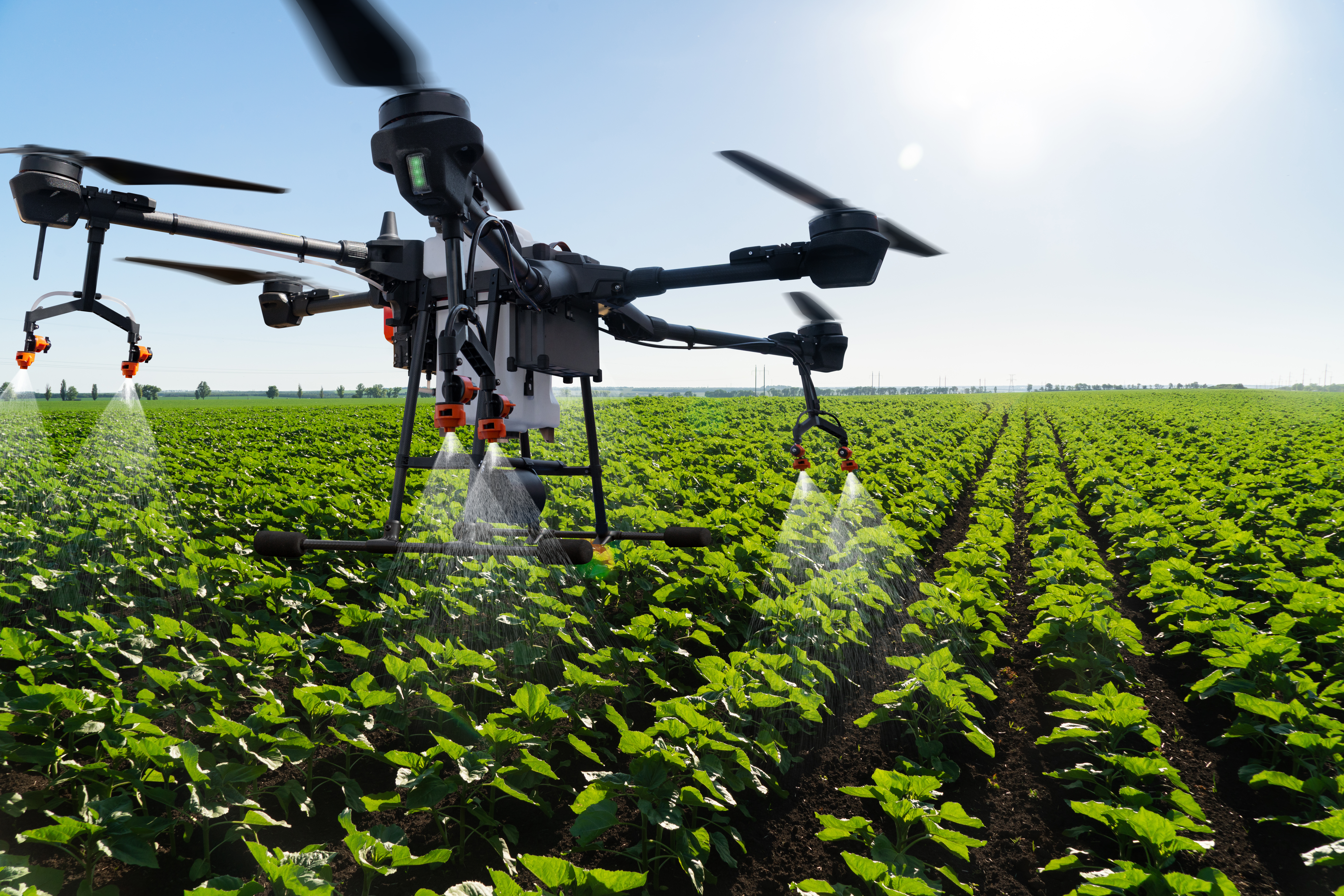
- Agriculture: Across Europe, extreme weather causes over €28 billion ($31.9 billion) in annual losses for farmers, according to EU-backed analysis.5 Flooding, drought, heatwaves, and storms continue to disrupt crop yields, supply chains, and agricultural productivity. To mitigate these risks, producers are increasingly automating their resilience. Today, 35% of global weather API requests support real-time decisions on planting and crop health,6 allowing growers to integrate hyper-local soil and atmospheric data into their daily operations.
- Retail: With over $1 trillion in global sales influenced by weather,7 brands use seasonal and localized weather signals to optimize promotions, staffing, and inventory, down to the store level.
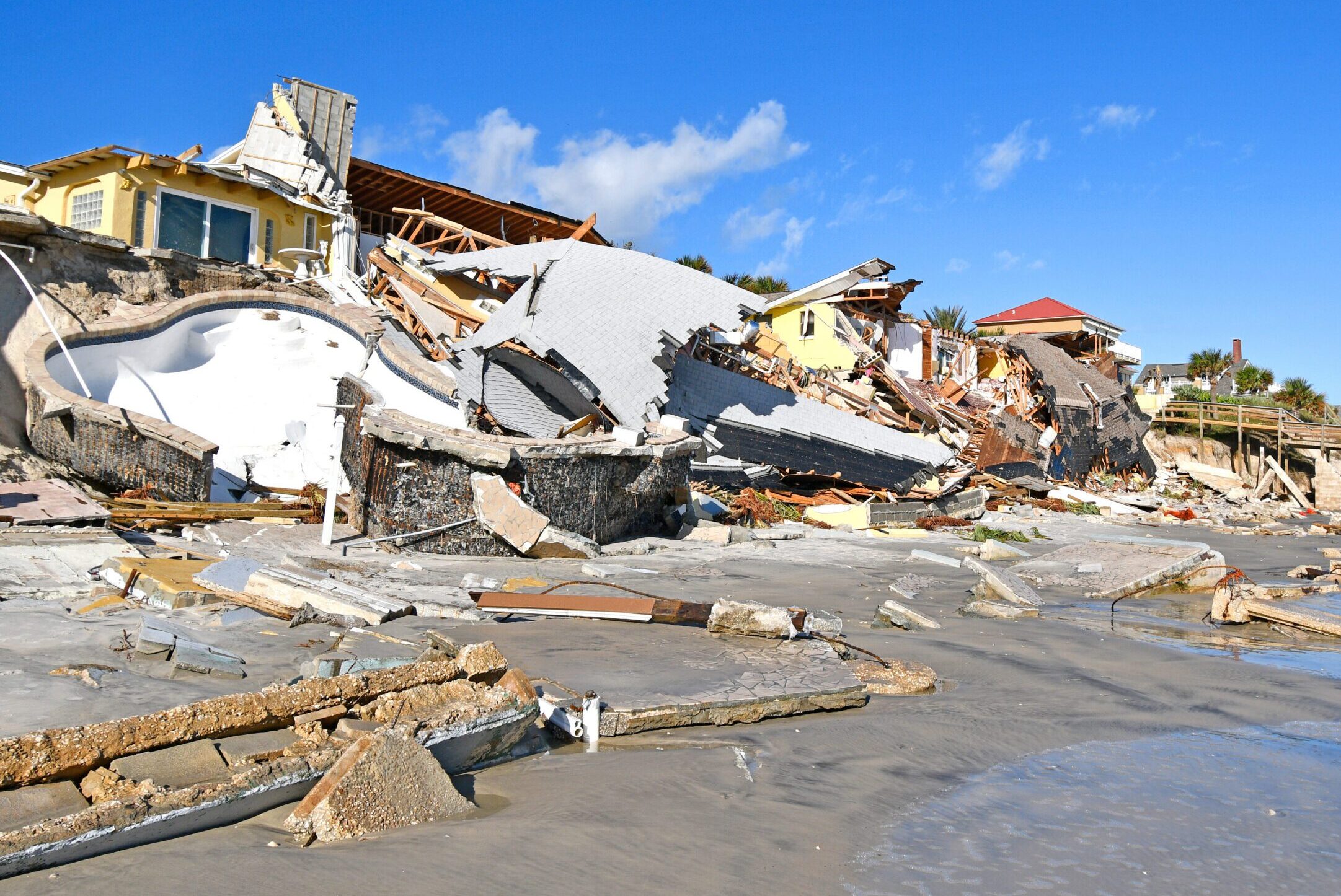
- Insurance & finance: Global insured losses from natural catastrophes were projected to reach $107 billion in 2025, with the U.S. accounting for a staggering 83% of that total.8 As wildfires and severe storms push losses higher, insurers are turning to high-resolution weather forecasts and risk modeling tools to better price policies, reduce exposure, and support more resilient coverage strategies.
- Construction: Weather regularly disrupts construction timelines – damaging materials, delaying crews, and forcing costly rework. In 2024 alone, the U.S. faced 27 separate billion-dollar weather disasters, totaling more than $182.7 billion in losses.9 By integrating forecast data into scheduling tools, project teams can plan around conditions like rain, wind, and heat to reduce downtime and stay on track.
- Sports & entertainment: Weather and climate extremes are increasingly disrupting major sports and outdoor entertainment events worldwide. In 2025, severe conditions such as wildfires, high winds, and heat forced cancellations and rescheduling of professional competitions (including PGA golf events and marathons), affecting revenue and the fan experience in an industry valued at $2 trillion.10 Organizers are integrating real‑time weather intelligence to make safer go/no‑go decisions, adjust schedules, and protect athletes, spectators, and operations.
The rise of the “Shadow CEO”
This cross-industry momentum reflects a fundamental shift: weather is no longer just a background disruption; it is the “Shadow CEO” of the global economy. It quietly influences shipping routes, energy costs, and staffing needs every single day.
%
of executives say weather significantly impacts their operations11
%
plan to increase or maintain their investment in weather intelligence12
This rising awareness is shifting weather from a background disruptor to a boardroom priority.
What’s next for data-driven problem solving in weather and climate intelligence?
As weather volatility intensifies, businesses are moving beyond basic forecasting and embracing climate intelligence – a more comprehensive approach that layers in air quality, environmental data, and AI-driven insights.
- Generative AI is unlocking new ways to simulate risk, test mitigation strategies, and optimize business continuity plans, before disruption occurs.
- Open data collaboration is expanding, with public and private sectors sharing environmental intelligence to advance climate resilience at scale.
- AI-ready datasets from The Weather Company are purpose-built for integration into digital twins, planning tools, and real-time operations systems. These integrations help organizations anticipate disruption rather than simply react to it.
And business leaders are taking note: in a recent study, 100% of surveyed executives agreed that weather intelligence gives their business a competitive edge.13 When data becomes both scalable and strategic, weather shifts from a source of risk to a driver of opportunity.
Built for developers: Scalable, high-impact weather data APIs
APIs are at the heart of it all, making it easy for developers and data teams to bring high-resolution weather insights straight into the tools they already use. Add AI into the mix, and suddenly you’re spotting patterns – like a storm that could delay shipments or a cold snap that’ll drive up energy demand – so businesses can stay one step ahead.
The Weather Company offers a robust portfolio of enterprise-grade weather APIs designed to deliver real-time, forecast, and historical weather intelligence at scale. Trusted across industries, our APIs support over 200 billion calls per day with enterprise-grade performance, low latency, and secure integration.
These RESTful APIs enable access to:
- Hyper-local forecasts (hourly, daily, and 15-minute “nowcasts”)
- Historical conditions and almanac data for trend analysis
- Severe weather alerts from trusted government sources
- Environmental and lifestyle indices like air quality, UV risk, pollen, and even use cases for driving difficulty, power disruption, and travel comfort
- Marine and aviation insights, geospatial mapping layers, and current site-based conditions for any latitude/longitude
These APIs are built for flexible implementation – whether you’re powering operational dashboards, IoT platforms, public safety alerts, or mobile apps.
A success story in weather intelligence
 Want to see how organizations are already using weather data to solve complex challenges? One example is CAA Club Group, which worked with The Weather Company to improve road safety and operational readiness using real-time weather insights.
For a broader look at how accurate forecasts are driving measurable impact across transportation, energy, and public safety, read our Weather Means Business report.
Ready to build a weather-resilient business?
Don’t just react to the elements — plan for them. Start your free trial to explore our enterprise-grade weather data and start making smarter, data-driven decisions.
Get started
Contact our experts today to discover how Weather Data APIs can empower your decision-making and strengthen your business resilience. Let us help you transform weather data into a strategic asset.
Contact usRelated resources
1 ForecastWatch, Global and Regional Weather Forecast Accuracy Overview, 2021-2024, commissioned by The Weather Company
2 Federal Aviation Administration, FAQ
3 Federal Aviation Administration, Air Traffic By The Numbers
4 U.S. Energy Information Administration, U.S. electricity peak demand set new records twice in July, 2025 (data from EIA’s Hourly Electric Grid Monitor)
5 Reuters, Extreme weather costs EU farmers €28 billion per year, EU says, May, 2025
6 The Weather Company’s own internal data
7 National Retail Federation, Climate-proofing retail: How weather and climate affect retail sales, 2024
8 Reuters, Global insured catastrophe losses set to hit $107 billion in 2025 report shows, December 2025
9 NOAA National Centers for Environmental Information, U.S. Billion-Dollar Weather and Climate Disasters, 2024
10 Reuters, How climate change is putting sport on a sticky wicket, December 2025
11 12 13 Weather Means Business report, Magid for The Weather Company, October 2024
Key takeaways:
- Predict seasonal resets: Harness the New Year mentality year round by timing campaigns with weather-driven shifts in consumer optimism.
- Capture the “Creating” mindset: Use Weather Targeting to identify the precise atmospheric shifts that trigger curiosity and brand openness.
- Leverage privacy-first relevance: Weather data is a high-intent contextual signal to maintain personalization without relying on third-party cookies.
A new year sparks a natural surge in consumer optimism and engagement. Luckily, you can ride the wave of that ‘Day 1’ receptivity and spend all year long.
How? Become a Mindset Marketer. This year, resolve to look past the January hype and adopt a mindset-first marketing strategy that taps into the ultimate year-round trigger for human behavior: the weather.
Predicting the next “fresh start”
The fresh start effect isn’t limited to January 1. In reality, human optimism is cyclical. According to ground-breaking neuroscience research, a change in season acts as a psychological reset button. A sudden stretch of spring-like warmth during winter months, or even the first crisp autumn weather in summer can influence mood and decision making. We call this the Creating mindset.
A window for brand discovery
During seasonal firsts, the brain’s engagement and detail-memory centers are at their peak. This isn’t just about consumers feeling happy; it is a state of heightened curiosity and openness. When people are in a Creating mindset, they are more likely to seek out new experiences and routines, process complex information, and — most importantly — try new brands. For a marketer, this is the ultimate fresh start moment.
This is the ideal time for “conquesting” campaigns, product launches, or any message that requires a consumer to break an old habit and start a new one. When the weather triggers a Creating mindset, your audience isn’t just listening — they’re looking for what’s next, and spending accordingly.
How Weather Targeting predicts and captures the Creating mindset
At The Weather Company, our AI-powered Weather Targeting doesn’t just react to the temperature; it anticipates these renewed moments of optimism. While your competitors are fighting the mid-winter slump, a mindset-first marketing strategy allows you to predict exactly when a local weather shift will reignite a consumer’s desire to invest in their wellness routines, home organization, or healthy behaviors.
By layering atmospheric science with sophisticated machine learning, we help marketers move from reactive tactics to proactive strategy. This approach allows you to reach consumers with a “fresh start” message precisely when their environment is signaling them to begin something new — often before that renewed motivation even consciously kicks in.
- Anticipating intent: We move past basic meteorology to understand the “so what” of the weather. Our AI models analyze how specific conditions correlate with shifts in consumer intent, giving you a blueprint for human behavior.
- Privacy-first relevance: In a landscape where third-party data is disappearing, weather provides a powerful, high-intent signal. You can deliver hyper-relevant ads based on a consumer’s current context without needing to track their personal identity.
- Maximizing receptivity: Whether it’s the first break of spring sunshine or a crisp autumn morning, our technology activates your mindset-first marketing strategy at the peak of the Creating mindset when consumers are most open to discovery.
The AI-powered difference: Context without intrusion
The future of marketing is less about knowing who a person is, and more about knowing what moment they are in.
Beyond January: The perpetual performance cycle
The weather-brain connection isn’t a seasonal gimmick — it’s a perpetual cycle. The consistent, predictable influence of weather makes our AI-powered targeting relevant 365 days a year.
How the cycle of weather influences continuous consumer action:
- Spring renewal: As temperatures shift, the consumer mindset pivots toward renewal and pollen relief. This is the moment for brands to meet the surge in health and wellness activity – from starting new fitness routines and seeking out fresh, healthy foods to organizing the home and filling up the social calendar. It’s the peak time for brands to help consumers refresh every aspect of daily life.
- Summer sneak peek: The debut of summer heat shifts cognitive focus toward immediate refreshment and preparation. Consumers begin swapping in seasonal foods and beverages, updating personal care and beauty routines, and refreshing outdoor living spaces to enjoy activities like grilling.
- First fall: The first signs of fall trigger a nesting mindset. Consumers become focused on preparing their sanctuary for cooler weather, getting back to routines that may have lapsed in the heat of summer, and pivoting their palate to seasonal foods and beverages.
- Winter preservation: As daylight dwindles, the mindset moves into a state of emotional and physical warmth. Consumers are more responsive to themes of empathy, nostalgia, and comfort as those first magical snowflakes inspire holiday shopping and festive decor.
The takeaway for a successful 2026
Keeping your marketing resolution to achieve truly relevant, privacy-forward connection requires moving beyond static demographics and focusing on dynamic human context.
The most powerful, universal trigger is the weather. It’s time to harness the neuroscience of weather with a mindset-first marketing strategy and AI-powered targeting from The Weather Company. Through this approach, your message can be delivered at the moment of highest consumer receptivity. Cheers to that.
Let's talk
What’s your weather marketing strategy? To learn more about harnessing the power of weather to increase engagement and drive growth, contact our advertising experts today.
Contact usRelated resources
Key takeaways
- The Weather Company’s forecast accuracy is backed by ForecastWatch data, showing it’s nearly 4x more likely to be the most accurate globally than any competitor.
- Reliable weather intelligence depends on continuous updates, hyperlocal granularity, and rigorous third-party validation.
- The GRAFTM model, WxMix ensemble, and Human-over-the-Loop (HOTL) process combine AI with expert insight to produce real-time, on-demand forecasts.
- Weather APIs deliver data with 15-minute resolution, helping businesses across sectors act faster and reduce disruption risks.
- Integrating weather intelligence with enterprise systems like IoT, finance, and logistics drives smarter cross-functional decision-making.
Weather is one of the most complex, high-volume data streams organizations can leverage – and one of the easiest to get wrong. For operations leaders in logistics, energy, and agriculture, the gap between an acceptable weather data model and a truly accurate one comes down to the precision, freshness, and validation of the underlying data.
What was once a general prediction must now become a location-specific, real-time decision input. To get there, businesses are turning to proprietary AI forecasting systems layered with human insight — systems capable of delivering resolutions as detailed as 3.5km while keeping pace with rapidly changing conditions.
Understanding how weather data is structured and applied reveals why precision, validation, and granularity now drive competitive advantage.
Why does weather data matter?
Weather’s impact is constant, but how businesses respond to it is changing. Companies are shifting from reactive strategies to proactive planning driven by high-resolution, real-time weather data.
The cost of inaction is steep: In 2023 alone, weather-related disruptions caused over $90 billion in damages across U.S. industries1 – a number that’s pushing more businesses to focus on resilience through proactive weather planning.
As climate variability increases, highlighted by 28 separate billion-dollar weather and climate disasters in the U.S. in 2023 alone,2 so does the need for predictive, adaptable tools. Weather intelligence is now a core component of decision-support tools across sectors like energy, agriculture, and logistics.
How is weather data structured and organized?
Understanding weather data starts with knowing its three main types:
- Real-time data – current observations from radar, satellites, and sensors
- Historical data – long-term climate patterns and trends
- Predictive data – forecast models that simulate future outcomes, including:
- GRAF® – A proprietary global model that delivers high-resolution forecasts as often as every five minutes, down to a kilometer level.
- WxMix – A continuously optimized blend of more than 100 weather models, customized per location, variable, and forecast window to maximize accuracy.
- HOTL (Human-over-the-Loop) – Oversight from 100+ expert meteorologists who refine AI-generated forecasts based on real-world conditions and operational context.
These tools allow enterprises to create forecasts that are on demand, location-specific, and AI-optimized in real time. That capability is made possible by advances in AI and weather technology.
How is weather data analyzed?
At The Weather Company, forecast accuracy is powered by more than automation. WxMix, our advanced multi-model ensemble, analyzes approximately 100 global weather models. Using AI, it synthesizes and optimizes inputs by location, parameter, and timeframe – maximizing accuracy where and when it matters most.
But it doesn’t stop there. Through Human-over-the-Loop (HOTL) intelligence, our team of over 100 expert meteorologists adds critical oversight so that forecasts are tweaked to reflect real-world complexities algorithms alone might miss. The result is a system that delivers real-time precision with the confidence of expert validation.
What defines reliable weather intelligence?
Not all data is created equal. The most reliable weather intelligence is:
- Accurate – validated against historical and current observations
- Granular – spatially and temporally precise
- Timely – updated continuously (not just 4x a day like legacy systems)
- Validated – tested by third-party accuracy audits

A ForecastWatch study found The Weather Company to be nearly 4x more likely to be the most accurate forecaster compared to the next-best weather forecast provider.3
Standard data vs. precision intelligence: A performance comparison
| Feature | Standard source | Precision source |
| Accuracy | Generalized estimates | Location-specific, validated |
| Granularity | Regional or hourly only | Hyperlocal, down to minutes |
| Timeliness | Updated 2-4x daily | On-demand, real-time updates |
| Validation | Minimal cross-checking | Multi-source & model verified |
| Uptime | Inconsistent delivery | 99.95%+ availability |
| Error handling | Manual lag fixes | Automated detection & failover |

Explore and evaluate a full range of APIs, free.
Start a free trial todayWhat turns weather information into intelligence?
Information tells you the weather is changing. Intelligence tells you what that change will cost and how much time you have to act.
At The Weather Company, that transformation happens through a refinement process that filters raw atmospheric data into signals that are specific, validated, and decision-ready. It starts with granularity – moving from broad forecasts to 3-kilometer, 15-minute updates that detect microclimates across a delivery network. Then comes validation, using a blend of over 100 models (WxMix) checked against real-world conditions from sensors, radar, and aircraft.
Contextualization adds historical insight – understanding how past weather patterns affect current risk, like black ice or power outages. Finally, human expertise enters the loop. Our meteorologists don’t just monitor model output; they translate it into actionable guidance, helping enterprises shift from reaction to optimization.
Together, this approach turns noise into signals and weather into a strategic input for smarter decisions.
Weather intelligence is most effective when it connects siloed enterprise systems. By combining high-resolution forecasts with IoT data, live inventory, and ERP platforms, organizations can build a digital twin of their operations. With that visibility, teams can model how future weather may affect supply chains, test response strategies in advance, and shift from reacting to planning.
How is weather data delivered?
Enterprise-grade weather data needs to be accessible, fast, and flexible. That’s why The Weather Company delivers insights via robust, scalable Weather Data APIs built to support real-time decisions across logistics, energy, insurance, and more.
Our APIs give you access to real-time, historical, and predictive weather data with industry-leading accuracy and sub-hourly updates, optimized for integration into your existing platforms. Start a free trial to experience the difference for yourself.
Why near-accurate isn’t accurate enough
If your current provider can’t clearly explain how their forecasts are built, validated, and applied, you may be optimizing against the wrong reality.
As weather becomes more volatile and business cycles more complex, operational success will hinge on forecast intelligence, not just awareness. The next competitive advantage won’t come from knowing the weather, but from engineering around it.
Get started
Contact our experts today to discover how Weather Data APIs can empower your decision-making and strengthen your business resilience. Let us help you transform weather data into a strategic asset.
Contact usRelated resources

1 2 NOAA National Centers for Environmental Information (NCEI) U.S. Billion-Dollar Weather and Climate Disasters (2025).
* 3 ForecastWatch, Global and Regional Weather Forecast Accuracy Overview, 2021-2024.
Key takeaways
- Weather Targeting delivers ads when the optimal mix of real-time conditions that influence consumer mood, behavior, and buying intent occurs.
- The dynamic nature of weather requires an equally dynamic targeting solution that uses hundreds of environmental signals, helping your message align with local buying habits (with a global reach).
- Weather changes on a dime. Weather Targeting can refresh every 10 minutes automatically to match and anticipate where opportunity actually exists.
In the scramble for consumer attention, marketers are always searching for the ultimate signal of real-time intent. The truth is, that signal has been outside the window all along.
Every day, the weather dictates millions of consumer choices — from what people wear and eat to how they travel and shop. For advertisers, understanding this constant environmental shift is the key to achieving perfect contextual relevance.
Weather Targeting is the sophisticated advertising solution – powered by AI and data from the world’s most accurate forecaster1 – turning these shifts into predictive insights. It moves past calendar-defined seasons and static forecasts to decode the intricate, often subtle, relationship between climate and human behavior. The result: brand interactions that are meaningful and timely.
Here’s a deeper dive into how and what Weather Targeting can deliver for marketers.
Built to fit your existing media ecosystem
Weather influences every decision — from how people plan to what they buy. That’s why it works as a decisioning signal across your entire media ecosystem.
Weather Targeting is built to fit right in. It integrates with every major platform and channel you’re already using — social, CTV, your preferred DSP or SSP — so you don’t have to change how you work.
Whether you’re running campaigns on our properties or elsewhere, you’re tapping into the same reliable weather intelligence that helps your business perform better. It’s a complete solution designed for the complexity of today’s ad ecosystem, without the friction.
Maximize impact, minimize waste
Stop running irrelevant campaigns and start improving campaign effectiveness across all your digital destinations. Weather Targeting reduces the guesswork. It’s the dynamic intelligence that helps better position your brand at the moment of consumer intent — a moment influenced by the weather around them.
Let's talk
What’s your weather marketing strategy? To learn more about harnessing the power of weather to increase engagement and drive growth, contact our advertising experts today
Contact usRelated resources
1 ForecastWatch, Global and Regional Weather Forecast Accuracy Overview, 2021-2024, commissioned by The Weather Company.
Key takeaways
- Weather-based advertising powered by Weather Targeting delivers privacy-forward personalization by connecting campaigns to real-world conditions.
- The influence of weather shapes audience mood, behaviors, and purchase intent, giving marketers a powerful contextual advantage.
- Hyperlocal weather data equips brands to anticipate demand and adapt campaigns with precision at the ZIP code level.
- Weather-activated ads demonstrate contextual advertising effectiveness across CTV, retail media networks, and programmatic platforms.
What if the most influential marketing signal isn’t hidden in a dashboard, but right outside your window? For years, marketers have optimized for content, time of day, and audience segments. But they’ve been missing the one lever that truly moves the needle: the weather. Weather-based advertising powered by Weather Targeting can transform real-world weather conditions into a marketing superpower. It’s a strategy that delivers context, relevance, scale, and, most importantly, measurable ROI for your campaigns.
What is Weather Targeting?
As data privacy regulations fluctuate and consumer expectations shift, brands are searching for ways to deliver relevance without surveillance. At its core, Weather Targeting is an innovative, privacy-forward strategy that leverages hyperlocal weather data to anticipate human (and consumer) behavior. Instead of relying on identifiers or third-party cookies, Weather Targeting uses AI to personalize and contextualize ad delivery based on real-time and forecasted weather.
By tapping into environmental signals at the ZIP code or neighborhood level, brands can automate media buys for the micro-moments when people are most likely to click, engage, or buy. With Weather Targeting born from decades of forecast expertise, advertisers can deliver relevance without tracking, cookies, or profiles.
Privacy-forward, precision targeting with layered audience signals
Beyond just the forecast, Weather Targeting taps into a broader set of audience signals for deeper relevance, including:
- Relative conditions-based: Align ads with weather mixes like heat, humidity, pollen, or air quality.
- Activity-based: Connect with people during known conditions that align with desired behaviors, such as in-store shopping, outdoor activities, and food delivery.
- Product-based: Use third-party sales data from sources like IRI and NielsenIQ to identify the optimal mix of conditions that lead to incremental sales.
- Health and wellness-based: Leverage privacy-forward signals such as anonymized patient reports, OTC sales data, and prescription sales data from IQVIA, academic journals, medical reports, and medical claims data, to anticipate health-related needs.
- Emotion-based: Tap into the proven connection between weather, mood, and motivation to stimulate consumer engagement.
Each signal is strengthened with weather context and layered with trusted third-party data, making them smarter and more predictive.
Why is weather such a powerful signal in advertising?
So much more than the topic of small talk, weather is the ultimate contextual signal – measurable, scalable, and rooted in the real world. Unlike other contextual inputs, weather influences both emotion and behavior in real time. It universally shapes where people go, what they do, and how they spend.
In fact, weather actually rewires the brain at a subconscious level, where 90% of decisions are made. Four distinct weather-driven “mindsets” – creating, relishing, enduring, and cocooning – influence memory, motivation, and purchase behavior in unique ways. By aligning creative and messaging with specific Weather Mindsets, marketers can meet people where they are — emotionally and neurologically — and boost the effectiveness of every impression. For example, campaigns timed to sunny conditions can see a 10% lift in purchase intent, while stormy conditions can increase emotional engagement by nearly 29%.1
Proven results and ROI
Marketers across industries are already seeing the power of this predictive data science, with measurable results, including:
+%
lift in campaign performance for a leading cold & flu brand by activating ads ahead of rising seasonal illness trends.2
+%
increase in sales for a quick-service restaurant (QSR) chain by syncing warm-food promotions with incoming cold weather.3
+%
surge in ad awareness for a national retailer when localized weather conditions were used to dynamically align creative.4
+%
more foot traffic for a department store when campaigns matched weather-driven consumer mood.5
+%
higher engagement for a travel bureau when snowy conditions prompted warm-weather getaway ads.6
x
stronger CTR and a 7% lift in purchase intent for TruFuel by syncing generator messaging with severe weather.7
With predictive weather-based advertising, brands can plan and launch campaigns before consumer intent spikes – reducing wasted spend and maximizing ROI. The scale is unmatched: The Weather Company delivers insights across 44,000 ZIP codes and billions of intent signals monthly. It’s no surprise that this strategy drives results across industries and advertising channels.
Why are retailers turning to weather strategies?
Retailers are increasingly investing in weather-based advertising because it delivers measurable performance without compromising privacy. Weather emerges as a future-proof signal – objective, real-time, and universally understood. In fact, the data shows:
- 40% of daily retail sales variance is due to weather8
- 50%+ of consumers say their skin and hair needs change with the weather9
For retail brands, weather adds dynamic, real-world context that explains shifts in demand and helps tailor promotions to local conditions. A grocery chain can spotlight grilling supplies ahead of a warm weekend, while a clothing retailer may drive outerwear sales during the first cold snap. Even home improvement and DIY brands see measurable lifts when campaigns align with rainy-day or storm forecasts.
Retailers also value the geographic precision that hyperlocal weather data provides. Messaging can be adapted across ZIP codes, cities, or regions, accounting for the nuances that national campaigns often miss.
Ultimately, weather strategies allow brands to market with relevance at scale. Effective campaigns focus on real conditions, real needs, and real results.
Real-time responsiveness: Adapting campaigns to changing weather
When weather changes, consumer priorities shift – often quickly. Businesses that build flexibility into their marketing strategy can adapt in near real-time, reaching consumers with contextually relevant messages precisely when demand increases. The key lies in using weather as a reactive tool and a proactive signal for planning, activation, and optimization.
Short-term weather events – like storms, heatwaves, or cold fronts – can have immediate impacts on foot traffic, product interest, and purchase urgency. As a result, businesses that connect marketing to these conditions can shift ad spend toward the highest-performing regions, adjust creative assets to reflect the moment, and emphasize products suited to the current environment – all automated by Weather Targeting technology.
For example, a national retailer aligned its store promotion strategy with regional weather shifts by deploying warmwear and hot beverage promotions ahead of a cold front. The campaign produced a 12.2% lift in foot traffic, amounting to over 94,000 incremental store visits.10
The rise of real-time, weather-based advertising allows for even more responsiveness. Brands can deploy creative variations tailored to specific conditions (humid, overcast, chilly) across ZIP codes, adjusting message and tone to match local experiences. It’s marketing that feels alive, because it is.
How weather amplifies your marketing calendar
Some of the most effective advertising campaigns connect with audiences during shared cultural moments, big and small. But what amplifies those campaigns isn’t just the calendar. It’s the weather. Weather-based advertising allows brands to align creative with the season and how that season feels in a specific location at a specific time.
Football season
From planning moments leading up to the game to tailgates and watch parties, fall football traditions are deeply tied to the weather. As temperatures drop, fan rituals shift toward warm food, seasonal apparel, and outdoor gear. Brands can activate campaigns when the first chill hits, serving ads for chili ingredients, fleece pullovers, or team gear.
Halloween
Halloween shopping is often driven by short-term weather conditions. A sunny weekend in mid-October may drive costume purchases and outdoor décor, while a soggy forecast can spike demand for indoor entertainment or candy.
Entertainment
Weather directly impacts what people choose to do in their downtime. Rainy days or chilly nights often increase interest in streaming services, movie rentals, or cozy at-home activities. Weather-activated ads that promote these entertainment experiences at just the right moment can drive engagement and viewing time without needing personal data.
Holidays
Holiday campaigns often follow fixed calendars, but consumer behavior doesn’t. A sudden cold front can kickstart interest in warm beverages, travel deals, and gift planning – well before traditional campaign dates.
Weather Targeting helps brands tap into cultural moments using real-time environmental context. This elevates seasonal advertising from reactive to anticipatory. It also makes brand messaging feel perfectly timed.
Activating weather data in your media plan
Brands and agencies are integrating weather-based advertising across high-impact channels like connected TV (CTV), retail media networks (RMNs), and programmatic curation.
Within CTV
CTV offers a high-attention environment where mood and timing matter. By using weather-activated ads, brands can tailor creative to match a viewer’s emotional state or physical environment – without relying on identifiers.
Within RMNs
RMNs are increasingly central to retail strategy, and hyperlocal weather data adds a predictive layer that enhances their power. Retailers and brands gain the ability to segment campaigns by location, weather condition, and season, offering meaningful experiences without user tracking. Easy integration through Deal IDs or programmatic platforms helps Weather Targeting scale quickly across campaigns, without additional operational complexity.
Within programmatic curation
Programmatic curation allows marketers to pre-package inventory with enhanced context. Adding weather data enriches curated deals with real-world signals so impressions reach consumers at the right moment.
Why The Weather Company?
When every marketing dollar counts, you want to know you’re getting the most accurate weather intelligence possible fueling your campaign. With decades of data and proprietary AI forecasting models, we are nearly 4x more likely to be the most accurate than our closest competitor.11 As the global leader in contextual weather intelligence, The Weather Company powers over 2 billion daily forecasts across 178 countries, integrating into CTV, RMNs, programmatic platforms, and beyond. We forecast weather and help brands forecast demand.
Outsmart the competition with a weather-based strategy
As data privacy becomes the new standard, relying on outdated strategies is a risk. Weather-based advertising is the future-ready solution that lets you win on relevance, not personal data. Whether you’re planning for peak season or optimizing your always-on campaigns, The Weather Company can help you connect with consumers in the moments that matter most.
FAQs
Weather-based advertising is a strategy where ad delivery is aligned with real-time or forecasted weather conditions, using hyperlocal weather data and AI to reach consumers in the moments they are most receptive.
The influence of weather extends to mood, routines, and purchase intent. Sunshine can drive shopping and outdoor activity, while rain or cold often increases interest in comfort food, indoor entertainment, or warm apparel.
Hyperlocal weather data makes campaigns more precise by capturing conditions at the ZIP code level. This allows brands to personalize messages based on what consumers are actually experiencing in their exact location.
The importance of weather data lies in its ability to predict demand shifts. Retailers use it to optimize promotions, align inventory, and improve forecasting to reduce waste and boost ROI.
Weather-activated ads are creative assets that change automatically based on live conditions, such as showing cold-weather promotions during a frost or highlighting sunscreen when UV levels rise.
By aligning with real-world conditions, Weather Targeting boosts contextual advertising effectiveness. It enhances relevance, improves engagement, and drives measurable results without relying on personal identifiers.
Weather Targeting uses environmental signals instead of personal data. This means brands can deliver personalization without cookies, IDs, or surveillance to meet consumer expectations for privacy.
Let's talk
What’s your weather marketing strategy? To learn more about harnessing the power of weather to increase engagement and drive growth, contact our advertising experts today.
Contact usRelated resources
1 Impact of Weather study, Neuro-Insight on behalf of The Weather Company, April 2025. Metrics are based on calculations from the NI study and actual ROI metrics may vary.
2-4 The Weather Company campaign results from participating clients
5-7 Shine through the clouds: Weather’s central role in contextually relevant advertising
8 Journal of Retailing and Consumer Services, The impact of daily weather on retail sales: An empirical study in brick-and-mortar stores, 2019.
9 A beauty strategy that will always be on trend
10 InMarket Q4 2023
11 ForecastWatch, Global and Regional Weather Forecast Accuracy Overview, 2021-2024, commissioned by The Weather Company
Key takeaways
- The “Creating Mindset” is a predictable psychological state that occurs on pleasant, sunny fall days. It primes consumers for optimism, spontaneity, and new experiences.
- Marketers can leverage this mindset to launch new products, drive impulse purchases, and boost campaign ROI by nearly 20%.
- To tap into this state, use action-oriented messaging, align your brand with a “fresh start” mentality, and use bold, vibrant visuals.
- Weather-based targeting, powered by AI, allows brands to connect with consumers at the exact moment the Creating Mindset is active, leading to significant lifts in purchase intent and brand consideration.
Fall is officially here, and with it comes our first taste of cool, crisp air and hotly-anticipated pumpkin spice lattes. Have you noticed that these seasonal rites also bring a feeling of optimism and new possibilities? This isn’t a coincidence – it’s a predictable psychological state we call the Creating Mindset.
In a recent, groundbreaking research study with a leading neuroscience firm, we found that pleasant weather triggers this mindset, where people are primed for optimism, discovery, and new experiences. For marketers, this isn’t just a good mood; it’s a golden opportunity to launch products, drive spontaneity, and significantly boost your brand’s ROI.
When the sun is shining and the air is cool, people aren’t just happy; they’re ready to say “yes” to new routines and aspirational purchases.
What is the Creating Mindset?
The Creating Mindset – one of four weather-driven mindsets – is an ideal state for driving consumer action. On sunny days when the temperature, humidity, and wind speed signal fall’s arrival, the brain’s engagement and detail memory centers ignite.
In this mindset, consumers are curious, confident, and motivated to act. It’s an ideal time for campaigns designed to inspire spontaneity. Tailor your campaign to this mindset and you could boost ROI by nearly 20%.1
How to tap into spontaneity
The Creating Mindset is all about seizing the moment. Introduce something new and bold, tell a positive story, and create memorable brand impressions. Your audience is primed for:
- Product trials
- Product and brand launches
- Conquesting
- Full price or impulse purchases
- Campaigns that inspire and educate
Here’s how to craft a fall campaign that resonates with consumers on a beautiful fall day.
1. Use action-oriented messaging
Conditions are primed for conquesting. Go after new audiences and steal loyalty. Consumers in this mindset are motivated to act. Your messaging should reflect this urgency and confidence. Use phrases that encourage immediate action, such as “Start Your Fall Adventure,” “Try a New Pumpkin Spice Recipe,” or “Refresh Your Wardrobe.”
2. Embrace “fresh start” mentality
Position your product or service as the spark for something new this season. Whether it’s preparing your home for colder weather, starting a new wellness routine, or getting a head start on holiday planning, align your brand with the consumer’s desire for a fresh beginning. This is a prime psychological state for launching products or highlighting new seasonal features.
3. Go bold with your fall creative
Your visuals should reflect the optimism of the season. Use a rich, vibrant color palette. The imagery should evoke a sense of optimism and seasonal beauty. Ads that go bold visually can drive 13% higher visual attention2 and 19% stronger global memory,3 as they mirror the consumer’s upbeat emotional state.
4. Forecast your fall funnel with Weather Targeting
Powered by AI, Weather Targeting makes it easy and efficient to align your brand when and where people are primed for your message. As the world’s most accurate forecaster,4 we identify the specific atmospheric conditions – like a crisp, sunny autumn afternoon with low wind – that are scientifically proven to trigger a sense of optimism. It’s about more than seeing the season on the calendar; it’s knowing the exact moment the brain is wired to be inspired.
Coffeehouse brand perks up purchase intent with Gen Z
Using seasonal first Weather Targeting solutions, a leading coffeehouse brand connected with consumers when they were most likely to try new products and seasonal flavors.
%
lift in purchase intent among Gen Z audience5
%
lift in brand consideration among Hispanic audience6
A harvest of opportunity
Beautiful autumn days are far more than just pleasant weather; they are a predictable psychological forecast for marketers. By understanding and leveraging the Creating Mindset, you can align your brand with consumer optimism and turn fleeting moments of fall beauty into lasting connections and profitable conversions.
Let's talk
What’s your weather marketing strategy? To learn more about harnessing the power of weather to increase engagement and drive growth, contact our advertising experts today.
Contact usRelated resources
1 2 3 Impact of Weather study, Neuro-Insight on behalf of The Weather Company, April 2025. Metrics are based on calculations from the NI study and actual ROI metrics may vary.
4 ForecastWatch, Global and Regional Weather Forecast Accuracy Overview, 2021-2024, commissioned by The Weather Company
5 6 Coffeehouse brand campaign on The Weather Channel, Nov 2022 GAM & Lucid
During football season, the most valuable play for marketers comes long before kickoff. It begins with the fan’s planning journey in the weeks, days, and hours leading up to the game.
From choosing what to wear to planning a tailgate, every decision is informed by a powerful and influential force: the weather. For smart brands, these aren’t just gameday details; they’re golden opportunities to connect with a highly engaged audience at their most receptive moments.
The power of planning: from outfit to outcome
This pre-game fan behavior is a consistent and predictable pattern. Consumers are in a distinct “planning mindset” as they prepare for outdoor sporting activities, and they turn to a trusted source, The Weather Channel digital, for guidance. Our data shows that:
%
check the weather a week or more in advance of the event1
%
say knowing the weather forecast ahead of outdoor events informs purchase decisions to better enjoy the event2
This pre-event planning window is a prime opportunity for brands to influence decisions and purchases with relevant, weather-aligned messaging. But that’s not the only opportunity to score.
The ultimate sports marketing play
Let’s take the recent Philadelphia Eagles season opener, for example. We captured digital traffic data from the Philadelphia DMA to The Weather Channel digital platforms3 leading up to, and on, game day. Interest in weather created a surge of audience traffic surrounding this major sporting event. Spoiler alert: It rained opportunity for marketers.
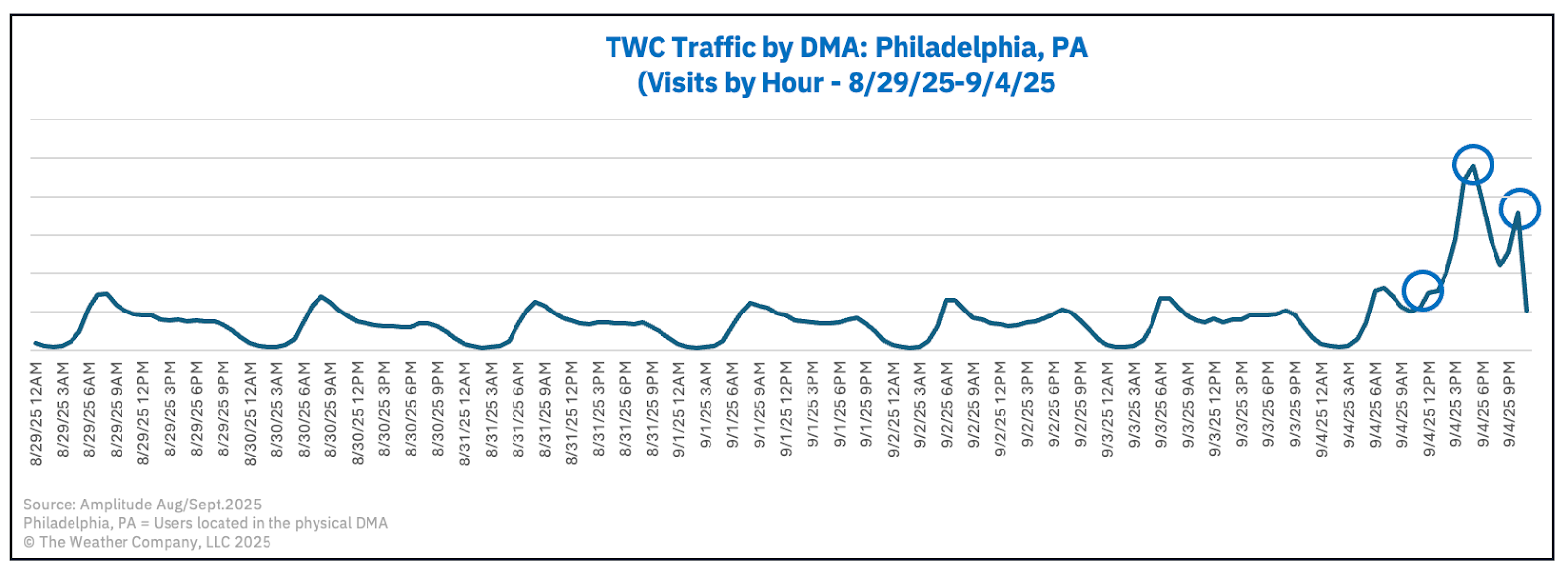
Traffic on The Weather Channel digital platforms saw a significant increase as fans sought real-time updates and game day planning information. Key takeaways:
- Weather is your game day assist: Traffic began climbing around 12 PM, informing game day garb and tailgating options.
- Mother Nature is the MVP for pre-game purchases: We saw 5X higher traffic compared to average during the 5 PM hour as pre-gaming activities peaked.
- A weather delay is “go time” for marketers: In sync with the rain delay call, we saw 4X higher traffic compared to average during the 10 PM hour as fans anxiously awaited the fate of the game.
Why this matters for your brand
This behavior isn’t unique to the Eagles season opener. It’s expected for any major events and activities that are influenced by weather. Consumers will actively seek out information to inform and influence their plans. For marketers, this represents a unique opportunity to:
- Reach a captive audience: The Weather Channel’s platforms aren’t just for checking the forecast; they become a critical tool for decision-making. Of our 130M+ MAUs in the U.S., 81M+ have watched a sporting event on TV in the past year, and 37M+ have attended in person in the last 6 months.4 This creates a highly engaged, focused audience that is receptive to relevant creative messaging.
- Align with a trusted authority: The Weather Company is the world’s most accurate forecaster.5 Aligning your brand with this trusted authority can help enhance your brand’s credibility and relevance.
- Leverage real-time context: By leveraging real-time weather data through Weather Targeting, you can deliver contextually relevant ads that resonate with the consumer’s immediate needs and mindset.
In the fast-paced world of digital advertising – as in football – timing is everything. Rely on universal and performant weather signals to call the right play.
Let's talk
What’s your weather marketing strategy? To learn more about harnessing the power of weather to increase engagement and drive growth, contact our advertising experts today.
Contact usRelated resources
1 2 TWC Entertainment Behavior Survey, January 2024
3 Amplitude August/September 2025
4 Comscore
5 ForecastWatch, Global and Regional Weather Forecast Accuracy Overview, 2021-2024, commissioned by The Weather Company