
Weather intelligence for the future: Crafting a strategic enterprise approach to changing environmental conditions
Continue reading

Key takeaways
- Weather data is becoming a foundational input for smarter planning and decision-making across industries.
- Cities, logistics providers, and energy companies are integrating weather intelligence to improve efficiency and resilience.
- AI and APIs are transforming raw weather data into actionable insights within business systems.
- The Weather Company enables organizations to move from reactive to predictive operations through real-time data solutions.
Try naming a business that isn’t impacted by weather. Go ahead – really pressure test it. Weather touches every corner of the global economy. Whether it’s a farm, a freight company, a fashion brand, or even a software firm with a fully remote team, weather finds a way in.
Yes, even in sectors that feel “weather-proof,” its influence shows up in unexpected ways. That remote software firm? A localized heat wave or severe storm can strain regional power grids, risking the uptime and productivity of a distributed workforce. Your data center? Temperature spikes can strain the cooling systems. Your employees? Sunlight levels can affect human cognition and productivity.
Accepting that weather impacts your business is the first step; building resilience against it is the second. This shift from reactive to proactive requires a sophisticated pipeline that translates atmospheric physics into operational logic.
How do organizations turn weather data into actionable insights?
At The Weather Company, every real-world application starts with a rigorous process that transforms raw environmental signals into strategic intelligence:
- Collection: More than 75 billion terabytes of weather data are ingested daily, sourced from satellites, radar mosaics, aircraft, government feeds, and a global network of ~390,000 personal weather stations, with dense urban and suburban coverage.
- Normalization: This raw data is cleaned, quality-controlled, and standardized to maintain consistency across inputs. It’s then structured into formats ready for modeling and distribution.
- Integration: APIs built for enterprise-scale operations – supporting billions of requests per day – deliver this data into systems such as ERP platforms, IoT networks, digital twins, and custom applications.
- Application: AI-powered technologies like WxMix synthesize over 100 global forecast models, including The Weather Company’s own GRAF® system. These models are continuously optimized for every location and weather variable, surfacing predictive insights that businesses can act on in real time. Independent evaluations rank our forecasts #1 in accuracy across both global and regional scales.1
Download our free and exclusive Weather Means Business report to learn how smart businesses are transforming their enterprise strategies.
Get your copyHow is weather data driving innovation across industries?
Across industries, businesses are integrating weather intelligence more deeply than ever to unlock value and build long-term resilience:
- Aviation: Weather is responsible for roughly 75% of all flight delays,2 and airlines depend on real‑time weather insights to optimize routing, reduce fuel use, and enhance safety. To combat this, more than 44,000 flights in the U.S. alone3 rely on weather forecasts every day to plan safer, more efficient routes, reduce fuel burn, and minimize disruptions.
- Energy & utilities: In summer 2025, U.S. electricity demand across the Lower 48 states set new peak records twice, reaching 759,180 megawatts as hot weather drove up cooling needs – nearly 2% higher than the prior year’s peak.4 High‑resolution weather intelligence helps utilities anticipate demand swings, balance renewables, and plan grid operations more effectively under weather‑driven stress.
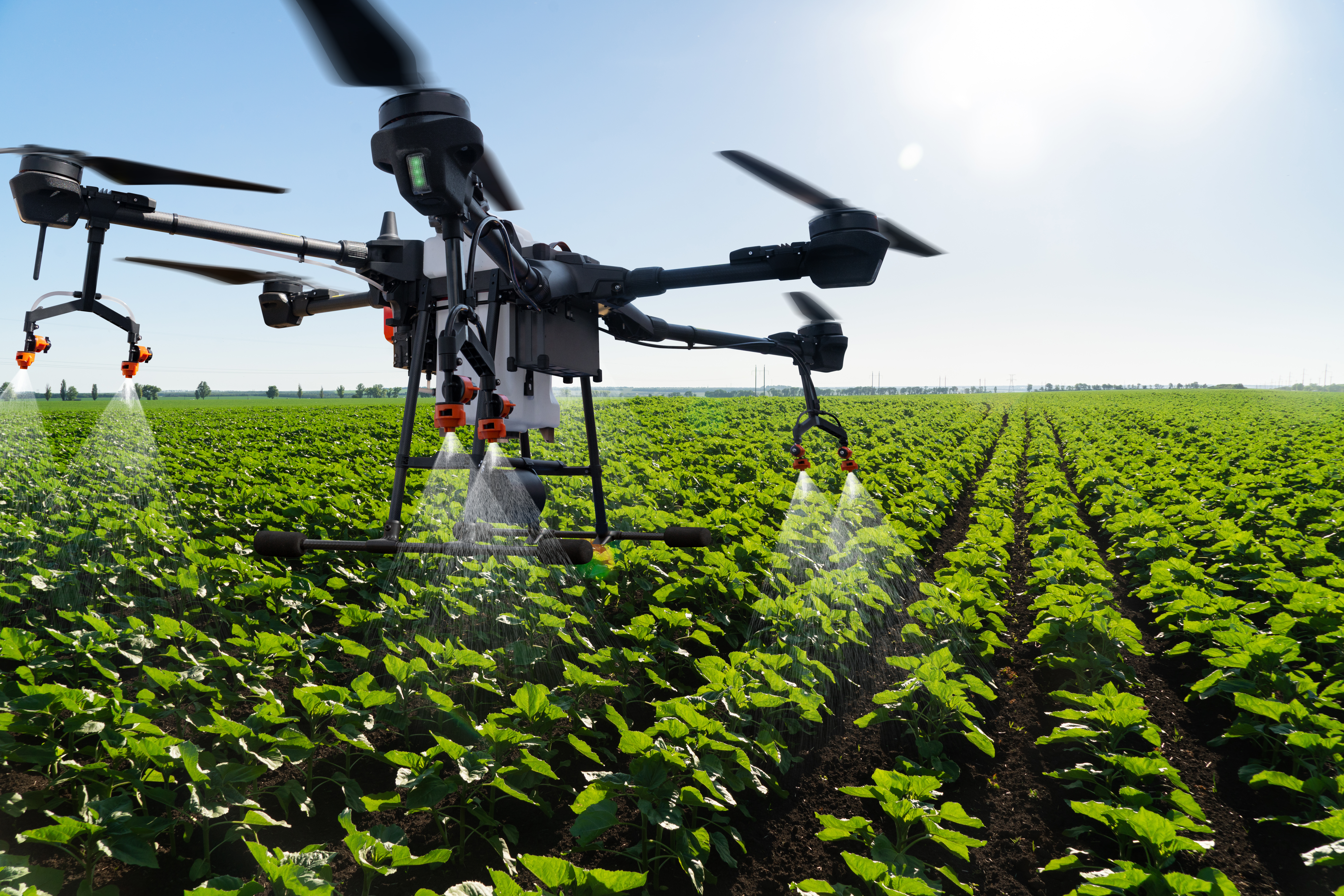
- Agriculture: Across Europe, extreme weather causes over €28 billion ($31.9 billion) in annual losses for farmers, according to EU-backed analysis.5 Flooding, drought, heatwaves, and storms continue to disrupt crop yields, supply chains, and agricultural productivity. To mitigate these risks, producers are increasingly automating their resilience. Today, 35% of global weather API requests support real-time decisions on planting and crop health,6 allowing growers to integrate hyper-local soil and atmospheric data into their daily operations.
- Retail: With over $1 trillion in global sales influenced by weather,7 brands use seasonal and localized weather signals to optimize promotions, staffing, and inventory, down to the store level.
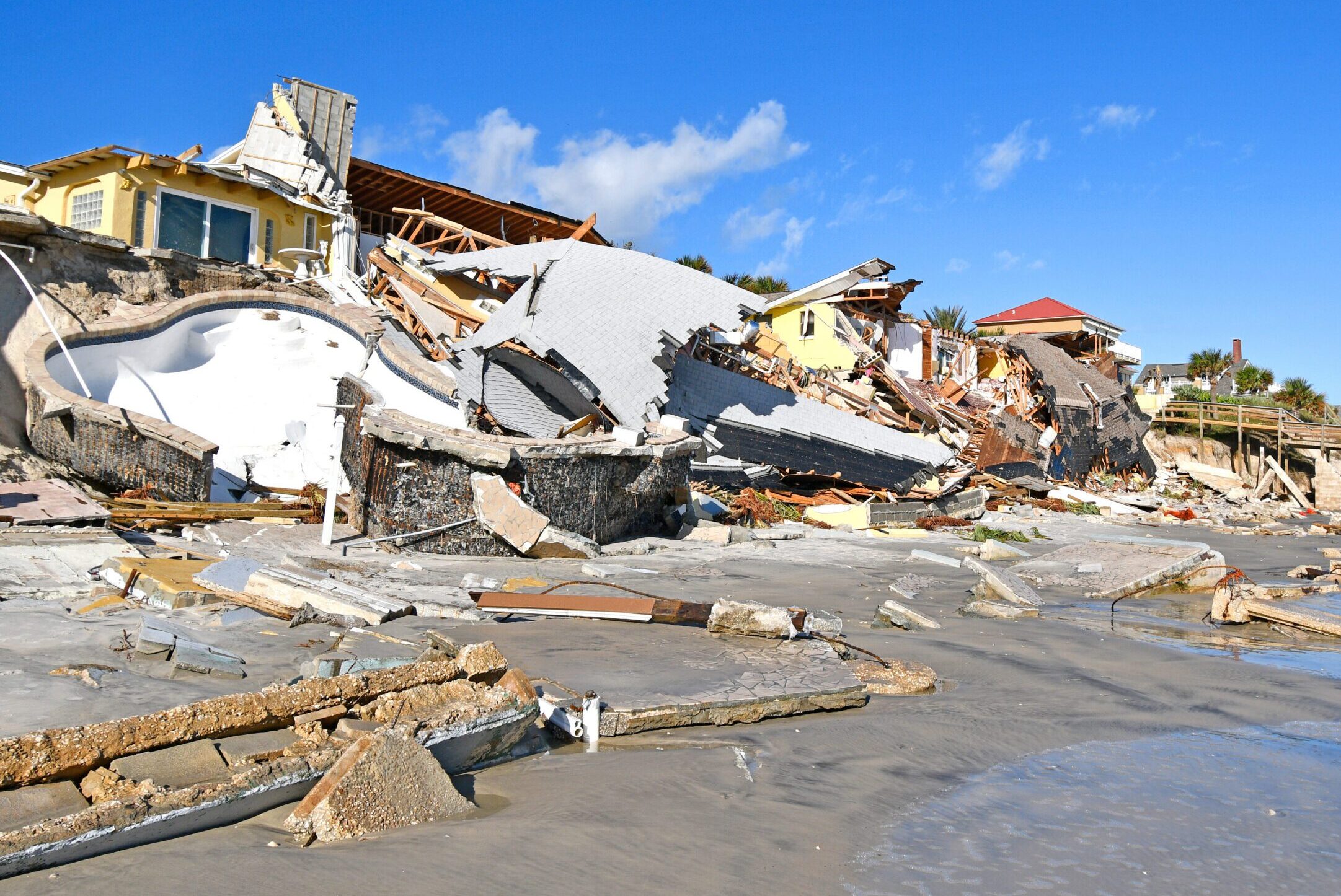
- Insurance & finance: Global insured losses from natural catastrophes were projected to reach $107 billion in 2025, with the U.S. accounting for a staggering 83% of that total.8 As wildfires and severe storms push losses higher, insurers are turning to high-resolution weather forecasts and risk modeling tools to better price policies, reduce exposure, and support more resilient coverage strategies.
- Construction: Weather regularly disrupts construction timelines – damaging materials, delaying crews, and forcing costly rework. In 2024 alone, the U.S. faced 27 separate billion-dollar weather disasters, totaling more than $182.7 billion in losses.9 By integrating forecast data into scheduling tools, project teams can plan around conditions like rain, wind, and heat to reduce downtime and stay on track.
- Sports & entertainment: Weather and climate extremes are increasingly disrupting major sports and outdoor entertainment events worldwide. In 2025, severe conditions such as wildfires, high winds, and heat forced cancellations and rescheduling of professional competitions (including PGA golf events and marathons), affecting revenue and the fan experience in an industry valued at $2 trillion.10 Organizers are integrating real‑time weather intelligence to make safer go/no‑go decisions, adjust schedules, and protect athletes, spectators, and operations.
The rise of the “Shadow CEO”
This cross-industry momentum reflects a fundamental shift: weather is no longer just a background disruption; it is the “Shadow CEO” of the global economy. It quietly influences shipping routes, energy costs, and staffing needs every single day.
%
of executives say weather significantly impacts their operations11
%
plan to increase or maintain their investment in weather intelligence12
This rising awareness is shifting weather from a background disruptor to a boardroom priority.
What’s next for data-driven problem solving in weather and climate intelligence?
As weather volatility intensifies, businesses are moving beyond basic forecasting and embracing climate intelligence – a more comprehensive approach that layers in air quality, environmental data, and AI-driven insights.
- Generative AI is unlocking new ways to simulate risk, test mitigation strategies, and optimize business continuity plans, before disruption occurs.
- Open data collaboration is expanding, with public and private sectors sharing environmental intelligence to advance climate resilience at scale.
- AI-ready datasets from The Weather Company are purpose-built for integration into digital twins, planning tools, and real-time operations systems. These integrations help organizations anticipate disruption rather than simply react to it.
And business leaders are taking note: in a recent study, 100% of surveyed executives agreed that weather intelligence gives their business a competitive edge.13 When data becomes both scalable and strategic, weather shifts from a source of risk to a driver of opportunity.
Built for developers: Scalable, high-impact weather data APIs
APIs are at the heart of it all, making it easy for developers and data teams to bring high-resolution weather insights straight into the tools they already use. Add AI into the mix, and suddenly you’re spotting patterns – like a storm that could delay shipments or a cold snap that’ll drive up energy demand – so businesses can stay one step ahead.
The Weather Company offers a robust portfolio of enterprise-grade weather APIs designed to deliver real-time, forecast, and historical weather intelligence at scale. Trusted across industries, our APIs support over 200 billion calls per day with enterprise-grade performance, low latency, and secure integration.
These RESTful APIs enable access to:
- Hyper-local forecasts (hourly, daily, and 15-minute “nowcasts”)
- Historical conditions and almanac data for trend analysis
- Severe weather alerts from trusted government sources
- Environmental and lifestyle indices like air quality, UV risk, pollen, and even use cases for driving difficulty, power disruption, and travel comfort
- Marine and aviation insights, geospatial mapping layers, and current site-based conditions for any latitude/longitude
These APIs are built for flexible implementation – whether you’re powering operational dashboards, IoT platforms, public safety alerts, or mobile apps.
A success story in weather intelligence
 Want to see how organizations are already using weather data to solve complex challenges? One example is CAA Club Group, which worked with The Weather Company to improve road safety and operational readiness using real-time weather insights.
For a broader look at how accurate forecasts are driving measurable impact across transportation, energy, and public safety, read our Weather Means Business report.
Ready to build a weather-resilient business?
Don’t just react to the elements — plan for them. Start your free trial to explore our enterprise-grade weather data and start making smarter, data-driven decisions.
Get started
Contact our experts today to discover how Weather Data APIs can empower your decision-making and strengthen your business resilience. Let us help you transform weather data into a strategic asset.
Contact usRelated resources



1 ForecastWatch, Global and Regional Weather Forecast Accuracy Overview, 2021-2024, commissioned by The Weather Company
2 Federal Aviation Administration, FAQ
3 Federal Aviation Administration, Air Traffic By The Numbers
4 U.S. Energy Information Administration, U.S. electricity peak demand set new records twice in July, 2025 (data from EIA’s Hourly Electric Grid Monitor)
5 Reuters, Extreme weather costs EU farmers €28 billion per year, EU says, May, 2025
6 The Weather Company’s own internal data
7 National Retail Federation, Climate-proofing retail: How weather and climate affect retail sales, 2024
8 Reuters, Global insured catastrophe losses set to hit $107 billion in 2025 report shows, December 2025
9 NOAA National Centers for Environmental Information, U.S. Billion-Dollar Weather and Climate Disasters, 2024
10 Reuters, How climate change is putting sport on a sticky wicket, December 2025
11 12 13 Weather Means Business report, Magid for The Weather Company, October 2024
Key takeaways
-
ForecastWatch’s 2021-2024 global forecast accuracy study found The Weather Company to be the world’s most accurate forecaster during that period.
-
Reliable weather intelligence depends on continuous updates, hyperlocal granularity, and rigorous third-party validation.
- The GRAFTM model, WxMix ensemble, and Human-over-the-Loop (HOTL) process combine AI with expert insight to produce real-time, on-demand forecasts.
- Weather APIs deliver data with 15-minute resolution, helping businesses across sectors act faster and reduce disruption risks.
- Integrating weather intelligence with enterprise systems like IoT, finance, and logistics drives smarter cross-functional decision-making.
Weather is one of the most complex, high-volume data streams organizations can leverage – and one of the easiest to get wrong. For operations leaders in logistics, energy, and agriculture, the gap between an acceptable weather data model and a truly accurate one comes down to the precision, freshness, and validation of the underlying data.
What was once a general prediction must now become a location-specific, real-time decision input. To get there, businesses are turning to proprietary AI forecasting systems layered with human insight — systems capable of delivering resolutions as detailed as 3.5km while keeping pace with rapidly changing conditions.
Understanding how weather data is structured and applied reveals why precision, validation, and granularity now drive competitive advantage.
Why does weather data matter?
Weather’s impact is constant, but how businesses respond to it is changing. Companies are shifting from reactive strategies to proactive planning driven by high-resolution, real-time weather data.
The cost of inaction is steep: In 2023 alone, weather-related disruptions caused over $90 billion in damages across U.S. industries1 – a number that’s pushing more businesses to focus on resilience through proactive weather planning.
As climate variability increases, highlighted by 28 separate billion-dollar weather and climate disasters in the U.S. in 2023 alone,2 so does the need for predictive, adaptable tools. Weather intelligence is now a core component of decision-support tools across sectors like energy, agriculture, and logistics.
How is weather data structured and organized?
Understanding weather data starts with knowing its three main types:
- Real-time data – current observations from radar, satellites, and sensors
- Historical data – long-term climate patterns and trends
- Predictive data – forecast models that simulate future outcomes, including:
- GRAF® – A proprietary global model that delivers high-resolution forecasts as often as every five minutes, down to a kilometer level.
- WxMix – A continuously optimized blend of more than 100 weather models, customized per location, variable, and forecast window to maximize accuracy.
- HOTL (Human-over-the-Loop) – Oversight from 100+ expert meteorologists who refine AI-generated forecasts based on real-world conditions and operational context.
These tools allow enterprises to create forecasts that are on demand, location-specific, and AI-optimized in real time. That capability is made possible by advances in AI and weather technology.
How is weather data analyzed?
At The Weather Company, forecast accuracy is powered by more than automation. WxMix, our advanced multi-model ensemble, analyzes approximately 100 global weather models. Using AI, it synthesizes and optimizes inputs by location, parameter, and timeframe – maximizing accuracy where and when it matters most.
But it doesn’t stop there. Through Human-over-the-Loop (HOTL) intelligence, our team of over 100 expert meteorologists adds critical oversight so that forecasts are tweaked to reflect real-world complexities algorithms alone might miss. The result is a system that delivers real-time precision with the confidence of expert validation.
What defines reliable weather intelligence?
Not all data is created equal. The most reliable weather intelligence is:
- Accurate – validated against historical and current observations
- Granular – spatially and temporally precise
- Timely – updated continuously (not just 4x a day like legacy systems)
- Validated – tested by third-party accuracy audits
ForecastWatch’s 2021-2024 global forecast accuracy study found The Weather Company to be the world’s most accurate forecaster during that period.
Standard data vs. precision intelligence: A performance comparison
| Feature | Standard source | Precision source |
| Accuracy | Generalized estimates | Location-specific, validated |
| Granularity | Regional or hourly only | Hyperlocal, down to minutes |
| Timeliness | Updated 2-4x daily | On-demand, real-time updates |
| Validation | Minimal cross-checking | Multi-source & model verified |
| Uptime | Inconsistent delivery | 99.95%+ availability |
| Error handling | Manual lag fixes | Automated detection & failover |

Explore and evaluate a full range of APIs, free.
Start a free trial todayWhat turns weather information into intelligence?
Information tells you the weather is changing. Intelligence tells you what that change will cost and how much time you have to act.
At The Weather Company, that transformation happens through a refinement process that filters raw atmospheric data into signals that are specific, validated, and decision-ready. It starts with granularity – moving from broad forecasts to 3-kilometer, 15-minute updates that detect microclimates across a delivery network. Then comes validation, using a blend of over 100 models (WxMix) checked against real-world conditions from sensors, radar, and aircraft.
Contextualization adds historical insight – understanding how past weather patterns affect current risk, like black ice or power outages. Finally, human expertise enters the loop. Our meteorologists don’t just monitor model output; they translate it into actionable guidance, helping enterprises shift from reaction to optimization.
Together, this approach turns noise into signals and weather into a strategic input for smarter decisions.
Weather intelligence is most effective when it connects siloed enterprise systems. By combining high-resolution forecasts with IoT data, live inventory, and ERP platforms, organizations can build a digital twin of their operations. With that visibility, teams can model how future weather may affect supply chains, test response strategies in advance, and shift from reacting to planning.
How is weather data delivered?
Enterprise-grade weather data needs to be accessible, fast, and flexible. That’s why The Weather Company delivers insights via robust, scalable Weather Data APIs built to support real-time decisions across logistics, energy, insurance, and more.
Our APIs give you access to real-time, historical, and predictive weather data with industry-leading accuracy and sub-hourly updates, optimized for integration into your existing platforms. Start a free trial to experience the difference for yourself.
Why near-accurate isn’t accurate enough
If your current provider can’t clearly explain how their forecasts are built, validated, and applied, you may be optimizing against the wrong reality.
As weather becomes more volatile and business cycles more complex, operational success will hinge on forecast intelligence, not just awareness. The next competitive advantage won’t come from knowing the weather, but from engineering around it.
Get started
Contact our experts today to discover how Weather Data APIs can empower your decision-making and strengthen your business resilience. Let us help you transform weather data into a strategic asset.
Contact usRelated resources


1 2 NOAA National Centers for Environmental Information (NCEI) U.S. Billion-Dollar Weather and Climate Disasters (2025).
* 3 ForecastWatch, Global and Regional Weather Forecast Accuracy Overview, 2021-2024.
Key takeaways
- End the “logistics hangover”: Move from reactive “Acts of God” excuses to predictive data that stops a one-day storm from causing a ten-day backlog.
- Slash WISMO (Where Is My Order) calls: Use weather data to trigger proactive customer alerts, which can reduce customer complaints by 50-70%.
- Protect your bottom line: Proactive routing can reduce operation costs by 15–25% and prevent the loss of competitive market positioning.
- Unmatched scale: Leverage a platform that ingests 75+ billion terabytes of data daily with a 99.95% uptime SLA.
If you spend five minutes in customer forums and subreddits, you’ll see a common thread of frustration. Customers waiting for a delivery often post screenshots of tracking pages showing a “weather delay” when the sky is clear at their front door. To the customer, it feels like a generic excuse, not realizing the downstream effects of weather elsewhere. To the logistics provider, it’s a sign of a “logistics hangover” — the chaotic ripple effect where a single storm in a hub city paralyzes operations for a week.
The cost of being reactive is no longer just “the price of doing business.” In 2024, the U.S. experienced record-breaking climate volatility, with total economic damages from major weather events reaching $182.7 billion.1 For the logistics sector specifically, weather-related roadway delays cost the trucking industry an estimated $3.5 billion annually.2 Beyond the immediate waste, 78% of high-volume e-commerce sellers report that shipping delays directly impact their profitability and “Buy Box” status.3
Why reactive logistics is failing your customers
Customers value transparency over perfection. For too long, logistics providers have relied on “Acts of God” as a blanket justification for disruptions. But when a business sends a “weather delay” notification only after a package is already late, it’s a data failure, not an unavoidable miracle. In the eyes of the modern consumer, an “Act of God” without an accompanying plan of action feels like an excuse for poor planning.
- The transparency gap: Customers want to know why a delay happened. If your system knows a hub in Memphis is iced over, you should tell them before their package misses its scan.
- The “one-strike” rule: In today’s hyper-competitive landscape, 65% of customers will abandon a retailer after just two or three late deliveries.4
- The visibility demand: A storm doesn’t just delay one truck; it triggers a surge in anxiety. With 91% of consumers now actively tracking every shipment they order,5 a “weather delay” without a proactive explanation leads to a massive spike in “Where Is My Order” (WISMO) inquiries.
Moving from “what happened” to “what’s next” with predictive weather APIs for logistics
When operations are disrupted, the most critical question a business faces is: “How can we stop weather from ruining our delivery ETAs?” Traditionally, the answer was “we can’t.” But by integrating predictive weather APIs for logistics directly into your operational workflow, you shift from damage control to strategic prevention.
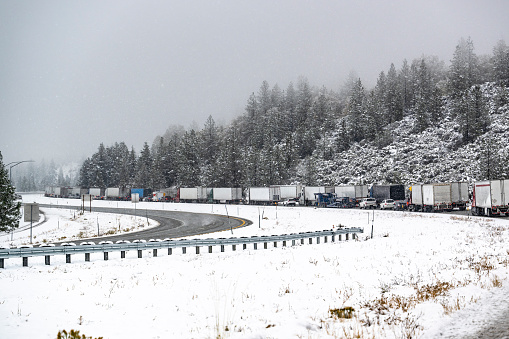
- Automated route optimization: Instead of reacting to a closed highway or a grounded flight, use predictive data to reroute freight 48 hours before the first snowflake hits. This helps keep ETAs reliable, even when the climate is volatile. Logistics leaders using these predictive analytics see an average 15–25% reduction in operating costs.6 By knowing exactly which routes are “workable,” you also eliminate the fuel waste of dry runs and the high cost of emergency, last-minute rerouting.
- Proactive “pre-storm” communication: Send a “heads up” alert before the customer even thinks to check their tracking number. By notifying a customer that you’ve moved their ship date up by 12 hours to beat an incoming storm, you turn a potential delay into a demonstration of reliability. Predictive notifications about delivery status and potential delays reduce customer complaints by 50-70%7 while simultaneously improving on-time delivery performance by 35%.8

Why The Weather Company is the choice for enterprise logistics
Building a resilient supply chain requires more than just a 5-day forecast; it requires dense, global data. The Weather Company is the world’s most accurate forecaster9 in the industry, providing:
- Accuracy you can trust: The Weather Company has been named the world’s most accurate forecaster overall for several years running by ForecastWatch. Our lead over the next best provider has grown by nearly 4x,10 meaning your data is reliable even when the storm is at its worst.
- Massive data volume: We ingest over 75+ billion terabytes of weather data daily, sourced from satellites, radar, and a global network of over 390,000 personal weather stations. This equips your team with high-resolution data for both rural corridors and dense urban ‘last-mile’ deliveries.
- Scale you can trust: We handle 6 trillion API calls per month with a guaranteed 99.95% uptime SLA, ensuring your data is available when the storm is at its worst.
Make weather your competitive advantage
The future of logistics isn’t about avoiding the storm — it’s about seeing it coming. By adopting predictive weather APIs for logistics, you can stop using weather as an excuse and start using it as a reason for your customers to trust you more.
- Explore our API offerings: Visit the API hub to see our full catalog of data layers available.
- Test it yourself: Ready to build? Start your weather data API free trial today.
Get started
Contact our experts today to discover how Weather Data APIs can empower your decision-making and strengthen your business resilience. Let us help you transform weather data into a strategic asset.
Contact usRelated resources


1 NOAA National Centers for Environmental Information (NCEI): U.S. Billion-Dollar Weather and Climate Disasters
2 US National Science Foundation: Analysis of Weather Incident Effects on Commercial Vehicle Mobility in Large U.S. Cities conducted by Mitretek Systems in partnership with the Federal Highway Administration (FHWA)
3 AMZ Prep: How Shipping Delays In 2025 Are Impacting Amazon FBA Sellers
4 Procurement Tactics: 70 Key Supply Chain Statistics for 2025/2026
5 Businesswire: Verte Research Reveals Consumers Are Obsessed With Order Tracking, Visibility
6 SR Analytics: Supply Chain Predictive Analytics: Cut Costs 25% & Improve Forecast Accuracy
7 8 Deliberate Directions: Logistics Analytics: How Data-Driven Decisions Transform Supply Chain Operations
9 10 ForecastWatch, Global and Regional Weather Forecast Accuracy Overview, 2021-2024, commissioned by The Weather Company
Key takeaways
- Supply chain weather risk is growing due to climate volatility, forcing businesses to rethink logistics and resilience strategies.
- Companies are adopting AI weather models and weather data applications to improve forecasting and reduce costly weather-driven disruptions.
- Weather API integration and severe weather API services provide real-time insights that can help prevent supply chain delays.
Editor’s note: All data sourced from the Weather Means Business report, October 2024, Magid for The Weather Company, unless otherwise noted.
Is your business ready for the new normal of extreme weather? Today’s supply chains face a growing, consistent threat from climate events that are more frequent and severe than ever before. Reacting to a crisis isn’t enough; future-proofing your operations with smart weather intelligence is now a necessity.
%
increase in weather disruption alerts YoY, according to Resilinc1
New research from The Weather Company’s Weather Means Business report makes it clear that businesses must increasingly incorporate weather data into their business intelligence strategies. Nearly 90% of executives say weather impacts their operations, and 92% plan to increase or maintain their use of weather intelligence. The ability to anticipate and respond to changing weather conditions – both severe and sunny – is no longer just about mitigating risk but creating competitive advantages.
Why businesses are investing in weather intelligence
Weather isn’t just a concern during extreme storms or severe seasonal shifts. Even sunny weather patterns influence supply chains, customer demand, and workforce planning. Businesses that harness weather intelligence can:
- Optimize supply chains by predicting disruptions and improving logistics efficiency.
- Increase revenue by aligning pricing, promotions, and inventory with weather-driven consumer behavior.
- Improve customer experience with more personalized, weather-responsive engagement.
- Reduce financial risk by preparing for weather-related disruptions before they occur.
The data supports this strategic shift. Companies that effectively leverage weather intelligence can achieve revenue increases of 5-10% and substantial reductions in operating costs. Businesses also use AI weather models to improve forecasting accuracy, helping them make faster, data-driven decisions in response to weather risks.
Here are the key ways businesses are leveraging weather data to build a more resilient and profitable future.
Industry-specific applications of weather intelligence
Weather intelligence is transforming industries with data-driven insights. Different industries apply it in various ways, including:
Retail & consumer goods
Retailers and consumer goods companies rely on weather intelligence to plan promotions, manage inventory, and optimize logistics. A sudden drop in temperature can trigger increased demand for winter clothing, while a heatwave can drive higher sales of cold beverages. By leveraging predictive weather data, companies can prepare for these shifts in advance, ensuring they have the right products available at the right time.
Many companies are now integrating weather data applications into their supply chain management and marketing strategies. These tools help businesses predict demand fluctuations, track product shipments, and minimize supply chain disruptions caused by severe weather.
Pharmaceutical & healthcare
 In the pharmaceutical industry, weather influences everything from manufacturing to distribution and patient care. Temperature-sensitive medications must be transported and stored under strict conditions, and extreme weather events can delay shipments. Hospitals and healthcare providers also need weather intelligence to manage staffing, patient transportation, and emergency preparedness.
As supply chain weather risks increase due to climate volatility, pharmaceutical companies are prioritizing predictive analytics to avoid disruptions and ensure the timely delivery of essential medicines.
Insurance & risk management
Insurance companies are adapting to rising climate-related risks by integrating weather intelligence into their underwriting, claims processing, and policy pricing. Real-time weather analytics can help insurers anticipate severe weather events, proactively communicate with policyholders, and speed up claims resolution. Using historical and predictive weather data, insurance providers can refine risk models and offer more competitive pricing.
Travel & tourism
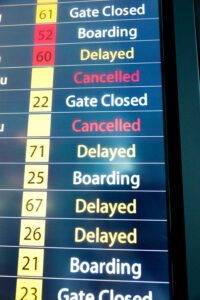 Weather conditions heavily influence the travel and tourism industry. Airlines, hotels, and travel agencies use weather intelligence to adjust schedules, reroute flights, and strengthen safety protocols. Delays due to storms or extreme heat can lead to costly disruptions. But companies anticipating these conditions can manage bookings more effectively and improve customer satisfaction.
Businesses in this sector also rely on weather intelligence to prepare for seasonal weather disruptions. By analyzing long-term climate trends, travel companies can adjust pricing, optimize staffing levels, and create promotional offers tailored to weather patterns in key travel destinations.
The Weather Company APIs: your strategic advantage
The business case for weather intelligence is clear, but how do you turn insight into action? The answer lies in leveraging the right tools. The Weather Company’s weather data APIs provide the powerful, comprehensive, and accurate weather data needed to operationalize weather intelligence across your business.
Our APIs are designed for seamless weather API integration, allowing you to embed real-time, historical, and forecast data directly into your existing supply chain management, logistics, and enterprise resource planning systems. This allows for:
- Proactive planning: Use our suite of forecast APIs to anticipate disruptions weeks or even months in advance. Our AI-driven models, including the Global High-Resolution Atmospheric Forecasting (GRAF) model, deliver unparalleled accuracy and resolution, helping you optimize inventory and logistics before a weather event.
- Real-time decision-making: With our Current Conditions, Severe Weather APIs, and Alerts APIs, you can get instant updates on severe weather and other impactful conditions. Real-time insights can help you adjust shipping routes, reroute fleets around hazardous conditions, and protect both assets and workforce safety.
- Data-driven optimization: Access decades of historical weather data through our APIs to analyze past trends, refine risk models, and inform long-term strategic decisions. A rich dataset like this helps you better understand the connection between weather and operational performance.
By integrating The Weather Company APIs, you can move beyond reactive measures and build a truly resilient, data-driven supply chain.
The business case for weather intelligence
Companies that fail to integrate weather intelligence into their strategies often operate reactively, responding to disruptions as they happen rather than preparing for them in advance. Such an approach leads to financial losses, inefficiencies, and missed opportunities.
By contrast, companies that embrace AI-driven weather insights can:
- Reduce operating costs by optimizing supply chain routes, avoiding delays, and minimizing waste.
- Enhance marketing effectiveness by aligning campaigns with weather-driven consumer behavior.
- Improve safety and compliance by making sure employees, assets, and operations are protected against weather risks.
The next step: Turning weather data into a business strategy
Executives who integrate weather insights into their business models are better positioned to drive growth, manage risk, and improve customer experiences. The latest research from The Weather Company breaks down how businesses across industries are using weather intelligence to gain a competitive advantage.
Download the full report today to explore real-world applications, industry-specific insights, and actionable strategies for integrating weather intelligence into your business.
Let's talk
Contact our experts today to discover how Weather Data APIs can empower your decision-making and strengthen your business resilience. Let us help you transform weather data into a strategic asset.
Contact usRelated resources

1 Resilinc, Global Supply Chains See Nearly 40% Increase in Disruptions, January 21, 2025
Key takeaways
- Weather intelligence can offer a strategic edge for QSRs facing rising tariffs and supply chain pressures.
- Weather data paired with sales and supply chain data can help identify seasonal consumer behavior shifts to better inform and guide menu planning.
- Targeted weather-based promotions can help drive efficient customer engagement during economically sensitive periods.
- The combination of weather and supply chain insights supports agility and operational efficiency in tariff-impacted markets.
The quick service restaurant (QSR) market operates in a pressure cooker, constantly balancing customer demand, operational efficiency, and fluctuating costs. Now, throw in the uncertain impact of tariffs, which can impact ingredient prices, supply chain stability, and even consumer spending habits. In this volatile environment, QSRs need every advantage they can get.
%
of US adults are likely to cut back on fast-food if tariffs lead to higher prices1
Think about the ripple effects of tariffs and food prices. Increased costs for imported ingredients might require menu adjustments or price increases. This, in turn, could influence customer choices. Simultaneously, weather continues its relentless cycle, impacting everything from foot traffic, to ingredient availability, to delivery demand. Smart QSR operators are realizing that understanding the interplay between these economic pressures and weather patterns is the key to staying ahead.
The strategic advantage: Weather intelligence in a tariff-sensitive market
While you can’t control global trade policies, you can control how you leverage data to navigate the resulting challenges. And one of the most powerful, often overlooked, data sources is weather intelligence. Imagine this: Tariffs drive up the price of a key ingredient for your popular summer menu item. You need to pivot. Weather intelligence can help provide crucial insights:
- Demand forecasting for alternatives: If the cost of imported beef for burgers increases, you might consider promoting chicken or vegetarian options. Weather patterns can help predict which of these alternatives will be most popular in different regions and at different times. For example, a heatwave might drive demand for lighter, non-beef options. In fact, 42% of people say they buy lighter and healthier foods when summer arrives.2
- Optimizing promotions: To offset potential price sensitivity due to tariffs, targeted weather promotions become even more critical. Weather-driven offers can drive traffic during specific times. A “rainy day comfort food” promotion might entice customers even if overall spending is tighter due to economic concerns. This is especially relevant considering that 61% of people choose more convenient food options, like delivery or quick meals, during hot or humid weather.3
 Supply chain agility: Weather and supply chain factors can exacerbate disruptions, especially for temperature-sensitive goods. Granular weather forecasts can help anticipate potential delays and inform inventory management, ensuring you have the necessary ingredients on hand without overstocking (especially important when ingredient costs are fluctuating due to tariffs). For instance, knowing a major storm is approaching a key distribution hub allows for proactive adjustments to delivery schedules.
 Supply chain agility: Weather and supply chain factors can exacerbate disruptions, especially for temperature-sensitive goods. Granular weather forecasts can help anticipate potential delays and inform inventory management, ensuring you have the necessary ingredients on hand without overstocking (especially important when ingredient costs are fluctuating due to tariffs). For instance, knowing a major storm is approaching a key distribution hub allows for proactive adjustments to delivery schedules.
- Menu diversification based on local conditions: Tariff impacts might vary regionally. Weather intelligence can help identify regional preferences for different menu items. If a certain region is experiencing an unusually cold spring, promoting warmer, heartier options might be a smart strategy, regardless of broader economic trends. Remember, 33% of people say spring weather impacts when they order food for delivery.4
The Weather Company: Your navigator through economic and meteorological uncertainty
The Weather Company, the world’s most accurate forecaster5 provides QSRs with the sophisticated tools needed to not only understand weather’s impact but also to strategically respond to the challenges posed by a fluctuating economic landscape:
- Hyperlocal, predictive weather data: Get down-to-the-minute forecasts for each of your locations, enabling more informed adjustments to staffing and inventory in response to immediate weather conditions, which can amplify or dampen the effects of tariff-related price changes.
- Historical weather analytics paired with sales data: Analyze how past weather events and periods of economic change (like previous tariff implementations) impacted specific menu item sales. This dual-layered analysis provides deeper insights for future planning – perfect for streamlining QSR operations.
- Targeted marketing powered by weather: In a tariff-conscious market, highlighting value is key. Use weather conditions to promote family meal deals on stormy evenings or discounts on less expensive menu items during periods of economic uncertainty – boosting customer engagement in restaurants.
- Operational optimization for cost efficiency: Efficient delivery routes based on real-time weather can help save on fuel costs, a crucial factor when other operational expenses might be rising due to tariffs. Accurate staffing based on weather-driven demand prevents overspending on labor during slow periods.
%
of executives say weather has a moderate or high impact on their business6
Thriving in the face of change: QSR resilience powered by weather intelligence
The QSR industry has always been about adapting to customer needs and market conditions. In an era marked by both a changing climate and economic headwinds like tariffs, the ability to leverage data for informed decision-making is key. Weather intelligence from The Weather Company isn’t just about predicting rain; it’s about providing a strategic lens through which QSRs can better understand customer behavior, optimize operations, and ultimately, build resilience in the face of any challenge.
Ready to equip your QSR business with the intelligence to help navigate both meteorological and economic storms? Discover how The Weather Company can be your strategic advantage.
Let's talk
Contact our experts today to discover how weather data can empower your decision-making and strengthen your business resilience. Let us help you transform weather data into a strategic asset for your business.
Contact usRelated resources



1 CivicScience, February 2025
2 3 The Weather Company, Summer 2023 Behavior Survey, March 2023
4 The Weather Company, Spring 2022 Behavior Survey, December 2021
5 ForecastWatch, Global and Regional Weather Forecast Accuracy Overview, 2021-2024, commissioned by The Weather Company
6 The Weather Company (in collaboration with Magid), Weather Means Business Report, October 2024
Key takeaways
- More than 360 million people rely on The Weather Channel’s digital properties1 for decisions ranging from daily activities to major life choices, such as where to live and what vehicle to drive.
- Weather insights and data science offer businesses a competitive edge by enabling them to anticipate and influence consumer behavior and optimize operations.
- According to recent research, 100% of executives say weather intelligence can give their business a competitive edge.2
- Proactive weather strategies help businesses reduce environmental risks, capitalize on emerging revenue opportunities, and improve operational efficiency.
In an age where weather isn’t just small talk but instead, the headline, the impact of changing weather patterns on people and businesses is more significant than ever. From everyday weather conditions to extreme temperatures, the environment is now a critical factor driving strategic decision-making in everything from supply chain management to consumer engagement. As global temperatures continue to rise, businesses need to see the opportunity weather presents. At The Weather Company, we help businesses use weather intelligence to drive business resilience, growth, and competitive advantage.
Adapting at the speed of weather
We’ve all seen it. The world is witnessing unprecedented changes in weather patterns. This intensifying weather volatility is fueling more frequent extreme weather events and economic upheavals.
As a result, keeping tabs on the weather has made The Weather Channel digital properties a habitual touchpoint for over 360 million monthly average users1 worldwide. This widespread reliance shows the powerful influence of weather on consumer behavior. In 2023 alone, Adobe projected that weather would influence over $13.5 billion (about $42 per person) in U.S. e-commerce sales3 — the equivalent of an extra Cyber Monday.
The message is clear — businesses need to evolve from reactive to proactive, weaving weather data deeply into their strategic fabric.
Climate Week Spotlight
Thriving in the face of a changing climate
Sheri Bachstein, The Weather Company President, and Peter Neilley, The Weather Company SVP of Science & Forecasting Operations, share insights on how people and businesses can improve weather resilience in this Climate Week NYC 2025 interview.
The power of a weather strategy
So, what exactly is a weather strategy? A weather strategy is a savvy, data-driven approach that harnesses the power of cutting-edge weather data science and AI to optimize business processes, personalize marketing efforts, and gain an enterprise advantage. It’s about transforming weather from a risk factor into a strategic ally.
According to a recent research study of nearly 300 executives across the retail, CPG, pharmaceutical, insurance, and travel & tourism industries:
%
said that weather intelligence could give their company a competitive advantage2
%
believe that leveraging weather insights as a service provides greater value than relying solely on raw data2
%
say incorporating advanced weather analytics could enhance their ability to anticipate and respond to market fluctuations2
%
recognize enhanced weather insights as a powerful tool for driving revenue growth and reducing costs2
%
of pharma executives say using weather insights effectively can help them be better at their job2
%
of CPG executives will increase or continue their use of weather intelligence in the coming years2
Download our free and exclusive Weather Means Business report to learn how smart businesses are transforming their enterprise strategies with innovative weather intelligence.
Get your copyFuture-proof your business with The Weather Company
As businesses look to the future, integrating weather intelligence into long-term planning is a must. At The Weather Company, we offer unparalleled forecasting capabilities and weather intelligence that enable businesses to thrive in the face of changing weather patterns. With over 40 years of expertise in weather data science, we’ve become the world’s most accurate forecaster,4 a distinction that sets us apart from other providers. Our commitment to innovation and accuracy has earned us the trust of consumers and businesses around the globe.5
Beyond accurate forecasts, we provide scalable, proven solutions for consumers and businesses alike. Businesses tapping into these weather insights will be better positioned to anticipate consumer needs and tailor their offerings.
- Our weather intelligence platform and AI provide the precision and scalability your business process optimization needs to stay ahead.
- Weather Targeting enables advertisers to deliver personalized, relevant messaging that resonates with their audience in real time across the digital ecosystem.
- Premium consumer experiences across The Weather Channel digital properties help marketers engage with consumers at scale in meaningful moments to help them live healthier, safer, smarter, and happier.
A robust weather strategy isn’t just a nice-to-have; it’s essential. Let’s work together to create a weather strategy that drives your business forward.
1 360M monthly active users based on the average of the total monthly (non-unique) users for Jan – June, 2023 across The Weather Company digital properties and consumer products (weather.com, The Weather Channel app, Weather Underground app, wunderground.com, Storm iOS app,) according to internal data
2 Weather Means Business report, October 2024, Magid for The Weather Company
3 Adobe Digital Economy Index 2023
4 ForecastWatch, Global and Regional Weather Forecast Accuracy Overview, 2021-2024, commissioned by The Weather Company
5 According to a Morning Consult Q1 2024 survey, The Weather Channel brand was the #13 most trusted brand in the U.S. The surveys were conducted from January 1, 2024 through March 31, 2024, among nationally representative samples of between 1,158 and 35,280 U.S. adults.
Accurate weather forecasting fosters trust and enables better decision-making. Here’s how it works.
Key takeaways
- Accurate weather forecasting combines real-time data, advanced models, and expert interpretation.
- High-resolution models, such as GRAF®, multi-model ensembles like WxMix, and new AI methodologies are transforming forecast precision on a global scale.
- The Weather Company is nearly 4x more likely to be the most accurate forecaster, according to ForecastWatch.1
- Forecast accuracy directly impacts decision-making across various industries, including aviation, media, advertising, utilities, government sectors, and the daily lives of people everywhere.
Weather forecasts have been around since the beginning of civilization, when humans used recurring meteorological and astronomical events to better monitor weather patterns and plan for seasonal changes. Initially based on (mostly inaccurate) observations of the sky, wind, and temperature, these forecasts have thankfully evolved into more advanced and reliable ones.
Incorporating technology into weather forecasting began in the 1700s with the development of the barometer and thermometer. These basic yet advanced tools not only paved the way for more accurate weather predictions but also inspired generations of weather enthusiasts interested in advancing the science.
Today, individuals and businesses alike rely on accurate weather forecasting to anticipate severe weather and drive daily decision making. But how truly reliable are weather forecasts?
To understand the reliability, it’s crucial to first define what constitutes an accurate forecast.
What is accurate weather forecasting?
An accurate weather forecast is a measure of how closely the forecast matches reality. To produce an accurate forecast, scientists combine complex data analysis, modeling, and human expertise. Forecasts can range from short-term to long-range predictions, each with varying degrees of accuracy.
Short-range weather forecasts
Short-range forecasts (1–14 days) are typically generated by physics-driven models that ingest global weather data and simulate outcomes using advanced techniques, with AI increasingly contributing to the precision of these forecasts within this timeframe. These are considered more reliable due to their frequent model updates and high-resolution input data.
Long-range weather forecasts
Long-range forecasts (15+ days) are largely based on historical data and pattern recognition to predict what’s ahead. Forecasts beyond 15 days are inherently less precise because of how rapidly the atmosphere can change. This means accuracy is likely to decrease the further out the forecast goes.
How reliable are weather forecasts?
The answer largely depends on the forecast range. Generally, short-term forecasts demonstrate high accuracy:
- A 7-day forecast can accurately predict the weather about 80% of the time.2
- A five-day forecast can accurately predict the weather approximately 90% of the time.3
Accuracy drops as the forecast range increases, but advanced models and AI can help improve even long-range predictions.
Why are reliable weather forecasts important?
Weather significantly impacts people’s daily lives, and accurate weather forecasting enables communities to better prepare for the effects of changing weather conditions. Weather forecasting determines the likelihood of a severe weather event or strong storm. By leveraging this information, utilities can strengthen the grid, and schools can decide if it’s safe for parents to drive their children.
Why are reliable weather forecasts important?
In the past four years, the United States saw a total of 93 individual billion-plus-dollar weather and climate disasters (20 in 2021, 18 in 2022, 28 in 2023, and 27 in 2024). Prior to 2020, the highest number for a single year was 16.4. In 2024 alone, there were more than 150 unprecedented climate disasters globally, and $182.7 billion in U.S. weather-related damages – the fourth-highest year on record.5 As extreme weather events become more common, people and businesses rely on weather forecast accuracy more than ever to try to mitigate losses, influence safety measures, increase productivity, and improve business-related decisions.
It’s this critical need that underscores why accurate weather forecasting helps instill confidence, drive informed decisions, and propel the world forward. That’s why we’re committed to continuous innovation of current and future solutions. From rerouting flights to adjusting supply chains, better forecasts reduce risk and support operational confidence.
How do meteorologists predict the weather?
Weather forecasting is the process of combining scientific insights, data, and technology to assess future atmospheric conditions. Meteorologists observe, study, and predict changes in precipitation, temperature, wind, and more.
In today’s data-rich environment, meteorologists combine real-time observations, advanced modeling techniques, and expert interpretation to produce accurate forecasts. But how do weather forecasters predict the weather, and how are weather predictions made?
How a weather forecast is made
Fundamentally, the process begins with gathering data and using that information to feed forecasting models. These simulations help anticipate everything from temperature changes to the path of major storms.
At The Weather Company, we combine human meteorological expertise with advanced AI to create forecasting capabilities that neither could achieve on its own. Our team of over 100 expert meteorologists works in real-time with our AI systems, providing critical oversight and adding invaluable human intelligence to the process – without slowing things down.
Essentially, how to predict the weather is a four-pronged approach:
1. Observe
What is the weather like now? We ingest data from a collection of instruments to observe conditions on the surface and in the upper atmosphere, including:
- Weather radar: Detects precipitation and storm intensity.
- Weather balloons: Measure upper-atmosphere conditions.
- Barometers and thermometers: Monitor pressure and temperature.
- Satellites: Observe cloud cover and storm systems globally.
- Weather stations: Collect ground-level conditions.
- IoT sensors: Deliver hyperlocal temperature, humidity, and pressure data.
2. Model
How will the weather evolve? Numeric Weather Prediction (NWP) models take current atmospheric conditions as a starting point to project a forecast. There are many well-known models, such as the European Centre for Medium-Range Weather Forecasts (ECMWF), the Global Forecast System (GFS), and The Weather Company’s proprietary, hyperlocal Global High-Resolution Atmospheric Forecasting System (GRAF).
Instead of relying on a single model, our AI-driven, multi-model ensemble, WxMix, synthesizes and optimizes over 100 models, ensuring that we always leverage the best available science.
3. Produce
We translate model outputs into actionable insights, such as daily highs/lows, severe weather alerts, and turbulence maps.
4. Deliver
Forecasts are delivered instantly through apps and websites, such as The Weather Channel, Weather Underground, and Storm Radar, which feature APIs that provide real-time and historical data, aviation dashboards, broadcast media systems and displays, as well as mission planning and simulation tools.
Our strength lies in modeling, productization, and delivery – applying advanced modeling techniques, AI integration, and human oversight to produce timely, accurate forecasts.
The role of AI in accurate weather forecasting
AI is rapidly transforming weather forecasting, significantly enhancing its accuracy and speed. This rapid processing enables more frequent forecast updates, which is crucial for quickly evolving weather events, such as severe thunderstorms. In particular, new Deep Learning-based AI models (DL-NWP) are showing promise in improving the accuracy, granularity, and cost-effectiveness of traditional models, while also demonstrating an enhanced ability to depict the range and likelihood of potential weather outcomes, enabling better decision-making.
Long before “AI” became a buzzword, The Weather Company was harnessing the power of sophisticated algorithms, statistical models, and data-driven computational methods to improve weather forecasting and deliver actionable insights to consumers and businesses globally.
Today, we’re working with partners like NVIDIA to actively develop new deep learning approaches and incorporate the latest AI models into our forecasting processes to continuously improve forecast precision.
Who has the most accurate weather forecast?
According to the latest ForecastWatch study, The Weather Company is nearly 4x more likely to be the most accurate weather forecaster than the next closest competitor.6
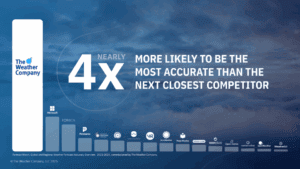
Building on our commitment to proven forecast accuracy, we continue to innovate and challenge ourselves to do even better.
- Consistent #1 finishes: The most 1st place finishes each year since ForecastWatch measurement began.7 8
- Regional accuracy dominance: The most accurate forecast provider is most often in 7 out of 8 regions.9
- Leading in longer-range forecasts: Nearly 6x more likely to be the most accurate when measuring a 14-day time horizon.10
Benefits of accurate weather forecasting
Weather affects nearly every sector — from supply chains and staffing to safety and customer engagement. It impacts an estimated $3 trillion of the U.S. economy annually and influences 30% of global GDP.11 Even a 1ºC temperature shift can cause a 1.2% swing in consumer spending.12
Simply, better accuracy means better decisions. Accurate weather forecasting can deliver measurable value across industries:
Aviation: For airlines, accurate forecasts are crucial for planning routes, minimizing delays, and enhancing safety. Weather is responsible for nearly 75% of flight delays,13 highlighting the importance of accurate, proactive forecasting for keeping flights on schedule and passengers safe. Turbulence prediction, wind shear detection, and runway condition forecasts enable flight crews to make informed decisions that protect passengers and optimize fuel consumption.
Advertising: Weather impacts consumer behavior, and accurate forecasts enable brands to align their messaging with what people are experiencing in the moment. The Weather Company’s advertising solutions use real-time weather and location insights to power smarter campaign delivery – reaching consumers when and where it matters most. These insights help brands anticipate shifts in mindset and purchase intent, such as promoting allergy relief ahead of high pollen days or iced coffee on a warmer-than-usual afternoon. With tools like Weather Targeting, advertisers can dynamically tailor messaging by region, season, or even zip code – improving performance while maintaining privacy-forward practices..
Media: Reliable forecasts built into broadcast media solutions keep viewers informed and engaged. Localized, timely forecasts build trust, improve viewer retention, and support higher ad revenue. Broadcasters can promote their accuracy, backed by The Weather Company, as a differentiator in competitive media markets.
Government & defense: From storm response to mission planning, government and defense agencies rely on accurate forecasts for operational readiness. Whether preparing for hurricanes or managing logistics during winter storms, accurate data helps leaders act decisively and allocate resources efficiently.
Given the ever-increasing reliance on precise weather insights, what’s next for forecasting?
What is the future of forecasting?
Forecasting is evolving to become faster, more personalized, and more precise. Key innovations include:
- Probabilistic forecasting: Instead of offering a single deterministic outcome, probabilistic forecasts show a range of possible scenarios and the likelihood of each one. This helps decision-makers understand risk and uncertainty more clearly – for example, while a deterministic forecast might indicate an expected snowfall amount of 5 inches in the next 24 hours, a probabilistic forecast reveals there’s also a chance of as little as 1 inch or as many as 10 inches of snowfall in that time, which might prompt a user to change plans or prepare alternatives accordingly.
- AI-powered modeling: Artificial intelligence and machine learning are increasingly playing a role in enhancing forecast accuracy. These systems can rapidly process massive volumes of historical and real-time data, identify subtle patterns, and provide a range of outcomes known as ensemble modeling, which supports probabilistic forecasting and gives a more complete picture of the weather’s nuances and variability. AI is particularly useful for refining forecasts in dynamic or hard-to-model environments.
- Street-level resolution: Forecasts are becoming hyperlocal, not just city-wide, but down to neighborhoods and even individual streets. This level of detail supports everything from route planning in logistics to micro-targeted alerts for consumers.
Precision, preparedness, and progress
Ultimately, accurate weather forecasting isn’t just about knowing if it will rain tomorrow; it’s about making smarter, more informed decisions that protect lives, livelihoods, and economies. The synergy of human meteorological insight and advanced AI is pushing the boundaries of what’s possible. Moving forward, our unwavering commitment to precision will continue to empower individuals and businesses to thrive in an ever-changing world.
Let's talk
To learn more about harnessing the power of weather to make better, more informed decisions across industries, contact our experts today.
Contact usRelated resources


1 2 3 6 7 9 10 ForecastWatch, Global and Regional Weather Forecast Accuracy Overview, 2021-2024, commissioned by The Weather Company
4 5 National Centers for Environmental Information, Billion Dollar Weather and Climate Disasters, 2024
8 ForecastWatch, Global and Regional Weather Forecast Accuracy Overview, 2017-2022, commissioned by The Weather Company
11 National Oceanic and Atmospheric Administration (NOAA)
12 Raja Rajamannar, Weather Wizards: How Marketers Can Harness the Elements for Unprecedented Success, September, 17, 2024
13 Federal Aviation Administration, FAQ: Weather Delay