
Weather intelligence for the future: Crafting a strategic enterprise approach to changing environmental conditions
Continue reading

Key takeaways
- Weather volatility puts $1 trillion in annual global retail revenue at risk. High-fidelity API integration transforms weather data into a primary hedge against these fluctuations.
- Beyond logistics and demand forecasting for retail planning, weather data helps optimize energy usage and costs, and more efficiently fastrack insurance claims due to weather.
- High-resolution APIs from The Weather Company move retailers from manual monitoring to automated, weather-aware systems.
- The Weather Company is consistently ranked the #1 most accurate forecaster globally by ForecastWatch.
For the world’s largest retailers, weather is no longer an “uncontrollable” factor — it’s a structured data asset that requires uncompromising precision. In a climate-volatile era, the difference between a record-breaking quarter and a supply chain disaster comes down to how a business integrates weather data for retail into its core logic.
For enterprise leaders, the mandate is clear: transition from manual checks to automated weather APIs for retail that feed directly into AI-driven decision engines.
%
of retail executives reported weather impacts on operating costs1
%
of CPG executives plan to increase or maintain their use of weather intelligence to improve supply chain efficiency and meet consumer demand2
How does weather data improve the accuracy of retail demand forecasting?
The financial stakes of atmospheric volatility are staggering. According to data from the National Retail Federation (NRF), weather impact on retail sales influences approximately $1 trillion in annual global retail revenue.3 When over 3% of total sales are tied directly to the weather,4 traditional historical models are no longer sufficient.
The use of The Weather Company weather APIs for retail allow retailers to move from descriptive data to prescriptive modeling. By treating weather as a primary financial variable, retailers can:
- Correlate history to sales: Use History-on-Demand (HoD) APIs to analyze retail weather trends (at a 4km resolution) to see how they impacted foot traffic and SKU performance in specific regions dating back to 2015.
- Predict demand peaks: Retail demand forecasting using weather data can predict how a 2-degree shift in a specific region can drive a double-digit spike in demand while cooling sales elsewhere.
- Trigger dynamic pricing: Use weather-based dynamic pricing retail strategies and lifestyle indices to delay markdowns on seasonal goods during a late-season chill, preserving millions in margin.
Mitigating impact through supply chain resilience
Logistics and weather-based inventory management are where weather volatility strikes the hardest. By integrating weather data into Enterprise Resource Planning (ERP) and Transportation Management Systems (TMS), companies can automate resilience at scale:
- Long-range merchandise ordering: Retailers use our 7-month seasonal probabilistic forecasts to inform production and ordering. By understanding the likelihood of temperature and precipitation anomalies half a year in advance, buyers can align seasonal stock with reality rather than guesswork.
- Autonomous rerouting: Logistics platforms can automatically divert freight from storm-impacted corridors to protect cold-chain integrity and prevent “dead-head” miles.
- Inventory pre-positioning: Use 15-day probabilistic models to shift stock to regional hubs before consumer demand peaks.
The “Hidden ROI”: Operational logic beyond the aisles
While logistics and demand are the pillars, weather intelligence provides a “multi-tool” for the broader C-suite:
Energy management & sustainability
For a retailer with thousands of locations, energy is a top “controllable” expense. By integrating weather APIs with Building Management Systems (BMS), retailers can pre-cool stores during off-peak hours based on upcoming heat spikes, reducing peak-load charges and meeting ESG goals.
Parametric insurance & risk mitigation
Modern retailers use Parametric Insurance, where high-fidelity weather APIs serve as the “ground truth” trigger for instant payouts following a weather event, providing immediate liquidity for repairs without the month-long wait for manual adjustments. For a $10B+ retailer, this isn’t just “insurance,” it’s capital management.
Why The Weather Company is the industry standard for retail weather data APIs
To be truly weather-ready, a retail data stack requires a foundation of precision. Free or public data often lacks the granularity and reliability required for enterprise weather data solutions. Retailers need a consistent, global dataset they can trust. We provide a consistent, global dataset of core weather parameters, all accessible through a single web API.
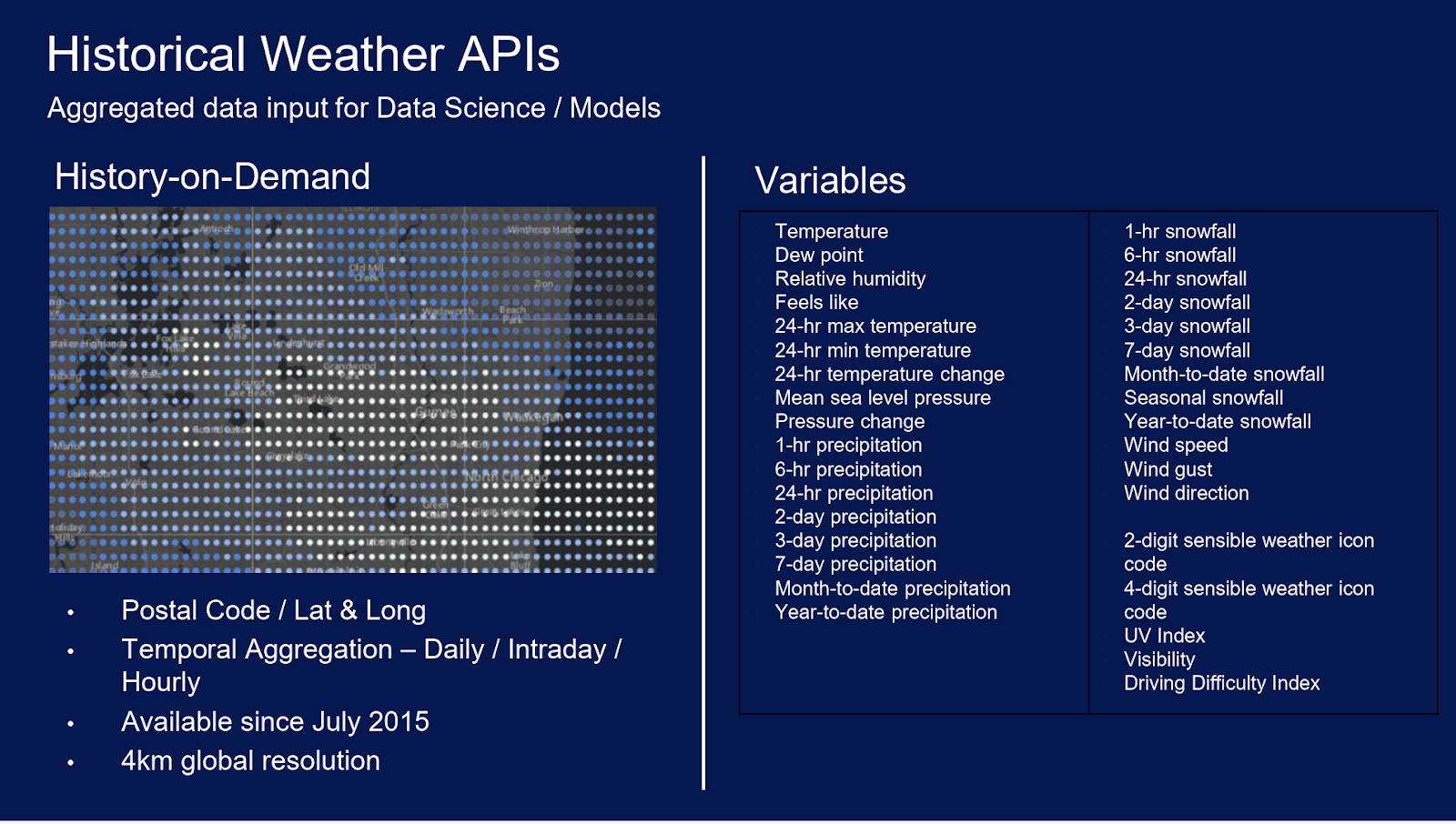
History-on-Demand (HoD)
Understanding weather’s historical impact is critical for training predictive analytics retail models. Our HoD capability provides:
- Global hourly data: 4km resolution covering the entire globe from July 2015 to the present.
- Ready-to-use datasets: One subscription provides access to all datasets, allowing retailers to pull the specific parameters most appropriate for their geography without rummaging through poorly organized public data.
Accuracy and AI modeling
- Ranked #1 in accuracy: For nearly a decade, ForecastWatch has named The Weather Company the most accurate forecaster globally—nearly 4x more often than the next-best competitor.5
- Proprietary GRAF™ modeling: Our Global High-Resolution Atmospheric Forecasting updates every hour at a 3km resolution, providing the low-latency weather data API inputs required for automated decisioning.
Ready to weatherproof your retail strategy?
Don’t let the forecast dictate your margins. Build a business that anticipates every atmospheric shift. Explore our weather API for retail solutions today or start a free trial to see how enterprise-grade weather data can transform your operations from reactive to resilient. Start making smarter, weather-informed decisions now.
Get started
Frequently asked questions
Weather intelligence for retail is the programmatic integration of high-fidelity, machine-readable weather APIs into business systems to automate demand forecasting, supply chain logistics, energy management, and workforce safety. It transforms raw atmospheric data into actionable business logic.
Retailers mitigate weather impact by integrating real-time weather data into Transportation Management Systems (TMS) and Enterprise Resource Planning (ERP) platforms. This enables automated freight rerouting to avoid storms, predictive inventory pre-positioning based on 15-day probabilistic models, and data-driven labor scheduling.
The primary benefits of weather APIs for retailers include reduction in stockouts, significantly lower energy costs through Building Management System (BMS) integration, optimized markdown strategies to preserve margins, and enhanced workforce safety via proactive weather alerts.
Weather data reduces retail operational costs by minimizing supply chain disruptions through automated rerouting, reducing perishable waste in the cold chain, and decreasing energy consumption. Furthermore, it helps avoid unnecessary markdowns by accurately predicting the duration of seasonal weather patterns.
Enterprise retailers choose The Weather Company APIs over free data because they offer 500-meter hyper-local granularity, sub-hourly update frequencies, and GDPR compliance. Free government data typically lacks the low latency and machine-readable JSON/RESTful architecture required for large-scale AI automation.
Weather intelligence is integrated into retail stacks via RESTful JSON APIs that connect seamlessly with cloud-native environments like SAP, Oracle, AWS, and Azure. This allows retail weather data to act as a real-time input for AI agents and predictive analytics engines across the enterprise.
Related resources




1 2 Magid, Weather Means Business: The role of weather intelligence to drive business resilience, growth, and a competitive advantage, October 2024. Commissioned by The Weather Company.
3 4 National Retail Federation, How retailers can stay ahead of weather-related challenges, August 2024
5 ForecastWatch, Global and Regional Weather Forecast Accuracy Overview, 2021-2024, commissioned by The Weather Company.
Key takeaways
- Weather data is becoming a foundational input for smarter planning and decision-making across industries.
- Cities, logistics providers, and energy companies are integrating weather intelligence to improve efficiency and resilience.
- AI and APIs are transforming raw weather data into actionable insights within business systems.
- The Weather Company enables organizations to move from reactive to predictive operations through real-time data solutions.
Try naming a business that isn’t impacted by weather. Go ahead – really pressure test it. Weather touches every corner of the global economy. Whether it’s a farm, a freight company, a fashion brand, or even a software firm with a fully remote team, weather finds a way in.
Yes, even in sectors that feel “weather-proof,” its influence shows up in unexpected ways. That remote software firm? A localized heat wave or severe storm can strain regional power grids, risking the uptime and productivity of a distributed workforce. Your data center? Temperature spikes can strain the cooling systems. Your employees? Sunlight levels can affect human cognition and productivity.
Accepting that weather impacts your business is the first step; building resilience against it is the second. This shift from reactive to proactive requires a sophisticated pipeline that translates atmospheric physics into operational logic.
How do organizations turn weather data into actionable insights?
At The Weather Company, every real-world application starts with a rigorous process that transforms raw environmental signals into strategic intelligence:
- Collection: More than 75 billion terabytes of weather data are ingested daily, sourced from satellites, radar mosaics, aircraft, government feeds, and a global network of ~390,000 personal weather stations, with dense urban and suburban coverage.
- Normalization: This raw data is cleaned, quality-controlled, and standardized to maintain consistency across inputs. It’s then structured into formats ready for modeling and distribution.
- Integration: APIs built for enterprise-scale operations – supporting billions of requests per day – deliver this data into systems such as ERP platforms, IoT networks, digital twins, and custom applications.
- Application: AI-powered technologies like WxMix synthesize over 100 global forecast models, including The Weather Company’s own GRAF® system. These models are continuously optimized for every location and weather variable, surfacing predictive insights that businesses can act on in real time. Independent evaluations rank our forecasts #1 in accuracy across both global and regional scales.1
Download our free and exclusive Weather Means Business report to learn how smart businesses are transforming their enterprise strategies.
Get your copyHow is weather data driving innovation across industries?
Across industries, businesses are integrating weather intelligence more deeply than ever to unlock value and build long-term resilience:
- Aviation: Weather is responsible for roughly 75% of all flight delays,2 and airlines depend on real‑time weather insights to optimize routing, reduce fuel use, and enhance safety. To combat this, more than 44,000 flights in the U.S. alone3 rely on weather forecasts every day to plan safer, more efficient routes, reduce fuel burn, and minimize disruptions.
- Energy & utilities: In summer 2025, U.S. electricity demand across the Lower 48 states set new peak records twice, reaching 759,180 megawatts as hot weather drove up cooling needs – nearly 2% higher than the prior year’s peak.4 High‑resolution weather intelligence helps utilities anticipate demand swings, balance renewables, and plan grid operations more effectively under weather‑driven stress.
- Agriculture: Across Europe, extreme weather causes over €28 billion ($31.9 billion) in annual losses for farmers, according to EU-backed analysis.5 Flooding, drought, heatwaves, and storms continue to disrupt crop yields, supply chains, and agricultural productivity. To mitigate these risks, producers are increasingly automating their resilience. Today, 35% of global weather API requests support real-time decisions on planting and crop health,6 allowing growers to integrate hyper-local soil and atmospheric data into their daily operations.
- Retail: With over $1 trillion in global sales influenced by weather,7 brands use seasonal and localized weather signals to optimize promotions, staffing, and inventory, down to the store level.
- Insurance & finance: Global insured losses from natural catastrophes were projected to reach $107 billion in 2025, with the U.S. accounting for a staggering 83% of that total.8 As wildfires and severe storms push losses higher, insurers are turning to high-resolution weather forecasts and risk modeling tools to better price policies, reduce exposure, and support more resilient coverage strategies.
- Construction: Weather regularly disrupts construction timelines – damaging materials, delaying crews, and forcing costly rework. In 2024 alone, the U.S. faced 27 separate billion-dollar weather disasters, totaling more than $182.7 billion in losses.9 By integrating forecast data into scheduling tools, project teams can plan around conditions like rain, wind, and heat to reduce downtime and stay on track.
- Sports & entertainment: Weather and climate extremes are increasingly disrupting major sports and outdoor entertainment events worldwide. In 2025, severe conditions such as wildfires, high winds, and heat forced cancellations and rescheduling of professional competitions (including PGA golf events and marathons), affecting revenue and the fan experience in an industry valued at $2 trillion.10 Organizers are integrating real‑time weather intelligence to make safer go/no‑go decisions, adjust schedules, and protect athletes, spectators, and operations.
The rise of the “Shadow CEO”
This cross-industry momentum reflects a fundamental shift: weather is no longer just a background disruption; it is the “Shadow CEO” of the global economy. It quietly influences shipping routes, energy costs, and staffing needs every single day.
%
of executives say weather significantly impacts their operations11
%
plan to increase or maintain their investment in weather intelligence12
This rising awareness is shifting weather from a background disruptor to a boardroom priority.
What’s next for data-driven problem solving in weather and climate intelligence?
As weather volatility intensifies, businesses are moving beyond basic forecasting and embracing climate intelligence – a more comprehensive approach that layers in air quality, environmental data, and AI-driven insights.
- Generative AI is unlocking new ways to simulate risk, test mitigation strategies, and optimize business continuity plans, before disruption occurs.
- Open data collaboration is expanding, with public and private sectors sharing environmental intelligence to advance climate resilience at scale.
- AI-ready datasets from The Weather Company are purpose-built for integration into digital twins, planning tools, and real-time operations systems. These integrations help organizations anticipate disruption rather than simply react to it.
And business leaders are taking note: in a recent study, 100% of surveyed executives agreed that weather intelligence gives their business a competitive edge.13 When data becomes both scalable and strategic, weather shifts from a source of risk to a driver of opportunity.
Built for developers: Scalable, high-impact weather data APIs
APIs are at the heart of it all, making it easy for developers and data teams to bring high-resolution weather insights straight into the tools they already use. Add AI into the mix, and suddenly you’re spotting patterns – like a storm that could delay shipments or a cold snap that’ll drive up energy demand – so businesses can stay one step ahead.
The Weather Company offers a robust portfolio of enterprise-grade weather APIs designed to deliver real-time, forecast, and historical weather intelligence at scale. Trusted across industries, our APIs support over 200 billion calls per day with enterprise-grade performance, low latency, and secure integration.
These RESTful APIs enable access to:
- Hyper-local forecasts (hourly, daily, and 15-minute “nowcasts”)
- Historical conditions and almanac data for trend analysis
- Severe weather alerts from trusted government sources
- Environmental and lifestyle indices like air quality, UV risk, pollen, and even use cases for driving difficulty, power disruption, and travel comfort
- Marine and aviation insights, geospatial mapping layers, and current site-based conditions for any latitude/longitude
These APIs are built for flexible implementation – whether you’re powering operational dashboards, IoT platforms, public safety alerts, or mobile apps.
A success story in weather intelligence
 Want to see how organizations are already using weather data to solve complex challenges? One example is CAA Club Group, which worked with The Weather Company to improve road safety and operational readiness using real-time weather insights.
For a broader look at how accurate forecasts are driving measurable impact across transportation, energy, and public safety, read our Weather Means Business report.
Ready to build a weather-resilient business?
Don’t just react to the elements — plan for them. Start your free trial to explore our enterprise-grade weather data and start making smarter, data-driven decisions.
Get started
Contact our experts today to discover how Weather Data APIs can empower your decision-making and strengthen your business resilience. Let us help you transform weather data into a strategic asset.
Contact usRelated resources




1 ForecastWatch, Global and Regional Weather Forecast Accuracy Overview, 2021-2024, commissioned by The Weather Company
2 Federal Aviation Administration, FAQ
3 Federal Aviation Administration, Air Traffic By The Numbers
4 U.S. Energy Information Administration, U.S. electricity peak demand set new records twice in July, 2025 (data from EIA’s Hourly Electric Grid Monitor)
5 Reuters, Extreme weather costs EU farmers €28 billion per year, EU says, May, 2025
6 The Weather Company’s own internal data
7 National Retail Federation, Climate-proofing retail: How weather and climate affect retail sales, 2024
8 Reuters, Global insured catastrophe losses set to hit $107 billion in 2025 report shows, December 2025
9 NOAA National Centers for Environmental Information, U.S. Billion-Dollar Weather and Climate Disasters, 2024
10 Reuters, How climate change is putting sport on a sticky wicket, December 2025
11 12 13 Weather Means Business report, Magid for The Weather Company, October 2024
Key takeaways
- The Weather Company’s forecast accuracy is backed by ForecastWatch data, showing it’s nearly 4x more likely to be the most accurate globally than any competitor.
- Reliable weather intelligence depends on continuous updates, hyperlocal granularity, and rigorous third-party validation.
- The GRAFTM model, WxMix ensemble, and Human-over-the-Loop (HOTL) process combine AI with expert insight to produce real-time, on-demand forecasts.
- Weather APIs deliver data with 15-minute resolution, helping businesses across sectors act faster and reduce disruption risks.
- Integrating weather intelligence with enterprise systems like IoT, finance, and logistics drives smarter cross-functional decision-making.
Weather is one of the most complex, high-volume data streams organizations can leverage – and one of the easiest to get wrong. For operations leaders in logistics, energy, and agriculture, the gap between an acceptable weather data model and a truly accurate one comes down to the precision, freshness, and validation of the underlying data.
What was once a general prediction must now become a location-specific, real-time decision input. To get there, businesses are turning to proprietary AI forecasting systems layered with human insight — systems capable of delivering resolutions as detailed as 3.5km while keeping pace with rapidly changing conditions.
Understanding how weather data is structured and applied reveals why precision, validation, and granularity now drive competitive advantage.
Why does weather data matter?
Weather’s impact is constant, but how businesses respond to it is changing. Companies are shifting from reactive strategies to proactive planning driven by high-resolution, real-time weather data.
The cost of inaction is steep: In 2023 alone, weather-related disruptions caused over $90 billion in damages across U.S. industries1 – a number that’s pushing more businesses to focus on resilience through proactive weather planning.
As climate variability increases, highlighted by 28 separate billion-dollar weather and climate disasters in the U.S. in 2023 alone,2 so does the need for predictive, adaptable tools. Weather intelligence is now a core component of decision-support tools across sectors like energy, agriculture, and logistics.
How is weather data structured and organized?
Understanding weather data starts with knowing its three main types:
- Real-time data – current observations from radar, satellites, and sensors
- Historical data – long-term climate patterns and trends
- Predictive data – forecast models that simulate future outcomes, including:
- GRAF® – A proprietary global model that delivers high-resolution forecasts as often as every five minutes, down to a kilometer level.
- WxMix – A continuously optimized blend of more than 100 weather models, customized per location, variable, and forecast window to maximize accuracy.
- HOTL (Human-over-the-Loop) – Oversight from 100+ expert meteorologists who refine AI-generated forecasts based on real-world conditions and operational context.
These tools allow enterprises to create forecasts that are on demand, location-specific, and AI-optimized in real time. That capability is made possible by advances in AI and weather technology.
How is weather data analyzed?
At The Weather Company, forecast accuracy is powered by more than automation. WxMix, our advanced multi-model ensemble, analyzes approximately 100 global weather models. Using AI, it synthesizes and optimizes inputs by location, parameter, and timeframe – maximizing accuracy where and when it matters most.
But it doesn’t stop there. Through Human-over-the-Loop (HOTL) intelligence, our team of over 100 expert meteorologists adds critical oversight so that forecasts are tweaked to reflect real-world complexities algorithms alone might miss. The result is a system that delivers real-time precision with the confidence of expert validation.
What defines reliable weather intelligence?
Not all data is created equal. The most reliable weather intelligence is:
- Accurate – validated against historical and current observations
- Granular – spatially and temporally precise
- Timely – updated continuously (not just 4x a day like legacy systems)
- Validated – tested by third-party accuracy audits

A ForecastWatch study found The Weather Company to be nearly 4x more likely to be the most accurate forecaster compared to the next-best weather forecast provider.3
Standard data vs. precision intelligence: A performance comparison
| Feature | Standard source | Precision source |
| Accuracy | Generalized estimates | Location-specific, validated |
| Granularity | Regional or hourly only | Hyperlocal, down to minutes |
| Timeliness | Updated 2-4x daily | On-demand, real-time updates |
| Validation | Minimal cross-checking | Multi-source & model verified |
| Uptime | Inconsistent delivery | 99.95%+ availability |
| Error handling | Manual lag fixes | Automated detection & failover |

Explore and evaluate a full range of APIs, free.
Start a free trial todayWhat turns weather information into intelligence?
Information tells you the weather is changing. Intelligence tells you what that change will cost and how much time you have to act.
At The Weather Company, that transformation happens through a refinement process that filters raw atmospheric data into signals that are specific, validated, and decision-ready. It starts with granularity – moving from broad forecasts to 3-kilometer, 15-minute updates that detect microclimates across a delivery network. Then comes validation, using a blend of over 100 models (WxMix) checked against real-world conditions from sensors, radar, and aircraft.
Contextualization adds historical insight – understanding how past weather patterns affect current risk, like black ice or power outages. Finally, human expertise enters the loop. Our meteorologists don’t just monitor model output; they translate it into actionable guidance, helping enterprises shift from reaction to optimization.
Together, this approach turns noise into signals and weather into a strategic input for smarter decisions.
Weather intelligence is most effective when it connects siloed enterprise systems. By combining high-resolution forecasts with IoT data, live inventory, and ERP platforms, organizations can build a digital twin of their operations. With that visibility, teams can model how future weather may affect supply chains, test response strategies in advance, and shift from reacting to planning.
How is weather data delivered?
Enterprise-grade weather data needs to be accessible, fast, and flexible. That’s why The Weather Company delivers insights via robust, scalable Weather Data APIs built to support real-time decisions across logistics, energy, insurance, and more.
Our APIs give you access to real-time, historical, and predictive weather data with industry-leading accuracy and sub-hourly updates, optimized for integration into your existing platforms. Start a free trial to experience the difference for yourself.
Why near-accurate isn’t accurate enough
If your current provider can’t clearly explain how their forecasts are built, validated, and applied, you may be optimizing against the wrong reality.
As weather becomes more volatile and business cycles more complex, operational success will hinge on forecast intelligence, not just awareness. The next competitive advantage won’t come from knowing the weather, but from engineering around it.
Get started
Contact our experts today to discover how Weather Data APIs can empower your decision-making and strengthen your business resilience. Let us help you transform weather data into a strategic asset.
Contact usRelated resources
1 2 NOAA National Centers for Environmental Information (NCEI) U.S. Billion-Dollar Weather and Climate Disasters (2025).
* 3 ForecastWatch, Global and Regional Weather Forecast Accuracy Overview, 2021-2024.
Key takeaways
- Personalized video advertising using weather insights helps create more relevant viewer experiences.
- Weather data provides a privacy-compliant signal that enhances CTV targeting capabilities.
- Ad targeting based on weather allows for dynamic creative tailored to viewer mindsets.
- Brands can benefit from improved ROI by integrating real-time weather targeting into CTV strategies.
The growing connected TV (CTV) landscape holds incredible promise for the long-awaited full-funnel, data-rich marketing opportunity. It’s why digital video is expected to generate 60% of the total TV/video ad spend in 2025, double its share from just five years ago.1 Additionally, a report by the IAB shows 36% and 32% of U.S. advertisers plan to reallocate spend from social and search, respectively, into CTV this year.2
By revolutionizing the advertising market with new ad tiers and advanced targeting capabilities, CTV has captured the attention and dollars of brands around the world. But with the influx of spend comes increased competition for consumer attention. What’s the secret weapon that smart marketers are deploying to cut through the clutter? It’s not a new technology platform. It’s something far more fundamental and universally understood: the weather. Get ready to discover how this ubiquitous force is revolutionizing CTV advertising.
CTV continues to grow, but targeting gets tougher
CTV adoption has surged. More households are streaming than ever before, and ad spend is following close behind. In fact, U.S. CTV ad spend is expected to reach $33.35 billion in 2025, making up 9.6% of total digital ad spend.3
However, targeting those viewers effectively has become more complex. Privacy rules are tightening, and platforms are protecting user data. Traditional tools like behavioral targeting and device IDs no longer deliver the precision advertisers want. As competition grows, brands need to stand out without intruding.
Viewers now expect ads to feel helpful, not disruptive. They want content that fits the moment, especially when streaming their favorite shows. That’s where CTV targeting capabilities shine – when they connect context to content in ways that feel natural and timely.
Weather creates powerful, real-time relevance
In a cluttered media environment, brands compete for limited attention, forcing them to find smarter, more relevant ways to connect with audiences. Demographics can’t capture what a person is feeling in the moment. Weather can. It influences what people do, how they feel, and what they buy. A sunny afternoon might inspire a barbecue, while a cold snap could spark a soup craving or a new coat purchase.
Ad targeting based on weather offers a unique advantage: It respects privacy while still delivering relevance. Weather doesn’t rely on personal identifiers. It works for every ZIP Code, every product category, and every stage of the funnel.
Here’s why weather data is especially powerful for CTV viewer engagement campaigns:
- Dynamic and real-time: Adapts to shifting consumer behaviors and mindsets as conditions shift
- Privacy-compliant: Doesn’t rely on personal identifiers, aligning with evolving data regulations
- Universally applicable: Effective across product categories and geographies
- Predictive: Supports campaign planning based on forecasted weather trends
And with The Weather Company’s probabilistic forecasting accuracy, advertisers can plan campaigns around future conditions – not just react to past trends or behaviors.
How Weather Targeting integrates with CTV
Weather Targeting fits seamlessly into existing CTV ad tech. The Weather Company’s data connects with demand-side platforms (DSPs) and supply-side platforms (SSPs), making it easy to activate across major streaming environments. Campaigns can launch based on real-time, historical, or forecasted conditions. Ahead of snowfall, auto brands might emphasize winter-ready vehicle features, while travel brands promote sunny escapes to cold-weather audiences. Sportswear companies could spotlight gear for damp conditions, and retailers might pivot to home entertainment promotions during heatwaves.
Real-time weather data supports hyperlocal targeting and dynamic creative optimization. Marketers can tailor video assets to fit local conditions to make sure the message is always relevant to the consumer’s physical and emotional environment.
Industry examples show a strong impact
Across sectors, brands are seeing measurable results from weather-informed campaigns, with research showing that businesses leveraging weather intelligence can achieve revenue gains of 5-10% and reduce operating expenses significantly.4 By aligning ads with current or forecasted conditions, advertisers can deliver messages that feel timely and relevant – often before a consumer even begins searching.
Here’s how Weather Targeting is being applied across key industry verticals:
- Retail: Promotes seasonal merchandise when weather creates the optimal mindset to shop online, such as during dreary or humid conditions.
- QSR/Food & Beverage: Suggests weather-appropriate menu items, such as iced drinks during heatwaves or soup during rainy spells.
- Automotive: Highlights features like all-wheel drive or safety features when snow or icy conditions are forecasted.
- Entertainment/Travel: Capitalizes on indoor or outdoor activities, such as pushing movie streaming during storms or beach travel during sunny stretches.
- CPG/Pharma: Aligns with weather-driven health needs, including allergy medication during high pollen days or skin care during dry winter conditions.
Weather Targeting gives advertisers a strategic edge. It lets them speak to real needs, right when viewers are most receptive. That kind of timing boosts engagement and drives action.
Looking ahead: Even smarter weather data
Today’s forecasting tools deliver game-changing accuracy and hyperlocal precision, empowering marketers to plan with unwavering confidence. And the innovation doesn’t end there. As CTV integration breakthroughs emerge, the ability to directly link exposure to outcomes is becoming a reality. Prepare for weather data to become a cornerstone of your targeting strategy, offering access to predictive intelligence you’ve never had before, adding ease and flexibility to activation by being accessible through almost all DSPs. This isn’t just about knowing the forecast; it’s about predicting campaign success. The future of high-performing CTV campaigns demand a deep understanding of the dynamic relationship between weather, content, and commerce.
The Weather Company: Where unrivaled accuracy meets unmatched insight
As the world’s most accurate forecaster,5 we offer more than just weather data; we provide the key to unlocking unparalleled relevance in a cookieless landscape. By understanding the profound impact of weather on behavior, our targeting solutions equip brands with a distinct advantage in today’s crowded media ecosystem. Don’t just navigate the future of advertising; anticipate it, connect with it, and thrive within it – powered by the precision of The Weather Company.
Let's talk
What’s your weather strategy? To learn more about harnessing the power of weather to increase engagement and drive growth, contact our advertising experts today.
Related resoures


1 Interactive Advertising Bureau (IAB), Digital Video Is Set to Capture Nearly 60% of All TV/Video Ad Spend in 2025, CTV Rebounds to Double-Digit Growth in 2024, According to IAB, February 2024.
2 Interactive Advertising Bureau (IAB), 2025 Digital Video Ad Spend & Strategy Report: Part One, April 2025.
3 eMarketer, US Connected TV (CTV) Ad Spending Forecast, November 2024.
4 The Weather Company, Weather Means Business: The Role of Weather Intelligence to Drive Business Resilience, Growth, and a Competitive Advantage, 2024.
5 ForecastWatch, Global and Regional Weather Forecast Accuracy Overview, 2021-2024, commissioned by The Weather Company
As we inch closer to the summer season, every change in weather signals a shift in consumer behavior. When temperatures rise, humidity intensifies, or thunderstorms roll in; people adapt their activities, needs, and purchasing decisions.
The Weather Channel’s summer outlook forecasts warmer-than-average temperatures over much of the country. Let’s explore how brands can transform forecasts into powerful marketing moments throughout the summer.
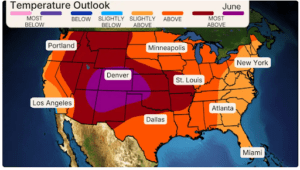
Temperature outlook: June 2025
It all starts with data from the world’s most accurate forecaster.1 But we don’t stop there. We go beyond the forecast to create actionable insights that people and businesses can use — building trust along the way. By turning weather data into weather intelligence, we create contextually relevant moments for brands to engage with your audience at precisely the right moment. It’s all about meeting your consumers exactly when the weather will be impacting their mood, mindset, and motivations.
Beyond forecasts: how summer weather impacts consumer decisions
Weather impacts every person and business on the planet. Smart marketers recognize these powerful behavioral patterns and use them to reach audiences when their products or services become most relevant. This summer, we are highlighting specific opportunities in skincare, outdoor activities, home improvement, culinary, and energy.
Success stories
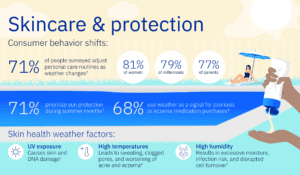
A leading dermatologist recommended skincare brand captured consumers’ attention on The Weather Channel app homescreen with dynamic messaging during the seasonal transition between spring and early summer. High-impact, native ads activated in ZIP codes during clear, warm, sunny, cloudy, and high UV conditions and led to higher incremental sales by new buyers (63%),8 sales lift (2.19%),9 and ROAS vs. benchmarks (2.3x).10
A global pharmaceutical brand activated social media messages in ZIP codes when the optimal mix of environmental conditions historically proven to increase symptoms, prescriptions, and insurance claims were forecasted. The results: more efficient cost per click for psoriasis (+70%)11 and psoriatic arthritis (+57%)12 brands.

Success story
Jeep® captured outdoor enthusiasts’ attention precisely when they were most receptive by aligning messaging with real-time weather conditions. The brand connected with consumers as they planned their adventures during cultural weather moments like Memorial Day. They drove impressive results, including 4.4% lift in familiarity,16 4% lift in brand consideration,17 and record-breaking site traffic.18
Success story
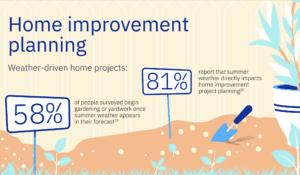
STIHL activated home improvement advertisement videos on social media with timely, relevant seasonal project tips tailored to sunny, inclement, and dry conditions. Matching relevant seasonal videos to local forecasts achieved dramatic engagement: 320% more time on site,21 and 113% higher video completion.22

Success stories
Tyson Ballpark captured consumer attention with dynamic creative on The Weather Channel app home screen in ZIP codes experiencing perfect grilling weather, driving full-funnel lift including a 22% lift in purchase likelihood.25
McCormick & Company, Incorporated engaged consumers on The Weather Channel app in 1:1 personalized dialogue. During ideal grilling weather, they received grilling tips, recipe inspiration, and local weather forecasts. This drove brand lift, including +15.7% in unaided awareness.26
Success story
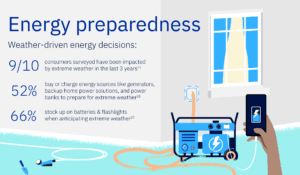
Ecoflow reached consumers with proactive preparedness messages on The Weather Channel app and across the digital ecosystem. By reaching people in ZIP codes predicted to have power outages from extreme summer weather — precisely when they’d likely be in need of backup energy solutions — the campaign generated 8.1x ROI.30
Heat up your sales: winning strategies for peak demand season
Ready to make weather work for your brand? Here are three powerful ways to put these summer insights into action with a weather strategy:
Hyper-relevant, high-impact creative
Premium ad formats on The Weather Channel digital properties connect your brand to a highly engaged audience of 330 million global monthly users while they are in their habitual planning routine.31 High-impact, contextual creatives drive real-time brand awareness and purchase consideration.
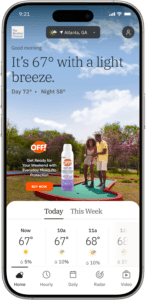
SC Johnson Integrated Marquee in The Weather Channel app
Premium consumer experiences
Personalized forecasts and tools on The Weather Channel Digital help people manage their health, maximize their time outside, and prepare for weather. These features directly influence consumer spending on health and wellness products by connecting brands during decision-making moments.
Scalable weather data
Weather Targeting, developed with advanced, AI-driven technology, helps brands align messaging with local weather patterns — at the ZIP code level — across the advertising ecosystem. A nuanced combination of weather factors activates ads in tune with consumers’ seasonal mindsets and behaviors for summer marketing campaign efficiency.

STIHL Weather Targeting social media example
Maximize your summer marketing campaign potential. Tap into The Weather Company’s advertising solutions for powerful insights and tools that elevate your brand and connect with consumers at the most impactful moments.
Let's talk
What’s your weather strategy? To learn more about harnessing the power of weather to increase engagement and drive growth, contact our advertising experts today.
Contact usRelated resources

1 ForecastWatch, Global and Regional Weather Forecast Accuracy Overview, 2017-2022, commissioned by The Weather Company
2 The Weather Company Personal Care & Beauty Survey (Aug 2022)
3 The Weather Company Summer Behavior Survey (Feb 2022)
4 Weather and Health Impact Study, Sago for The Weather Company, March 2024
5 6 Article: MI Blue Daily, How Hot Weather Affects the Skin
7 Article: Pour Moi Skincare, The Impact of Humidity on Your Skin
8-10 Sources: NCS Sales Effect Analysis; Campaign dates: 4/1 – 6/30/23
11 12 Source: Facebook, 9/13/24 – 10/13/24
13 TWC Consumer Behavior Survey (Nov 2023)
14 The Weather Company Summer Behavior Survey (Feb 2022)
15 The Weather Company Spring Behavior Survey (Dec 2021)
16-18 Source: DCM, Disqo, Q1 ‘25; Campaign dates: Q1 2024 – Q1 2025
19 20 Source: The Weather Company Summer 2022 Behavior Survey, Feb 2022
21 22 Source: META ads manager and Google Analytics 360
23 The Weather Company Summer Behavior Survey (Feb 2022)
24 The Weather Company Summer Behavior Survey (March 2023)
25 Lucid (The Weather Channel campaign only)
26 Dynata, April 2021 – September 2021
27-29 TWC Severe Weather Consumer Behavior Survey (March 2024)
30 Campaign Intelligence, Aug. – Oct. 2023
31 Based on the average of the total monthly (non-unique) users for Jan – Dec ’24 across The Weather Company digital properties and consumer products, according to internal, global data
June marks the official start of hurricane season. The Weather Channel meteorologists are forecasting a less active season than last year, but U.S. landfall risk remains above average. The impacts of changing weather are nearly impossible to ignore. Consumers are feeling these shifts firsthand, with extreme weather events becoming a year-round reality, not just seasonal occurrences.
This shift is fundamentally altering how people prepare for, respond to, and think about weather-related events in their daily lives. Not only do people report seeing more unusual weather activity for their location and season, the impact is widespread. In fact, a staggering 9 out of 10 respondents have been personally impacted by extreme weather in just the past two years.1
2024 hurricane season recap
The 2024 hurricane season confirmed it: Weather patterns are changing. This past season broke numerous records with 18 named tropical storms, 11 of which became hurricanes.2 Of these, five intensified to major hurricanes making landfall in the U.S., with two reaching Category 5 strength — a phenomenon that has occurred only five times since 1950.3 As for the records in 2024: Hurricane Beryl was the earliest Category 5 on record, arriving two months before peak season. Hurricane Helene stands out historically because it affected areas of the country that don’t usually see hurricane effects, like North Carolina, Georgia, and Tennessee.4
This tells us seasonal preparedness is an always-on need, with consumers seeking trusted guidance and solutions year round. So, how do we prepare for and recover from the seemingly inevitable impact of extreme weather events that now include not just hurricanes, but also wildfires, tornados, winter storms, and flooding?
We don’t have to go it alone and — the good news for marketers — consumers don’t want to. People turn to brands, products, and services they trust the most ahead of, during, and after weather events. In fact, 94% of people expect brands to step up to help communities affected by weather events.5 This gives marketers across CPG, energy, health, insurance, and retail, an invitation to show up with empathy, authenticity, and support when it matters most.
The new normal: Extreme weather beyond hurricanes
The evidence surrounds us: Winter wildfires spread through Southern California, the Carolinas,6 and even Long Island due to unusually dry conditions and strong winds7 — cementing that fire season now extends year round. Meanwhile, 2024 saw the second-highest tornado count on record, including San Francisco receiving its first-ever tornado warning.8 And maybe most surprisingly, all 50 states experienced snowfall this winter.9 Florida recorded its heaviest snowstorm ever, with Milton delivering over nine inches — doubling the state’s previous record from 1954.10
These weather events aren’t just meteorological anomalies — they’re a new normal reshaping consumer anxiety, behavior, and expectations. Our recent survey on The Weather Channel app asked consumers how they feel about changing weather, revealing:
%
of consumers report an increase in weather events11
%
have experienced unusual weather phenomena for their location or season12
%
believe weather is becoming more volatile and extreme — a 7% increase from just three years ago13
Interestingly, Gen Z (67%) and Millennials (66%) are even more convinced of weather’s increasing volatility.14 For marketers, this signals an important shift: consumers increasingly expect brands to acknowledge and address these climate realities.
The far-reaching effects of weather
The impact of extreme weather is sweeping, significantly touching many aspects of people’s lives. Outside of the physical impact to property, electricity and air quality weather also impacts mental health and decision making:
- 40% of those surveyed reported heightened anxiety due to weather events. This increased stress affects all generations, especially younger ones15
- 84% of people admit weather plays a role in their decision-making process16
- 1 in 4 have considered, or would consider, moving because of extreme weather conditions17
Preparing for changing weather
Checking the weather has become second nature: 99% check the weather more often when extreme weather events are forecasted, up 18% over the last four years.18 For most, it’s to secure safety for themselves, friends and family, while others are interested in the science of weather phenomena, or want to understand how they might help.
When it comes to critical safety and preparedness information, people rely on weather websites and apps above all other media sources, including government alerts:
%
rely on weather websites or apps the most, vs other media sources (#1 response)19
%
of respondents indicated they rely on The Weather Channel for trusted weather information (#1 response)20
This trust becomes especially evident during weather events, when people most need reliable information. For example, there’s a:
- 32% increase in The Weather Channel digital visits21 and 64% increase in app downloads during winter storms22
- 23% increase in The Weather Channel digital visits23 and 78% increase in app downloads during hurricane events24
Stocking up and charging up
We’ve all been there: faced with rapidly emptying shelves of supplies and essentials as storms approach. Meanwhile, early planners prepare ahead of the season with fully-stocked emergency kits of non-perishables, flashlights, batteries, and first aid. People prepare for extreme weather in both proactive and reactive ways. The most common preparation behaviors include stocking up on supplies like groceries, medication, and air purifiers; securing back-up energy sources; and protecting homes, yards, and vehicles.
Brands can authentically help customers weather the storm
It’s a sensitive topic, for sure. Brands may feel uncertain about how to engage when people are in some of their most stressful, vulnerable moments. When actually, people expect the support and assistance — whether it’s providing preparedness tips or essential supplies like medication, power, and groceries.
A strategic weather moment marketing approach aligns brands across the full weather journey:
- Weather preparedness: Connect before incoming weather during high-intent planning moments when preparation activities are happening
- Active weather: Reach engaged audiences seeking critical information
- Weather response: Support local communities, building meaningful connections during recovery
- Weather ready: Create year-round relevance through seasonal preparedness messaging
Brands can show up meaningfully at every stage of the weather experience. Two brands leading the way with this approach:
TruFuel’s full-funnel lift and engagement
TruFuel, a maker of pre-packaged, precision-engineered outdoor equipment fuel, harnessed the power of a weather-driven strategy.
By tapping into their authentic desire to help consumers be prepared for extreme weather conditions, TruFuel dynamically aligned messaging with real-time, local weather. This targeted campaign was activated across The Weather Channel properties and digital ecosystem through Adform. The contextual messaging highlighted the importance of keeping generators, chainsaws, snowblowers, and other equipment ready when weather strikes.
The moment marketing approach delivered impressive results for the brand, including:
%
lift in aided awareness25
%
lift in favorability and purchase intent26
%
lift in familiarity27
EcoFlow’s weather-driven preparedness strategy
EcoFlow, a leading provider of eco-friendly power solutions, understood a fundamental human need: safety and preparedness in the face of nature.
Their weather-driven strategy connected with people across The Weather Channel app and the digital ecosystem through The Trade Desk, and Meta with supportive messaging before weather strikes. This approach drove exceptional results, including a 2x higher conversion rate during the week following Hurricane Idalia’s landfall in 2023.28
%
lift in brand awareness29
x
ROI on average across the campaign30
x
ROI via Forecast Power Disruption Weather Targeting31
Secure your weather strategy
Brands can play a crucial role – and can build trust and loyalty by providing resources and support to people in need. As the world’s most accurate forecaster,32 we can help you harness Mother Nature to deliver empathetic messages when people need it most:
- Leverage Weather Targeting to integrate your preparedness message across the digital ecosystem. It automates media using weather as an activation signal so that brands can reach people during critical moments.
- Align your brand with seasonal preparedness content on The Weather Channel digital properties that provides people with information that help them stay safe and make informed decisions.
Weather is a reality we can’t ignore. But with it comes the chance for brands to help consumers navigate, with preparedness before, support during, and resilience after the storm. Will your brand be there when consumers need you most?
Let's talk
What’s your weather strategy? To learn more about harnessing the power of weather to increase engagement and drive growth, contact our advertising experts today.
Contact usRelated resources
1 5 11-18 21 Severe Weather Consumer Behavior Survey, March 2024
2 3 The Weather Channel: Atlantic Hurricane Season 2024: Florida Walloped, North Carolina Sees Catastrophe
4 AP News: It’s not really the typical time for nasty California fires. What changed that?
6 7 The Weather Channel: Strong Winds Could Hinder Carolina Wildfire Battles, But Incoming Rains May Help
8 The Weather Channel: San Francisco Gets Its First Tornado Warning As A Twister Hits Another California Town
9 The Weather Channel: All 50 States Have Seen Snow This Winter And Some Southern Cities Have Topped Northern Ones
10 The Weather Channel: Winter Storm Enzo Brought Historic Snow, Ice, To South, Including New Orleans, Florida
19 20 32 ForecastWatch, Global and Regional Weather Forecast Accuracy Overview, 2021-2024, commissioned by The Weather Company
21 23 Amplitude, The Weather Channel Digital Visits, 2024, 2025
22 24 Market share lift based on SensorTower download share of the top 25 downloaded weather apps in the US during active hurricane and winter events, Jan -Nov. 2024
25 26 27 Disquo; Campaign Date: 2023
28 Campaign Intelligence, Aug. – Oct. 2023
29 30 31 Lucid, Aug. – Oct. 2023
Key takeaways
- Advertisers tapping into retail media networks gain a competitive edge when Weather Targeting adds real-time, localized signals to personalize shopper engagement.
- Weather Targeting enhances first-party data by adding a privacy-compliant, predictive layer that captures consumer intent before it’s expressed.
- Campaigns incorporating weather data can see measurable improvements in engagement, conversion rates, and overall return on ad spend.
- The Weather Company provides AI-powered targeting solutions to help deliver reliable performance at scale.
Retail media networks (RMNs) have evolved. They’ve moved from simple ad placements to sophisticated, data-driven ecosystems. These ecosystems now connect brands directly with consumers at their most decisive moments. By 2028, retail media is expected to account for almost a quarter of all U.S. media spend.1 The race is on to find targeting signals that truly drive conversion. RMNs offer a gold mine of robust first-party data. Yet, the challenge they face today isn’t just capturing attention – it’s capturing relevance.
Forward-thinking retailers and brands are making a key discovery. Weather, perhaps the most universal influence on human behavior, provides this missing link. It connects historical purchase patterns with real-time environmental intelligence – a crucial connection for transforming passive browsers into active buyers.
The Weather Company’s AI-powered Weather Targeting solution goes beyond suggesting sunscreen on sunny days. It leverages over 40 years of weather data science to predict consumer needs based on hyperlocal conditions. These conditions can directly influence purchasing patterns across virtually every retail category.
RMNs are growing, but so are the challenges
RMNs have experienced explosive growth, evolving from a $13 billion channel in 2019 to a $50+ billion powerhouse today.2 This surge isn’t coincidental. Every major retailer – Walmart, Amazon, Target, CVS – is building sophisticated RMNs to offer brands the holy grail of advertising: closed-loop attribution connecting ad exposure directly to purchase.
But here’s the catch. The fundamental limitation of retail first-party data is its backward-looking nature. It excels at telling you what consumers purchased previously. Still, it struggles to predict why they might buy something new today. To break through these barriers, marketers need targeting signals that explain the ‘why now’ factor that drives purchases – an added data layer that is real-time, dynamic, scalable, and relevant.
Weather: the signal you didn’t know you needed
The relationship between weather and consumer behavior isn’t merely anecdotal – it’s quantifiable. Research shows that weather can explain up to 40.7% of the variance in daily retail sales, depending on the product category and location.3 This effect stems from fundamental behavioral economics: Weather creates both physical needs (e.g., hydration during heat) and psychological states (e.g., comfort-seeking during cold) that directly influence purchase motivation and urgency.
Weather represents a rare triple-threat in the targeting landscape:
- It’s predictive: Unlike most signals that react to expressed intent, weather anticipates needs before consumers search or browse
- It’s universal: Weather affects everyone, regardless of demographic or psychographic profile
- It’s actionable: Weather conditions create clear, time-bound opportunities for relevant messaging
Why Weather Targeting stands out
The Weather Company takes this a step further. Our Weather Targeting technology analyzes billions of data points across over 40 years of weather patterns, sales data, and consumer behavior to identify complex correlations between specific weather conditions and category-level purchasing across the retail spectrum. By using AI-driven forecasts and real-time data, we help advertisers predict what people will need – even before they start searching.
As the world’s most accurate forecaster,4 we provide targeting signals that retailers and brands can confidently use in their media strategies days in advance. A complement to first-party data, this approach creates unprecedented planning capabilities in an industry where agility drives competitive advantage. Our signal allows brands to trust in their ability to anticipate demand, not just respond to it. The connection between weather and retail sales is strong. Tapping into that connection means you’re no longer reacting. You’re anticipating.
Strategic applications across retail categories
Let’s look at how it works in execution:

- Home improvement: Rainy weekends spark indoor project interest. Brands push ads for painting supplies and DIY kits.
- Grocery: A heatwave is on the way. Smart RMNs activate ads for frozen treats and grilling essentials across apps and in-store screens.
- Apparel: A cold front is coming to the area. A retail brand promotes cozy layers on a store’s homepage and sends push notifications about outerwear deals.
- Health & beauty: High humidity and UV levels are forecasted. A neighborhood pharmacy app highlights sunscreen, moisturizers, and frizz-fighting hair products.
- Electronics: A snowstorm is expected. Ads for space heaters, home entertainment systems, or even productivity software go live.
When integrated with retailers’ first-party data, these weather signals create defined audience segments with demonstrated intent, which are ideal for driving relevance within the retail environment.
Easy to integrate, easy to scale
The Weather Company’s Weather Targeting solution plugs directly into leading RMN platforms. Advertisers can activate deals through Deal IDs or connect directly without complicated data-sharing agreements.
And measuring success? Straightforward. Brands can track lift in sales, click-through rates, and return on ad spend. Testing side-by-side with standard RMN tactics often shows stronger performance and deeper engagement.
Weather: The strategic edge in retail media’s future
In the race to win shopper attention at the point of sale, timing is everything. Weather Targeting adds that crucial layer of context that first-party data alone can’t provide. It helps brands anticipate needs, personalize messaging, and boost campaign results across categories.
The Weather Company brings unmatched accuracy,5 AI-powered forecasting, and seamless integration to help brands move beyond the basket – and into the moment that drives the purchase.
Let's talk
Schedule a strategy session with our team and learn how to integrate Weather Targeting into your retail media strategy today.
Contact usRelated resources
1 2 eMarketer, US Retail Media Ad Spending Forecast H1 2024, March 2024.
3 Journal of Retailing and Consumer Services, The impact of daily weather on retail sales: An empirical study in brick-and-mortar stores, 2019.
4 5 ForecastWatch, Global and Regional Weather Forecast Accuracy Overview, 2021-2024, commissioned by The Weather Company
Key takeaways
- A second back-to-school shopping season emerges as temperatures drop, influencing clothing and school supply purchases.
- Back-to-school marketing strategies are more effective when aligned with real-time weather data.
- Parents, educators, and students frequently check the weather for school-related purposes, creating prime ad opportunities.
- Weather-related advertising increases engagement, with parents being an exceptionally responsive audience.
Editor’s note: All data sourced by The Weather Company Back to School Consumer Behavior Survey, September 2024, except where noted.
Why smart back-to-school marketing strategies don’t end in August
A second back-to-school season? It’s real. While many campaigns focus on the early back-to-school rush in the summer, changing temperatures as fall weather arrives create a second wave of shopping demand. Weather-related advertising solutions from The Weather Company can help brands anticipate and prepare for it. So, get out your pencils and take notes as we share how to optimize campaign message timing, boost engagement, and drive better back-to-school marketing results this year.
How fall weather influences parents, students, and educators back to stores
When it comes to back-to-school shopping trends, most marketers focus on discounts, must-have items, and hitting the August shopping peak. Here’s where it gets interesting: The traditional back-to-school shopping season isn’t the whole story. Parents and students often make additional purchases as cooler fall weather arrives in September and October.
%
of parents purchase a second round of school supplies and clothing when weather starts feeling like fall.
Picture this: A mom checks her weather app first thing in the morning and sees an upcoming cold snap. Those jeans and sweaters from last year are likely outgrown. Probably need a new winter coat, too. Not to mention a bigger pair of snow boots. Suddenly, her back-to-school shopping list springs back to life.
This isn’t hypothetical. It’s relatable. For retailers, this back-to-school season revival is an opportunity that may be overlooked. Back-to-school advertising campaigns that account for seasonal weather changes can capture late-season demand and keep brands top-of-mind as parents and students adjust their wardrobes, meal plans, and daily routines.
%
of back-to-school shoppers consult weather forecasts specifically when buying school clothing and supplies.
Weather: Shaping what to buy and where to buy it
“Will I shop online or in-store today?” For 87% of back-to-school shoppers, the weather directly influences their decision. Hot, rainy, or otherwise unpleasant conditions drive shoppers online, while pleasant weather sends them to physical stores.
%
prefer in-store shopping during good weather.
%
shop online to avoid hot or unpleasant conditions.
This provides savvy marketers with a perfect opportunity to adjust their messaging in real-time. When storm clouds gather, your ads can highlight the convenience of online shopping. When sunshine returns, your messaging can highlight in-store exclusives and experiences.
Eyes on the weather: an essential part of the school day routine
Parents and educators aren’t casual weather watchers – they’re weather-obsessed from morning until evening throughout the school year. In fact, 87% of parents check the weather at least once a day.
Getting out the door: Morning (5-9 a.m.)
A staggering 73% check the weather first thing every morning. These early checks help inform decisions about transportation, clothing, and food for the day.
The after-school planning sweet spot: Mid-day (noon-3 p.m.)
Is ultimate frisbee practice still on? About 40% check in during this timeframe to see if the weather might impact after-school activities.
Tomorrow’s planning happens tonight: Evening (5-11 p.m.)
As homework wraps up and night falls, about 23% of parents are buying clothing and school supplies (5-8 p.m.) while many are deciding what food to pack or purchase for the next day: 24% from 5-8 p.m. and 20% from 8-11 p.m. In fact, around 54% say checking the weather is one of the last things they do before going to bed.
Weather-driven advertising drives results
The link between weather and consumer decisions is clear. By leveraging real-time and forecasted weather data, brands can optimize the impact of their back-to-school marketing campaigns and connect with consumers in a meaningful and memorable way.
%
of parents are more likely to notice or remember brands or products using weather-related advertising.
When brands incorporate weather signals into their back-to-school advertising strategies, they create a more relevant and engaging experience – leading to stronger performance and higher ROI.
Success story
A leading retailer captured parents’ attention on The Weather Channel app home screen as they were actively planning for the new school year. The weather-timed approach dynamically aligned promotions during this back-to-school planning period. The results: a 69% higher CTR compared to the brand’s benchmark.1
Practical ways to implement weather-smart marketing
Ready to incorporate weather intelligence into your back-to-school campaigns? Here are some A+ strategies:
- Develop a weather-responsive creative that adapts to local conditions
- Target morning and evening weather check times when purchase planning peaks
- Extend campaigns beyond August to capture the temperature-driven “second wave” of shopping
- Adjust online vs. in-store promotion based on forecast conditions
- Allow for regional weather variations in your messaging to provide hyper-local relevance
Back-to-school + The Weather Company ad solutions = success
Weather shapes nearly every back-to-school purchase. Our ad solutions help you appear at exactly those critical decision moments.
Eye-catching creative: Put your back-to-school advertising directly in front of 330+ million monthly The Weather Channel users2 when they’re planning their day. Our dynamic Integrated Marquee premium ad creative automatically adjusts to show the perfect message based on local weather, time of day, and location.
Weather smarts anywhere you advertise: Take weather intelligence beyond our channels with Weather Targeting that works across your entire digital campaign. AI-powered technology and hyperlocal weather data from the world’s most accurate forecaster3 can activate your ads based on the specific weather patterns that influence back-to-school shopping behaviors.
School your competition with weather intelligence
Don’t just capture the first wave of back-to-school shoppers. Be there when temperatures drop, and those summer purchases no longer make the grade. From fall clothing restocks to snow day preparations and after-school planning, the weather influences decisions throughout the entire school year. With The Weather Company advertising solutions, your back-to-school marketing campaigns will be at the top of the class.
Let's talk
What’s your weather strategy? To learn more about harnessing the power of weather to increase engagement and drive growth, contact our advertising experts today.
Contact usRelated resources
The Weather Company Back to School Consumer Behavior Survey, September 2024. The Weather Channel App users | US A18+ | Education Audience = Parents of Pre-K-High School (51%), Educators (33%), Students 18+ (14%) | N=1121
1 The Weather Company internal campaign reporting, 7/29/24-8/25/24
2 Based on the average of the total monthly (non-unique) users for January – December 2024 across The Weather Company digital properties and consumer products, according to internal, global data
3 ForecastWatch, Global and Regional Weather Forecast Accuracy Overview, 2021-2024, commissioned by The Weather Company
Key takeaways
- Spring’s first warm days spark a surge in consumer optimism, spending, and engagement.
- Home improvement, health, and travel brands see major spikes in demand as spring weather arrives.
- Gen Z is 80% more likely than other generations to buy personal care products at the first sign of spring weather.1
- The Weather Company’s advertising solutions reach consumers at key seasonal moments when they’re most receptive.
Spring isn’t just a season – it’s a powerful marketing catalyst. After enduring winter’s hibernation, shoppers emerge with refreshed mindsets and open wallets, ready to engage, explore, and spend. This spring buying season psychology is remarkably predictable: 45% of consumers report spring as the time they’re most likely to experiment with new products and experiences.2
For marketers, this season represents a golden opportunity. Spring advertising campaigns capture audiences when they’re naturally more social, less price-sensitive, and actively seeking fresh experiences – whether planning warm-weather travel, refreshing their homes, or recommitting to wellness goals. The Weather Company’s advertising solutions provide the contextual targeting and high-impact creative that advertisers need to capitalize on this seasonal momentum. We connect your brand with consumers at the perfect weather moment, when seasonal mindsets drive engagement and boost conversions.
Spring buying behavior: Why timing matters
When it comes to spring advertising campaigns, timing isn’t just important – it’s everything. From the moment spring weather enters the forecast, consumer psychology fundamentally changes. In fact, even just the forecast of spring weather in the days ahead is enough to drive behavior. For example, 58% of consumers make a plan to garden or do yard work once spring weather is in the forecast.3
Research confirms that seasonal behavior shifts create distinct consumer patterns, including:
- Spending surge: 69% of consumers report spring weather makes them more social4 – which translates to increased in-store shopping and dining experiences. This behavioral transition creates prime opportunities for weather-based advertising that connects with consumers in these social mindsets.
- Enhanced mood: A remarkable 90% of consumers experience improved mood and reduced stress after getting outside to enjoy spring weather.5 This positive emotional state creates the perfect psychological environment for brand discovery and purchase decisions.
- Optimism: 61% of consumers feel optimistic or energetic when spring appears in the forecast6 – making them more receptive to brand messages and new products.
These weather-influenced behavioral changes aren’t just interesting data points – they’re actionable intelligence for your spring advertising strategy. By synchronizing your seasonal advertising campaigns with these predictable consumer patterns, you transform ordinary marketing into precisely targeted moments of maximum impact.
Unlocking spring buying season: Industry-specific strategies for weather-based marketing
Spring’s unique energy translates into predictable spending behaviors across multiple sectors – creating prime opportunities for seasonal advertising campaigns.
Home & garden
When leaves start to bud, new DIY projects aren’t far behind. The spring months represent the ultimate sweet spot for home improvement marketing, as project planning and execution peak:
- 43% of consumers make home and lawn improvement products their first purchase of the season.7
- 86% report spring weather impacts their gardening and landscaping plans.8
Brands in home improvement, gardening, lawncare and landscaping, home organization, and beyond can leverage these predictable behavior patterns by deploying seasonal advertising campaigns that align with local weather signals – delivering messaging precisely when consumers begin planning spring projects.
Health & wellness
Without question, spring’s bloom brings a predictable spike in health-related purchases. As pollen counts rise, so does consumer demand for specific health and wellness products. Gen Z’s shopping habits in particular reflect an awareness of, and reliance on, weather to inform their allergy purchase activity:
- 42% of Gen Z say their first purchase of spring is allergy medication, compared to 26% of the general population.9
- Gen Z is 80% more likely than other generations to buy personal care products at the first sign of spring weather.10
This seasonal change presents a prime opportunity for health and wellness brands to create Gen Z advertising strategies alongside broader campaigns that reach all allergy sufferers exactly when symptoms begin.
Travel & hospitality
After months of cold weather, consumers are ready to get outside, explore, and reward themselves for surviving the holidays. The spring buying season heats up travel planning for spring break and beyond:
- 35% initiate trip planning when spring weather appears in forecasts.11
- 47% of Millennials report favorable weather forecasts inspire spontaneous road trips, creating perfect opportunities for last-minute promotional campaigns.12
Travel marketers who implement seasonal advertising campaigns synchronized with weather can capture consumers during these high-intent planning moments and drive significant booking conversions through precisely-timed, contextual targeting.
Optimize seasonal advertising campaigns with weather-driven ad solutions
Integrated Marquee ad in The Weather Channel app
Reach consumers through The Weather Channel’s digital platforms or extend your weather-driven campaigns across the entire digital ecosystem using our powerful data signals.
High-impact creative: Premium Ad Formats on The Weather Channel digital properties showcase your brand to a highly engaged audience. These platforms reach 330 million monthly users across our digital properties.13 Imagine your message in a visually engaging Integrated Marquee on The Weather Channel app home screen, where the creative adapts dynamically based on the viewer’s real-time weather, location, and time of day.
Scalable weather data: Weather Targeting, developed with data from the world’s most accurate forecaster14 and advanced, AI-driven technology, helps brands align messaging with local weather patterns across the advertising ecosystem. A nuanced combination of weather factors – including real-time and forecasted local condition mixes, temperature, precipitation, and humidity – activates ads in tune with consumers’ seasonal mindsets and behaviors.
Spring ahead of the competition
The numbers tell a compelling story. With spring weather comes heightened consumer engagement. Weather-driven advertising delivers the right message to the right audience at the perfect moment. It expertly aligns your ads with real-time weather conditions that influence buying behavior. Make your spring advertising as influential as the season itself. Spring shoppers are ready to engage. Are you ready to reach them?
Let's talk
What’s your weather strategy? To learn more about harnessing the power of weather to increase engagement and drive growth, contact our advertising experts today.
Contact usRelated resources
1 4 5 7 9 10 12 The Weather Company Spring Outlook Survey, January 2023
2 3 8 The Weather Company Spring 2021 Retail Survey, February 2021
6 The Weather Company Spring 2022 Behavior survey, December 2021
11 12 The Weather Company Fall 2022 Behavior Survey, July 2022
13 Based on the average of the total monthly (non-unique) users for January – December 2024 across The Weather Company digital properties and consumer products, according to internal, global data
14 ForecastWatch, Global and Regional Weather Forecast Accuracy Overview, 2021-2024, commissioned by The Weather Company
Key takeaways
- More than 360 million people rely on The Weather Channel’s digital properties1 for decisions ranging from daily activities to major life choices, such as where to live and what vehicle to drive.
- Weather insights and data science offer businesses a competitive edge by enabling them to anticipate and influence consumer behavior and optimize operations.
- According to recent research, 100% of executives say weather intelligence can give their business a competitive edge.2
- Proactive weather strategies help businesses reduce environmental risks, capitalize on emerging revenue opportunities, and improve operational efficiency.
In an age where weather isn’t just small talk but instead, the headline, the impact of changing weather patterns on people and businesses is more significant than ever. From everyday weather conditions to extreme temperatures, the environment is now a critical factor driving strategic decision-making in everything from supply chain management to consumer engagement. As global temperatures continue to rise, businesses need to see the opportunity weather presents. At The Weather Company, we help businesses use weather intelligence to drive business resilience, growth, and competitive advantage.
Adapting at the speed of weather
We’ve all seen it. The world is witnessing unprecedented changes in weather patterns. This intensifying weather volatility is fueling more frequent extreme weather events and economic upheavals.
As a result, keeping tabs on the weather has made The Weather Channel digital properties a habitual touchpoint for over 360 million monthly average users1 worldwide. This widespread reliance shows the powerful influence of weather on consumer behavior. In 2023 alone, Adobe projected that weather would influence over $13.5 billion (about $42 per person) in U.S. e-commerce sales3 — the equivalent of an extra Cyber Monday.
The message is clear — businesses need to evolve from reactive to proactive, weaving weather data deeply into their strategic fabric.
Climate Week Spotlight
Thriving in the face of a changing climate
Sheri Bachstein, The Weather Company President, and Peter Neilley, The Weather Company SVP of Science & Forecasting Operations, share insights on how people and businesses can improve weather resilience in this Climate Week NYC 2025 interview.
The power of a weather strategy
So, what exactly is a weather strategy? A weather strategy is a savvy, data-driven approach that harnesses the power of cutting-edge weather data science and AI to optimize business processes, personalize marketing efforts, and gain an enterprise advantage. It’s about transforming weather from a risk factor into a strategic ally.
According to a recent research study of nearly 300 executives across the retail, CPG, pharmaceutical, insurance, and travel & tourism industries:
%
said that weather intelligence could give their company a competitive advantage2
%
believe that leveraging weather insights as a service provides greater value than relying solely on raw data2
%
say incorporating advanced weather analytics could enhance their ability to anticipate and respond to market fluctuations2
%
recognize enhanced weather insights as a powerful tool for driving revenue growth and reducing costs2
%
of pharma executives say using weather insights effectively can help them be better at their job2
%
of CPG executives will increase or continue their use of weather intelligence in the coming years2
Download our free and exclusive Weather Means Business report to learn how smart businesses are transforming their enterprise strategies with innovative weather intelligence.
Get your copyFuture-proof your business with The Weather Company
As businesses look to the future, integrating weather intelligence into long-term planning is a must. At The Weather Company, we offer unparalleled forecasting capabilities and weather intelligence that enable businesses to thrive in the face of changing weather patterns. With over 40 years of expertise in weather data science, we’ve become the world’s most accurate forecaster,4 a distinction that sets us apart from other providers. Our commitment to innovation and accuracy has earned us the trust of consumers and businesses around the globe.5
Beyond accurate forecasts, we provide scalable, proven solutions for consumers and businesses alike. Businesses tapping into these weather insights will be better positioned to anticipate consumer needs and tailor their offerings.
- Our weather intelligence platform and AI provide the precision and scalability your business process optimization needs to stay ahead.
- Weather Targeting enables advertisers to deliver personalized, relevant messaging that resonates with their audience in real time across the digital ecosystem.
- Premium consumer experiences across The Weather Channel digital properties help marketers engage with consumers at scale in meaningful moments to help them live healthier, safer, smarter, and happier.
A robust weather strategy isn’t just a nice-to-have; it’s essential. Let’s work together to create a weather strategy that drives your business forward.
1 360M monthly active users based on the average of the total monthly (non-unique) users for Jan – June, 2023 across The Weather Company digital properties and consumer products (weather.com, The Weather Channel app, Weather Underground app, wunderground.com, Storm iOS app,) according to internal data
2 Weather Means Business report, October 2024, Magid for The Weather Company
3 Adobe Digital Economy Index 2023
4 ForecastWatch, Global and Regional Weather Forecast Accuracy Overview, 2021-2024, commissioned by The Weather Company
5 According to a Morning Consult Q1 2024 survey, The Weather Channel brand was the #13 most trusted brand in the U.S. The surveys were conducted from January 1, 2024 through March 31, 2024, among nationally representative samples of between 1,158 and 35,280 U.S. adults.