
Weather intelligence for the future: Crafting a strategic enterprise approach to changing environmental conditions
Continue reading

(Episode 4)
Episode overview: Precision avoidance and routing for volcanic hazards
Volcanic ash is one of the few weather events that demands total avoidance, but it doesn’t have to mean total disruption. This episode explores the sophisticated technology and forecaster expertise that has turned volcanic events from unpredictable crises into manageable operational playbooks.
Our experts break down the difference between standard government SIGMETs and the granular data layers used by The Weather Company’s meteorologists to help airlines “thread the needle” around volcanic plumes. We examine the critical role of summit-height wind modeling and real-time webcam streams in protecting terminal operations. Discover how the industry has moved from the panic of the 2010 E15 eruption to a future of proactive, 24-hour strategic planning.
More episodes

Key takeaways
- Forecast verification compares predictions to actual conditions, enhancing forecast accuracy, promoting performance transparency, and building reliability into operational tools.
- Verification confirms the accuracy of AI-powered products like TrACR, capacity forecasts, and deicing risk — converting atmospheric data into aviation insights.
- Collaboration with NVIDIA plus the JEDI data assimilation implementation are creating next-generation aviation AI capabilities trained and tested through proven verification methods.
The confidence to make critical flight decisions doesn’t come from technology alone. It comes from rigorous verification that validates forecasts, refines models, and holds every meteorologist accountable. Not only does verification help our products provide an invaluable service to our clients, it validates the essential human value-add in areas where technology cannot yet replicate expert intuition. Verification is how we prove our forecasts work. It’s also how our experts make them better.
How verification drives continuous improvement
Forecast verification systematically compares predictions to observed conditions. At The Weather Company, it serves three purposes:
- Improving forecast accuracy
- Promoting transparency about performance
- Embedding reliability into decision tools
Our automated verification system evaluates parameters against observed weather data recorded by stations at airports worldwide. This helps unlock consistent, objective performance tracking in near real-time. It also frees forecasters from the burden of manual verification, while delivering nuanced insights that drive continuous improvement.
Verification often reveals that a model might be technically accurate in its intensity prediction but poorly timed. By identifying these discrepancies, a human meteorologist can recognize when an actual storm is developing quicker or slower than the model suggests. This allows the forecaster to refine the forecast window in real-time, minimizing costly downtime and optimizing operational efficiency for the airline.
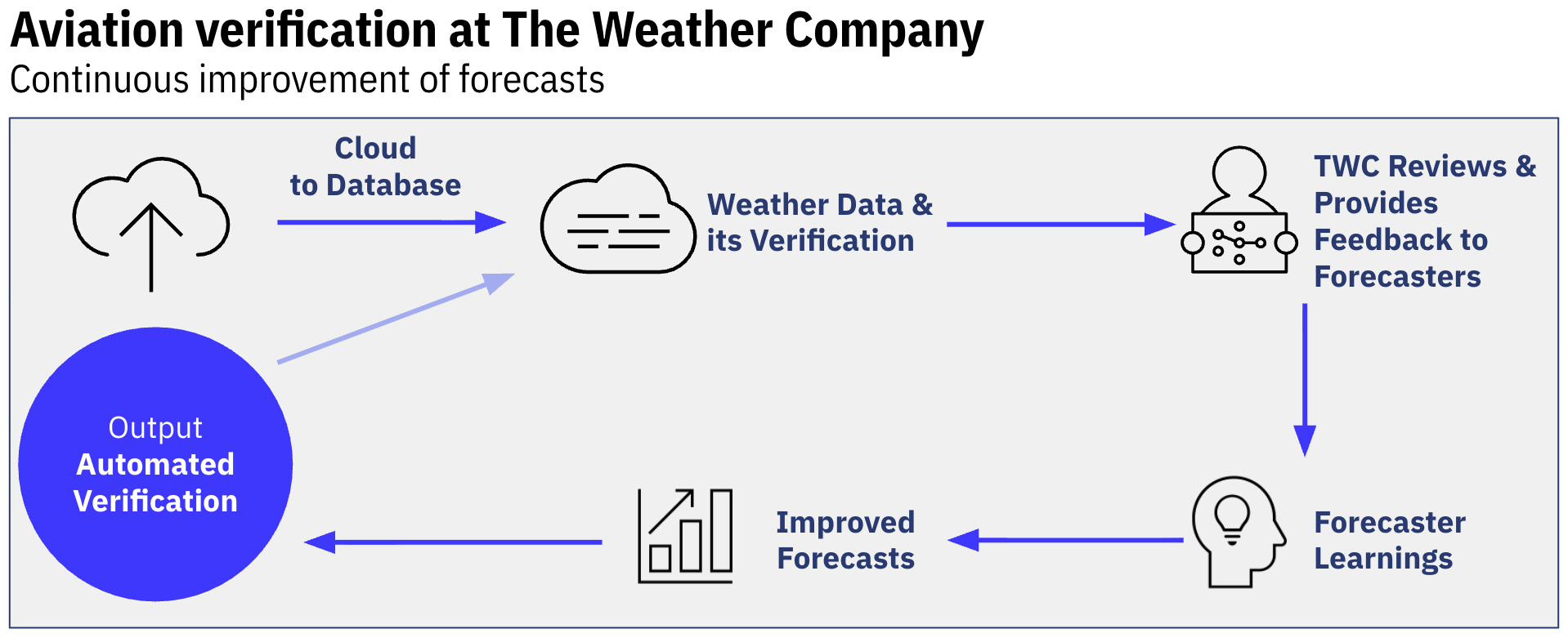
Verification is about creating a feedback loop that meaningfully improves aviation forecasts over time.
The technology behind the trust
The Weather Company is partnering with NVIDIA to train AI models on 20 years of proprietary aviation weather data — developing convective-scale forecast ensembles ideal for aviation decision making. Verification will validate these innovations, helping AI advancements translate into greater operational confidence.
We’ve also implemented the JEDI data assimilation system, which cycles forecasts back into the model rather than starting each hour from scratch and allows timely incorporation of diverse observations. This creates a more realistic, continuous view of the starting state of the atmosphere that powers our Global High-Resolution Atmospheric Forecasting System (GRAF®).
Where verification delivers results
This rigorous verification process delivers measurable improvements across our product suite, including:
Future radar: The latest version of our forecast radar is 2.5 times better at predicting where heavy precipitation will occur during the critical next two hours — giving operations teams earlier warning when conditions are expected to deteriorate.
Gate Convective Forecasts (GCF): This risk product now provides increasingly accurate predictions of thunderstorm coverage, timing, and intensity across terminal airspaces. By validating GCF against actual convective events and sharing those results back with our forecasters, we’ve refined the forecast process to better distinguish between scattered activity and widespread operational disruption.
Fog risk forecasts: Advancements have evolved rapidly through automated verification, providing immediate performance feedback that helped forecasters identify and eliminate bias before full deployment. Each new product undergoes the same accountability loop: forecast, verify, refine, repeat.
Beyond hit or miss: Partial credit matters
Traditional verification relies on binary thinking. For flight operations, this misses what actually matters — was the forecast useful for decision making? And airlines generally communicate risk on a spectrum from “no risk” to “operationally disruptive.” So, when operations see high risk, they hold departures and reroute aircraft.
Here’s the problem: Meteorologists may forecast high convective risk, but moderately impactful convection occurs instead. Traditional verification calls this a “false alarm.” Yet operationally, the forecast was useful— you held departures, rerouted arrivals, and avoided delays. This is why The Weather Company developed a Partial Credit Critical Success Index (PC-CSI) — to capture decision-grade accuracy and reward operational value over exact binary matches.
High-confidence risk assessment
One analysis identified that when The Weather Company forecasts high convective risk, impactful weather occurs approximately 80% of the time — the certainty needed to confidently trigger proactive flight delays or reroutes. This accuracy results from fostering forecaster accountability through continuous feedback.
Closing the feedback loop
Verification data only matters if it drives action. Lead meteorologists receive monthly performance summaries analyzing accuracy across airports and weather scenarios. They identify improvement opportunities and share findings with their forecasting teams — enabling collaborative learning and year-over-year performance gains.
Weather intelligence that moves aircraft
Just as verification can help to address forecast biases in weather prediction, it also validates how AI translates weather into aviation decisions. The same rigorous process enables AI models to correctly link atmospheric conditions to operational impacts.
We aren’t talking about generic weather forecasts. Our verification process validates that AI models accurately translate weather patterns into actionable insights. The Weather Company trains these weather impact models on historical weather data and real operational outcomes, then tests their performance through continuous verification. The result is a suite of predictive tools designed to answer the specific questions flight operations teams face daily:
TrACR (terminal airspace convective risk): AI-driven forecasts visualize thunderstorm risks in the departure and arrival gates around airports up to 7 hours in advance with 30-minute intervals, helping airlines optimize traffic and reduce delays.
Airport-specific capacity predictions: Forecasts limits on arrival and departure rates, giving clear visibility into when demand will outstrip capacity — before it happens.
Runway configuration predictions: Enable optimized route adjustments in advance of ATC clearance.
Ground de-icing insights: Allow dispatchers to proactively plan for icing conditions.
Achieving forecast “consensus”
Our forecasters leverage WxMix®, The Weather Company’s proprietary multi-model ensemble, which analyzes over 100 global weather models and intelligently combines them to create a consensus forecast that is more accurate than any of the inputs. Verification validates that the engine delivers on its promise.
Using these insights with our risk products allows for better preparation – when we forecast widespread convective coverage, it verifies frequently, and you can be more confident in that high risk forecast.
Accuracy that earns trust
The Weather Company is the world’s most accurate forecaster — nearly 4x more likely to be the most accurate than the next closest competitor.1 That accuracy is built on cutting-edge AI, rigorous verification, and human oversight working together to deliver critical aviation insights.
The Weather Company delivers more than accurate weather data — we deliver the confidence to stay ahead of the storm. With FAA-compliant EWINS meteorologists blending aviation and meteorological expertise with innovative forecast technology, our Weather Forecast Services deliver real-time weather analysis and insights you can trust — globally, 24/7. When stakes are high, you need more than data, you need weather intelligence you can act on with confidence.
Let's talk
To learn more about our advanced aviation weather solutions, contact our aviation experts today.
Contact usRelated resources





1 ForecastWatch, Global and Regional Weather Forecast Accuracy Overview, 2021-2024, commissioned by The Weather Company.
(Episode 3)
Episode overview: Proactive fog mitigation for cargo operations
In this episode, we explore the specialized strategies used to keep cargo airlines moving when visibility drops. The core philosophy is simple: move from reactive scrambling to proactive decision-making.
We take a deep dive into the unique operational flexibility of cargo carriers, discussing how contingency plans—such as splitting flights or rerouting around fog banks—can significantly minimize fuel costs and logistical delays. From leveraging advanced predictive alerts to managing unforecasted fog events, learn how tailored weather intelligence keeps the supply chain on track even when the clouds roll in.
Let's talk
To learn more about our advanced aviation weather solutions, contact our aviation experts today.
Contact usMore episodes
(Episode 2)
Episode overview: Advancing turbulence safety and communication
In this episode, we reflect on three decades of evolution in aviation safety and turbulence management. Our subject matter expert shares insights into how the “unpredictable” is becoming increasingly manageable through better data and real-time coordination.
The discussion highlights the drastic improvements in cockpit-to-cabin communication and how modern tools are keeping crews and passengers safer than ever before. We explore the critical role that real-time reporting and short-term forecast products, such as SIGMETs, play in providing the early warnings necessary to seat flight attendants and secure the cabin before the first bump is even felt.
Let's talk
To learn more about our advanced aviation weather solutions, contact our aviation experts today.
Contact usMore episodes
(Episode 1)
Episode overview: The human-machine edge in aviation forecasting
In this episode, we dive into what sets The Weather Company apart in the competitive landscape of aviation weather services. While government and private data sources are plentiful, the true “secret sauce” for airlines lies in the synergy between technology and talent.
Join us as we discuss the powerful combination of our high-quality FOD (Flight Operations Data) and the specialized expertise of our human meteorologists. You’ll learn how this hybrid approach transforms raw data into actionable, high-fidelity forecasts, helping airlines make faster, more confident decisions in an increasingly complex airspace.
Let's talk
To learn more about our advanced aviation weather solutions, contact our aviation experts today.
Contact usMore episodes
Key takeaways
- The November 2025 volcanic eruption of Hayli Gubbi sent ash 50,000 feet into a subtropical jet stream with winds exceeding 100 knots.
- Government SIGMETs often close entire Flight Information Regions (FIRs), but precision polygons kept safe corridors open for continued operations.
- Differentiating between hazardous ash and harmless sulfur dioxide prevented unnecessary and costly flight cancellations.
- High-frequency updates enabled surgical airspace management — avoiding disruptions without compromising safety.
- Precision volcanic intelligence within Enroute Hazards turns “just in case” diversions into confident, data-driven decisions that save fuel while keeping passengers and crew safe.
The November 2025 eruption of Hayli Gubbi in Ethiopia served as a wake-up call for the aviation industry. An ancient volcano with no recorded history of activity suddenly sent an ash plume 50,000 feet into the atmosphere, directly into one of the world’s most active subtropical jet streams.
For flight operations, the challenge wasn’t just the ash — it was the data. While government-issued SIGMETs (Significant Meteorological Information) shuttered massive swaths of airspace, The Weather Company provided a more surgical approach.
The Hayli Gubbi event: From quiet to 50,000 feet
On November 23, 2025, at approximately 08:22Z, Hayli Gubbi erupted. Because the volcano had no confirmed historical eruptions, it wasn’t on every operator’s immediate radar.
The timing was particularly difficult. A strong subtropical jet core was positioned directly over Ethiopia, with winds exceeding 100 knots. This acted as a conveyor belt, rapidly transporting high-level ash toward the Arabian Sea and India. By 19:45Z, three distinct ash layers were identified, with the highest reaching FL500 (50,000 feet) along the Yemen border.
The problem with “blanket” SIGMETs
When a major event like Hayli Gubbi occurs, the default response for many government agencies is to issue broad SIGMETs. During this event, we saw government advisories cover entire FIRs over India and Bangladesh, extending from the flight ceiling down to the surface.
For a Director of Flight Operations, these blanket closures are an operational nightmare. They lead to:
- Massive fuel burn due to long-range diversions.
- Widespread schedule disruptions across hubs like New Delhi.
- Increased pressure on flight ops teams to find viable routes in congested, restricted airspace.
A more surgical approach to Enroute Hazards
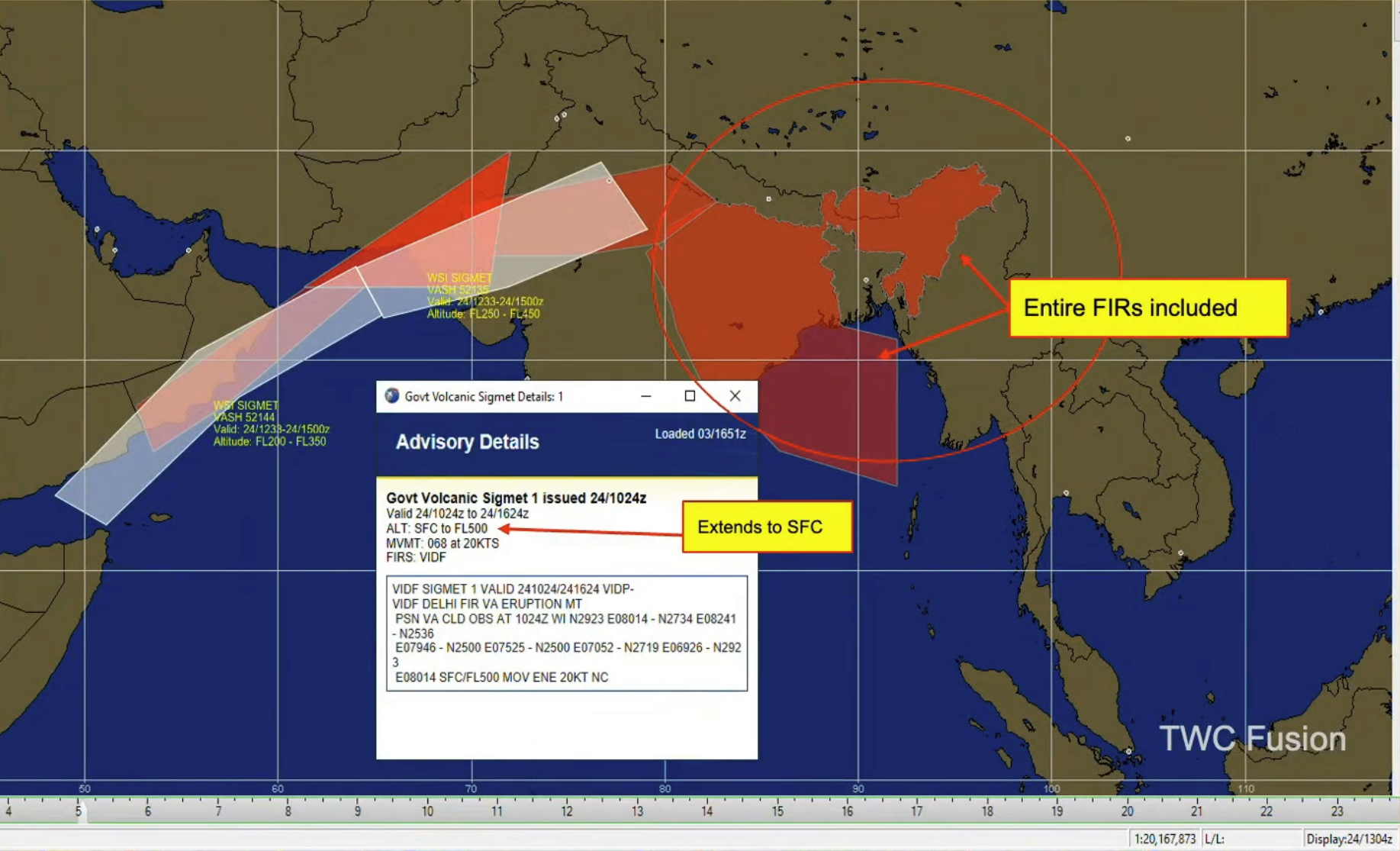
TWC SIGMETs clearly begin to offer more precision as compared to Government SIGMETs being issued over India and Bangladesh.
The Weather Company’s approach during the Hayli Gubbi eruption focused on high-frequency updates and particulate differentiation.
As the plume moved toward Central China, TWC meteorologists noticed a shift. While some agencies continued to flag the entire remnant plume as volcanic ash, TWC’s analysis suggested the trailing edge was primarily sulfur dioxide (SO2) — a gas that, while notable, does not pose the same structural threat to jet engines as abrasive volcanic ash.
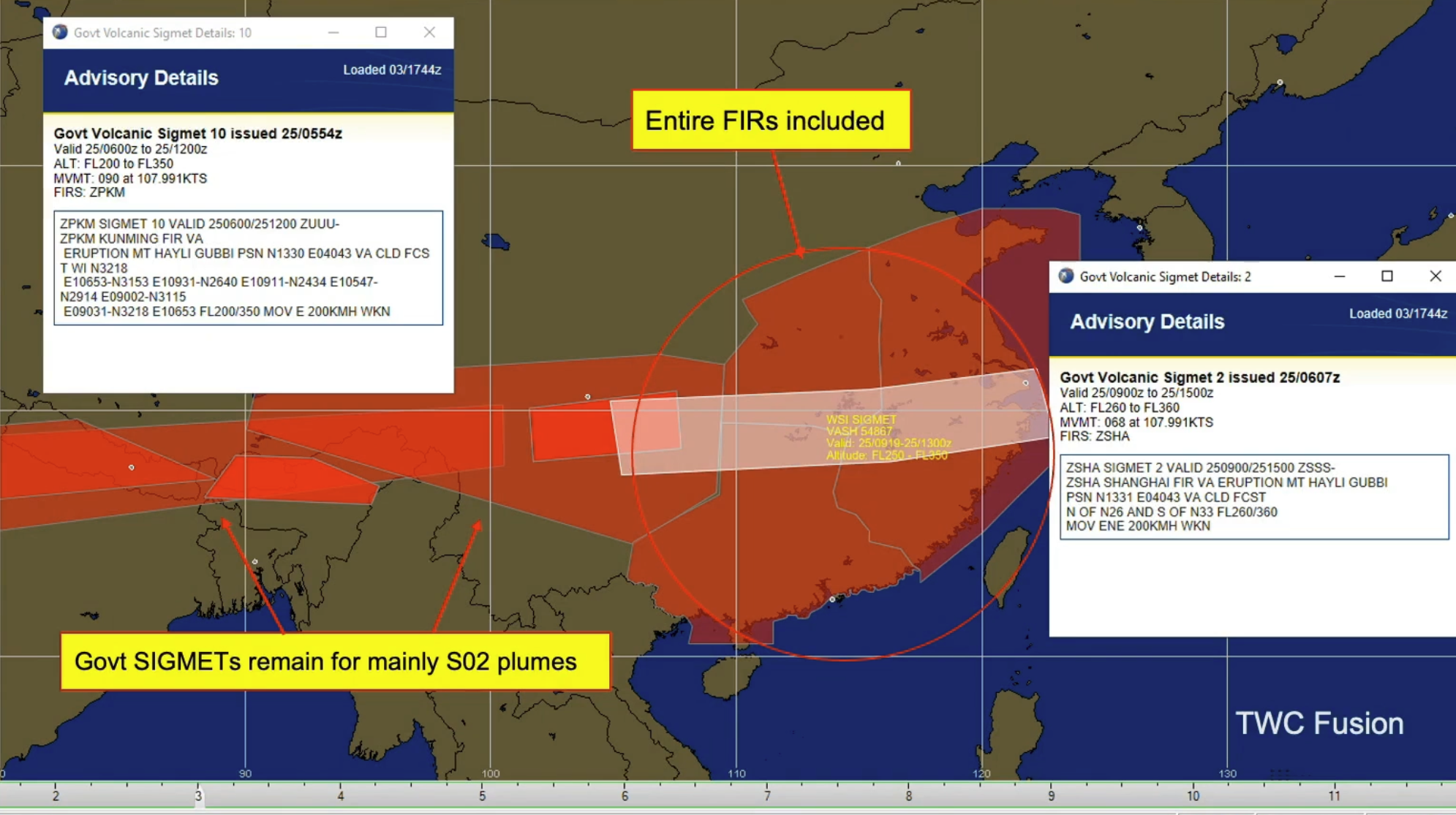
Over China, TWC SIGMETs focus on where the narrowing and thinning remnant ash resides.
The result: The Weather Company was able to drop SIGMETs over northern India and eventually east of Shanghai hours before official agencies, as our team confirmed the ash had dissipated into harmless gas.
Comparing government vs. The Weather Company SIGMET precision
A time lapse view of the Hali Gubbi event comparing government and TWC SIGMETs.
| Feature | Government SIGMETs | The Weather Company Volcanic Ash SIGMETs |
| Area coverage | Often entire FIRs (broad) | Precise polygons (targeted) |
| Update frequency | Standardized intervals | Constant monitoring & rapid updates |
| Vertical precision | Often surface to FL500 | Targeted at specific ash-layer altitudes |
| Data granularity | General ash presence | Differentiation between ash and SO2 |
Why precision is the ultimate safety tool
For pilots who may be looking at a weather brief that is already three or four hours old by the time they reach the cockpit, precision is synonymous with confidence. Knowing exactly where the “narrowing and thinning” remnant ash resides — rather than seeing a giant red block on the EFB — allows for better in-flight decision-making and fewer “just in case” diversions that eat into fuel reserves.
By integrating volcanic ash insights within our Enroute Hazards suite, we provide the clarity needed to keep the fleet moving without compromising passenger safety.
How confident is your volcanic ash response?
Don’t let outdated or overly broad advisories ground your fleet or put passengers at risk. See how our high-precision SIGMETs within Pilotbrief and Maverick Dispatch can streamline your operations during the next major eruption.
Let's talk
To learn more about our advanced aviation weather solutions, contact our aviation experts today.
Contact usRelated resources





Key takeaways
- Moderate-or-greater turbulence reports are rising, driven by the impact of a changing climate on jet streams and atmospheric conditions.
- Operations teams face turbulence forecasts that lag behind real-time conditions.
- The newly-developed turbulence nowcast from The Weather Company synthesizes and utilizes diagnostic signals, real-time aircraft observations, GRAFTM forecasts, and forecaster expertise into one authoritative snapshot.
- By merging these inputs, the turbulence nowcast within MaverickTM Dispatch helps significantly reduce dispatcher cognitive load while alerting pilots to emergent hazards.
- 10-minute refresh captures real-time hazards that can be quickly relayed ahead to avoid the next model runtime gap.
Turbulence remains one of aviation’s most persistent safety and operational challenges. Moderate-or-greater turbulence reports per 100 flight hours have been steadily climbing in recent years.1 And it’s also the leading cause of in-flight injuries, accounting for the majority of air carrier accidents recorded by the U.S. National Transportation Safety Board between 2008 and 2022.2
In a world of razor-thin margins and viral social media moments, a single “clear air” turbulence (CAT) encounter can trigger a cascade of costs. When an aircraft hits severe turbulence, the financial fallout can be immediate: flight diversions, emergency medical services at the gate, and the grounding of aircraft for multi-day structural inspections. Beyond the balance sheet, these events erode passenger trust and disrupt crew scheduling or impact pilot flight time limits. For operations teams, this means the tools and strategies that worked a decade ago may no longer be enough — especially as weather becomes increasingly erratic in a changing climate.
The turbulence problem demands a more sophisticated, real-time approach. Building on our trusted solutions for fleet safety, The Weather Company’s turbulence nowcast delivers exactly that. Embedded within Maverick Dispatch, it synthesizes real-time observations, model forecasts, and human forecaster expertise. The result: a single, frequently updated snapshot of current turbulence from one authoritative source — one screen, one truth.
Today’s problem: More data, but less clarity
The challenge isn’t a lack of data; it’s an abundance of noise. Flight dispatchers and ops teams can be flooded with fragmented information. As a result, they are sometimes forced to do “mental math” to reconcile what’s in front of them. Real-time observations are scattered across multiple sources, including:
- Automated systems measuring both aircraft shake and atmospheric conditions.
- Traditional PIREPs, which remain globally critical despite their subjectivity.
- NCAR’s in-situ EDR algorithm, now standard on new Boeing aircraft.
Existing forecaster products provide:
- SIGMET and FPG polygons issued by trained The Weather Company meteorologists, often in three hour windows to account for dynamic conditions.
- Polygonal regions account for dynamic conditions through a forecast period and hazardous turbulence may evolve through the forecast period.
- Turbulence reports are valuable for real time situational awareness but often come with questions such as “will the turbulence persist when I arrive?”
Many forecasting services fall short because they fail to reconcile their models with fresh, real-time observations. When teams are forced to juggle static forecasts against observations streaming in every minute, it can lead to “analysis paralysis.” Our approach eliminates this friction, turning model output, observations, and forecaster input into a single, verified truth.
Turbulence nowcast: From data fatigue to tactical confidence
The Weather Company’s newly-developed turbulence nowcast does the heavy lifting for your team by fusing these fragmented signals into one high-fidelity stream. Unlike traditional models that update only a few times a day, the turbulence nowcast refreshes every 10 minutes. It doesn’t just present data; it synthesizes it. By blending diagnostic signals like global models, aircraft observations, radar observations, satellite observations, lighting observations, and forecaster input into one high-resolution grid, we provide the clarity needed to “thread the needle” through complex weather.
The big picture: Global modeling builds strategic awareness
GRAF (Global High-Resolution Atmospheric Forecasting System) model diagnostics operate at horizontal resolutions of 15 kilometers, forecasting large-scale atmospheric phenomena — mountain waves, thunderstorm outflows, jet stream dynamics — out to 72 hours in 3D. But, the turbulence that actually impacts aircraft occurs at scales of just 100 meters or so.
Bridging that gap requires sophisticated turbulence diagnostics: algorithms that translate model-scale conditions into aircraft-scale forecasts. Artificial intelligence optimally blends these diagnostics based on atmospheric level and forcing conditions, producing gridded forecasts in both EDR and categorical turbulence intensity.
The human-over-the-loop advantage
While we leverage industry-leading AI, we believe in “human-over-machine” reliability. Our solution utilizes SIGMET and FPG nudging, where our global team of meteorologists refines the AI-synthesized output in real-time. This helps prevent your flight crews from reacting to “ghost” turbulence vs. the most tactically accurate nowcast available.
You don’t have to guess which observation to look at or how old it might be. We’re blending all of the best information that we have, creating the best snapshot of turbulence.
How it works: From fragmented to unified turbulence nowcast data
The turbulence nowcast delivers global coverage with immediate insight into where turbulence exists right now — not where it was an hour ago, or might be in four hours. It starts with GRAF’s turbulence forecast as its foundation, then blends the right ingredients to enhance it intelligently using multiple data streams, including:
- Observation nudging: Adjusts the forecast grid toward in-situ EDR data and the latest turbulence reports from all available sources — automated systems like The Weather Company’s TAPS®, traditional PIREPs (scaled by aircraft size and type to support consistency), and more. This helps enable the grid to reflect what aircraft are actually experiencing.
- SIGMET and FPG nudging (an innovation from The Weather Company): Scales turbulence values within meteorologist-issued warning polygons so the grid remains consistent with human forecaster expertise. If a SIGMET indicates moderate turbulence in a region, the nowcast reflects that intelligence.
- Intelligent interpolation: Supports smooth temporal continuity as conditions evolve between preceding and following forecast hours.
The result: A three-dimensional EDR grid at 15-kilometer horizontal resolution and 1,000-foot vertical resolution, from 1,000 ft to FL500. The same familiar grid operations teams already use with GRAF Turbulence is now infused with real-time awareness.
The turbulence nowcast isn’t just faster — it’s smarter. It merges the comprehensive spatial coverage of model forecasts with the immediacy of live observations and the tactical judgment of expert meteorologists. For dispatch and flight operations, that means one authoritative answer: This is where turbulence is, right now.
See the difference: Forecast vs. “nowcast”
What separates a forecast from a “nowcast” becomes clearer when you see them side by side. The turbulence nowcast enhances turbulence regions where recent observations and SIGMET/FPG polygons indicate heightened activity. When real-time intelligence is layered in, areas that might appear benign in the model forecast reveal themselves as active hazards. Similarly, the nowcast reduces turbulence regions in areas where recent flights have found smooth air.
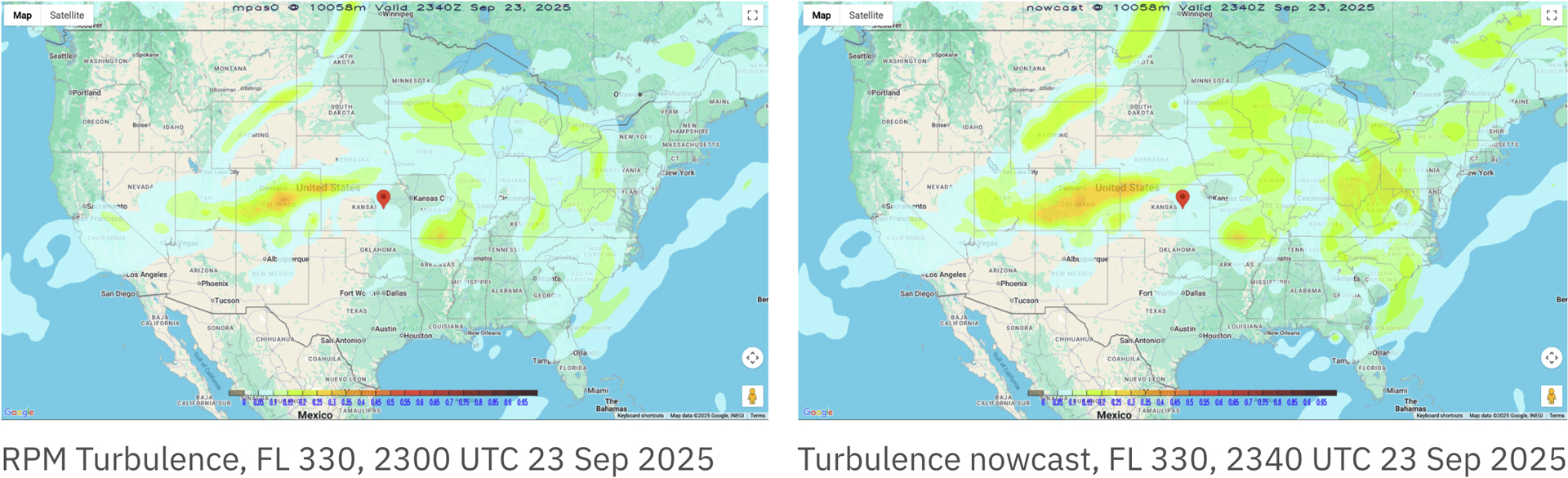
Turbulence nowcast (right) side-by-side base comparison with GRAF Turbulence (left), featuring enhancement of turbulence severity due to recent observations, SIGMETs, and more.
Know now, decide fast: Actionable, real-time turbulence intelligence
Turbulence will always be part of aviation. The Weather Company’s turbulence nowcast gives operations teams the real-time clarity they need to act proactively — reducing passenger and crew injuries, costly aircraft inspections, schedule disruptions, and the spillover that likely follows.
This isn’t about generating more alerts; it’s about generating better situational awareness from the world’s most accurate forecaster.3 Take advantage of a single, trusted source for what’s happening in the atmosphere right now — so you can focus on what happens next.
Let's talk
To learn more about our advanced aviation weather solutions, including Maverick Dispatch, contact our aviation experts today.
Contact usRelated resources
1 Internal reporting from The Weather Company
2 US NTSB Report: Weather Related Accidents
3 ForecastWatch, Global and Regional Weather Forecast Accuracy Overview, 2021-2024, commissioned by The Weather Company
Key takeaways
- Weather data is becoming a foundational input for smarter planning and decision-making across industries.
- Cities, logistics providers, and energy companies are integrating weather intelligence to improve efficiency and resilience.
- AI and APIs are transforming raw weather data into actionable insights within business systems.
- The Weather Company enables organizations to move from reactive to predictive operations through real-time data solutions.
Try naming a business that isn’t impacted by weather. Go ahead – really pressure test it. Weather touches every corner of the global economy. Whether it’s a farm, a freight company, a fashion brand, or even a software firm with a fully remote team, weather finds a way in.
Yes, even in sectors that feel “weather-proof,” its influence shows up in unexpected ways. That remote software firm? A localized heat wave or severe storm can strain regional power grids, risking the uptime and productivity of a distributed workforce. Your data center? Temperature spikes can strain the cooling systems. Your employees? Sunlight levels can affect human cognition and productivity.
Accepting that weather impacts your business is the first step; building resilience against it is the second. This shift from reactive to proactive requires a sophisticated pipeline that translates atmospheric physics into operational logic.
How do organizations turn weather data into actionable insights?
At The Weather Company, every real-world application starts with a rigorous process that transforms raw environmental signals into strategic intelligence:
- Collection: More than 75 billion terabytes of weather data are ingested daily, sourced from satellites, radar mosaics, aircraft, government feeds, and a global network of ~390,000 personal weather stations, with dense urban and suburban coverage.
- Normalization: This raw data is cleaned, quality-controlled, and standardized to maintain consistency across inputs. It’s then structured into formats ready for modeling and distribution.
- Integration: APIs built for enterprise-scale operations – supporting billions of requests per day – deliver this data into systems such as ERP platforms, IoT networks, digital twins, and custom applications.
- Application: AI-powered technologies like WxMix synthesize over 100 global forecast models, including The Weather Company’s own GRAF® system. These models are continuously optimized for every location and weather variable, surfacing predictive insights that businesses can act on in real time. Independent evaluations rank our forecasts #1 in accuracy across both global and regional scales.1
Download our free and exclusive Weather Means Business report to learn how smart businesses are transforming their enterprise strategies.
Get your copyHow is weather data driving innovation across industries?
Across industries, businesses are integrating weather intelligence more deeply than ever to unlock value and build long-term resilience:
- Aviation: Weather is responsible for roughly 75% of all flight delays,2 and airlines depend on real‑time weather insights to optimize routing, reduce fuel use, and enhance safety. To combat this, more than 44,000 flights in the U.S. alone3 rely on weather forecasts every day to plan safer, more efficient routes, reduce fuel burn, and minimize disruptions.
- Energy & utilities: In summer 2025, U.S. electricity demand across the Lower 48 states set new peak records twice, reaching 759,180 megawatts as hot weather drove up cooling needs – nearly 2% higher than the prior year’s peak.4 High‑resolution weather intelligence helps utilities anticipate demand swings, balance renewables, and plan grid operations more effectively under weather‑driven stress.
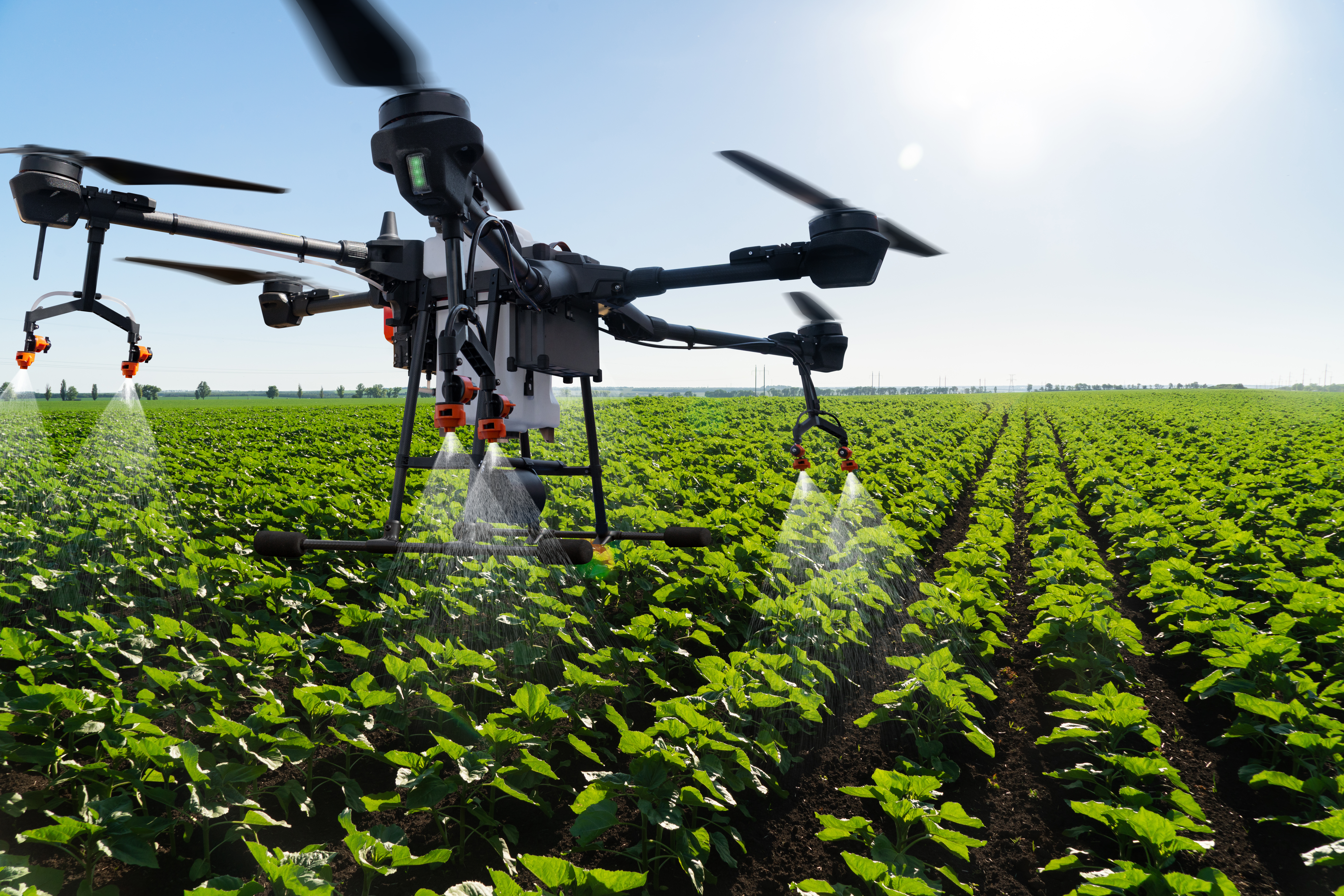
- Agriculture: Across Europe, extreme weather causes over €28 billion ($31.9 billion) in annual losses for farmers, according to EU-backed analysis.5 Flooding, drought, heatwaves, and storms continue to disrupt crop yields, supply chains, and agricultural productivity. To mitigate these risks, producers are increasingly automating their resilience. Today, 35% of global weather API requests support real-time decisions on planting and crop health,6 allowing growers to integrate hyper-local soil and atmospheric data into their daily operations.
- Retail: With over $1 trillion in global sales influenced by weather,7 brands use seasonal and localized weather signals to optimize promotions, staffing, and inventory, down to the store level.
- Insurance & finance: Global insured losses from natural catastrophes were projected to reach $107 billion in 2025, with the U.S. accounting for a staggering 83% of that total.8 As wildfires and severe storms push losses higher, insurers are turning to high-resolution weather forecasts and risk modeling tools to better price policies, reduce exposure, and support more resilient coverage strategies.
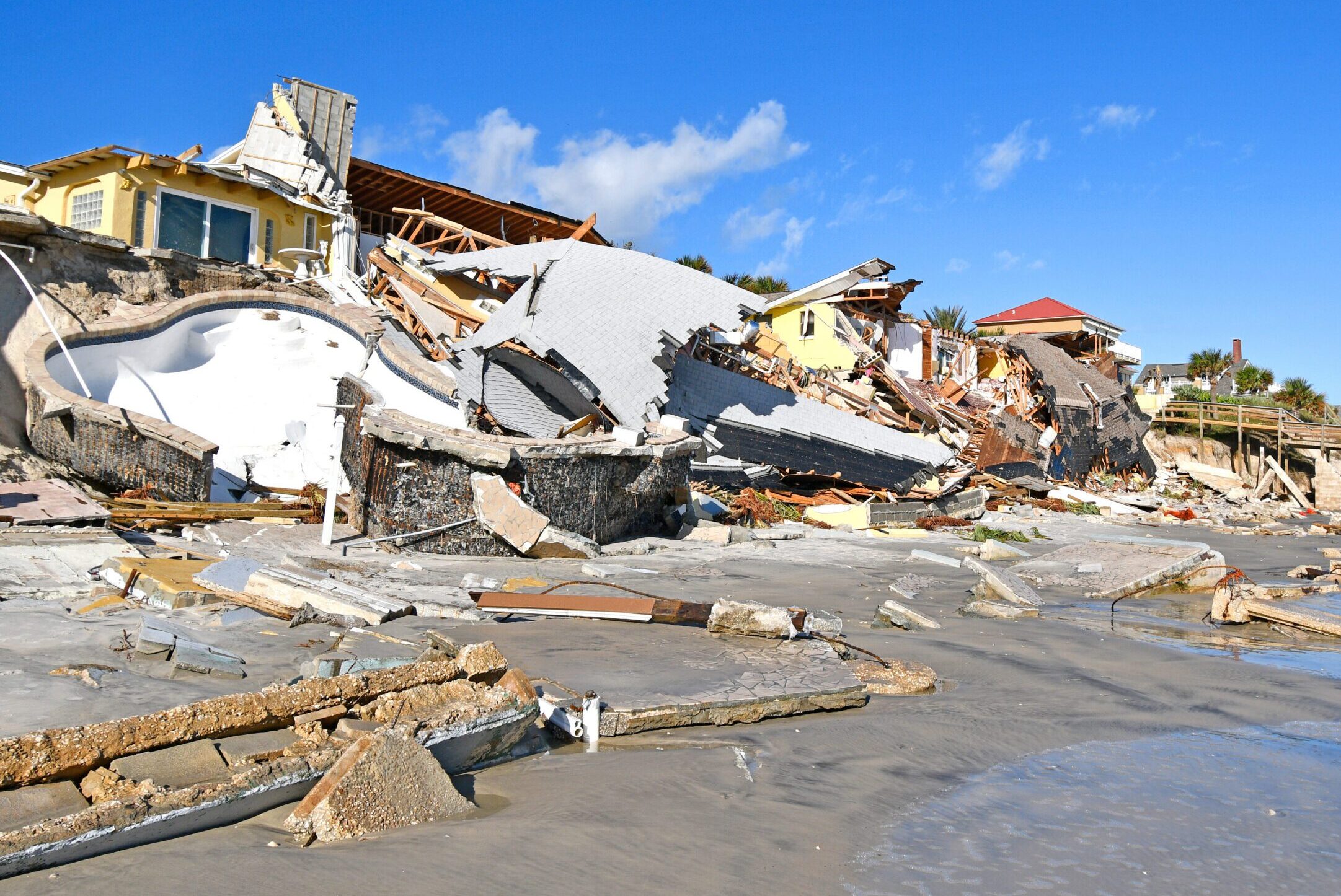
- Construction: Weather regularly disrupts construction timelines – damaging materials, delaying crews, and forcing costly rework. In 2024 alone, the U.S. faced 27 separate billion-dollar weather disasters, totaling more than $182.7 billion in losses.9 By integrating forecast data into scheduling tools, project teams can plan around conditions like rain, wind, and heat to reduce downtime and stay on track.
- Sports & entertainment: Weather and climate extremes are increasingly disrupting major sports and outdoor entertainment events worldwide. In 2025, severe conditions such as wildfires, high winds, and heat forced cancellations and rescheduling of professional competitions (including PGA golf events and marathons), affecting revenue and the fan experience in an industry valued at $2 trillion.10 Organizers are integrating real‑time weather intelligence to make safer go/no‑go decisions, adjust schedules, and protect athletes, spectators, and operations.
The rise of the “Shadow CEO”
This cross-industry momentum reflects a fundamental shift: weather is no longer just a background disruption; it is the “Shadow CEO” of the global economy. It quietly influences shipping routes, energy costs, and staffing needs every single day.
%
of executives say weather significantly impacts their operations11
%
plan to increase or maintain their investment in weather intelligence12
This rising awareness is shifting weather from a background disruptor to a boardroom priority.
What’s next for data-driven problem solving in weather and climate intelligence?
As weather volatility intensifies, businesses are moving beyond basic forecasting and embracing climate intelligence – a more comprehensive approach that layers in air quality, environmental data, and AI-driven insights.
- Generative AI is unlocking new ways to simulate risk, test mitigation strategies, and optimize business continuity plans, before disruption occurs.
- Open data collaboration is expanding, with public and private sectors sharing environmental intelligence to advance climate resilience at scale.
- AI-ready datasets from The Weather Company are purpose-built for integration into digital twins, planning tools, and real-time operations systems. These integrations help organizations anticipate disruption rather than simply react to it.
And business leaders are taking note: in a recent study, 100% of surveyed executives agreed that weather intelligence gives their business a competitive edge.13 When data becomes both scalable and strategic, weather shifts from a source of risk to a driver of opportunity.
Built for developers: Scalable, high-impact weather data APIs
APIs are at the heart of it all, making it easy for developers and data teams to bring high-resolution weather insights straight into the tools they already use. Add AI into the mix, and suddenly you’re spotting patterns – like a storm that could delay shipments or a cold snap that’ll drive up energy demand – so businesses can stay one step ahead.
The Weather Company offers a robust portfolio of enterprise-grade weather APIs designed to deliver real-time, forecast, and historical weather intelligence at scale. Trusted across industries, our APIs support over 200 billion calls per day with enterprise-grade performance, low latency, and secure integration.
These RESTful APIs enable access to:
- Hyper-local forecasts (hourly, daily, and 15-minute “nowcasts”)
- Historical conditions and almanac data for trend analysis
- Severe weather alerts from trusted government sources
- Environmental and lifestyle indices like air quality, UV risk, pollen, and even use cases for driving difficulty, power disruption, and travel comfort
- Marine and aviation insights, geospatial mapping layers, and current site-based conditions for any latitude/longitude
These APIs are built for flexible implementation – whether you’re powering operational dashboards, IoT platforms, public safety alerts, or mobile apps.
A success story in weather intelligence
 Want to see how organizations are already using weather data to solve complex challenges? One example is CAA Club Group, which worked with The Weather Company to improve road safety and operational readiness using real-time weather insights.
For a broader look at how accurate forecasts are driving measurable impact across transportation, energy, and public safety, read our Weather Means Business report.
Ready to build a weather-resilient business?
Don’t just react to the elements — plan for them. Start your free trial to explore our enterprise-grade weather data and start making smarter, data-driven decisions.
Get started
Contact our experts today to discover how Weather Data APIs can empower your decision-making and strengthen your business resilience. Let us help you transform weather data into a strategic asset.
Contact usRelated resources



1 ForecastWatch, Global and Regional Weather Forecast Accuracy Overview, 2021-2024, commissioned by The Weather Company
2 Federal Aviation Administration, FAQ
3 Federal Aviation Administration, Air Traffic By The Numbers
4 U.S. Energy Information Administration, U.S. electricity peak demand set new records twice in July, 2025 (data from EIA’s Hourly Electric Grid Monitor)
5 Reuters, Extreme weather costs EU farmers €28 billion per year, EU says, May, 2025
6 The Weather Company’s own internal data
7 National Retail Federation, Climate-proofing retail: How weather and climate affect retail sales, 2024
8 Reuters, Global insured catastrophe losses set to hit $107 billion in 2025 report shows, December 2025
9 NOAA National Centers for Environmental Information, U.S. Billion-Dollar Weather and Climate Disasters, 2024
10 Reuters, How climate change is putting sport on a sticky wicket, December 2025
11 12 13 Weather Means Business report, Magid for The Weather Company, October 2024
Key takeaways
- The Weather Company’s forecast accuracy is backed by ForecastWatch data, showing it’s nearly 4x more likely to be the most accurate globally than any competitor.
- Reliable weather intelligence depends on continuous updates, hyperlocal granularity, and rigorous third-party validation.
- The GRAFTM model, WxMix ensemble, and Human-over-the-Loop (HOTL) process combine AI with expert insight to produce real-time, on-demand forecasts.
- Weather APIs deliver data with 15-minute resolution, helping businesses across sectors act faster and reduce disruption risks.
- Integrating weather intelligence with enterprise systems like IoT, finance, and logistics drives smarter cross-functional decision-making.
Weather is one of the most complex, high-volume data streams organizations can leverage – and one of the easiest to get wrong. For operations leaders in logistics, energy, and agriculture, the gap between an acceptable weather data model and a truly accurate one comes down to the precision, freshness, and validation of the underlying data.
What was once a general prediction must now become a location-specific, real-time decision input. To get there, businesses are turning to proprietary AI forecasting systems layered with human insight — systems capable of delivering resolutions as detailed as 3.5km while keeping pace with rapidly changing conditions.
Understanding how weather data is structured and applied reveals why precision, validation, and granularity now drive competitive advantage.
Why does weather data matter?
Weather’s impact is constant, but how businesses respond to it is changing. Companies are shifting from reactive strategies to proactive planning driven by high-resolution, real-time weather data.
The cost of inaction is steep: In 2023 alone, weather-related disruptions caused over $90 billion in damages across U.S. industries1 – a number that’s pushing more businesses to focus on resilience through proactive weather planning.
As climate variability increases, highlighted by 28 separate billion-dollar weather and climate disasters in the U.S. in 2023 alone,2 so does the need for predictive, adaptable tools. Weather intelligence is now a core component of decision-support tools across sectors like energy, agriculture, and logistics.
How is weather data structured and organized?
Understanding weather data starts with knowing its three main types:
- Real-time data – current observations from radar, satellites, and sensors
- Historical data – long-term climate patterns and trends
- Predictive data – forecast models that simulate future outcomes, including:
- GRAF® – A proprietary global model that delivers high-resolution forecasts as often as every five minutes, down to a kilometer level.
- WxMix – A continuously optimized blend of more than 100 weather models, customized per location, variable, and forecast window to maximize accuracy.
- HOTL (Human-over-the-Loop) – Oversight from 100+ expert meteorologists who refine AI-generated forecasts based on real-world conditions and operational context.
These tools allow enterprises to create forecasts that are on demand, location-specific, and AI-optimized in real time. That capability is made possible by advances in AI and weather technology.
How is weather data analyzed?
At The Weather Company, forecast accuracy is powered by more than automation. WxMix, our advanced multi-model ensemble, analyzes approximately 100 global weather models. Using AI, it synthesizes and optimizes inputs by location, parameter, and timeframe – maximizing accuracy where and when it matters most.
But it doesn’t stop there. Through Human-over-the-Loop (HOTL) intelligence, our team of over 100 expert meteorologists adds critical oversight so that forecasts are tweaked to reflect real-world complexities algorithms alone might miss. The result is a system that delivers real-time precision with the confidence of expert validation.
What defines reliable weather intelligence?
Not all data is created equal. The most reliable weather intelligence is:
- Accurate – validated against historical and current observations
- Granular – spatially and temporally precise
- Timely – updated continuously (not just 4x a day like legacy systems)
- Validated – tested by third-party accuracy audits

A ForecastWatch study found The Weather Company to be nearly 4x more likely to be the most accurate forecaster compared to the next-best weather forecast provider.3
Standard data vs. precision intelligence: A performance comparison
| Feature | Standard source | Precision source |
| Accuracy | Generalized estimates | Location-specific, validated |
| Granularity | Regional or hourly only | Hyperlocal, down to minutes |
| Timeliness | Updated 2-4x daily | On-demand, real-time updates |
| Validation | Minimal cross-checking | Multi-source & model verified |
| Uptime | Inconsistent delivery | 99.95%+ availability |
| Error handling | Manual lag fixes | Automated detection & failover |

Explore and evaluate a full range of APIs, free.
Start a free trial todayWhat turns weather information into intelligence?
Information tells you the weather is changing. Intelligence tells you what that change will cost and how much time you have to act.
At The Weather Company, that transformation happens through a refinement process that filters raw atmospheric data into signals that are specific, validated, and decision-ready. It starts with granularity – moving from broad forecasts to 3-kilometer, 15-minute updates that detect microclimates across a delivery network. Then comes validation, using a blend of over 100 models (WxMix) checked against real-world conditions from sensors, radar, and aircraft.
Contextualization adds historical insight – understanding how past weather patterns affect current risk, like black ice or power outages. Finally, human expertise enters the loop. Our meteorologists don’t just monitor model output; they translate it into actionable guidance, helping enterprises shift from reaction to optimization.
Together, this approach turns noise into signals and weather into a strategic input for smarter decisions.
Weather intelligence is most effective when it connects siloed enterprise systems. By combining high-resolution forecasts with IoT data, live inventory, and ERP platforms, organizations can build a digital twin of their operations. With that visibility, teams can model how future weather may affect supply chains, test response strategies in advance, and shift from reacting to planning.
How is weather data delivered?
Enterprise-grade weather data needs to be accessible, fast, and flexible. That’s why The Weather Company delivers insights via robust, scalable Weather Data APIs built to support real-time decisions across logistics, energy, insurance, and more.
Our APIs give you access to real-time, historical, and predictive weather data with industry-leading accuracy and sub-hourly updates, optimized for integration into your existing platforms. Start a free trial to experience the difference for yourself.
Why near-accurate isn’t accurate enough
If your current provider can’t clearly explain how their forecasts are built, validated, and applied, you may be optimizing against the wrong reality.
As weather becomes more volatile and business cycles more complex, operational success will hinge on forecast intelligence, not just awareness. The next competitive advantage won’t come from knowing the weather, but from engineering around it.
Get started
Contact our experts today to discover how Weather Data APIs can empower your decision-making and strengthen your business resilience. Let us help you transform weather data into a strategic asset.
Contact usRelated resources

1 2 NOAA National Centers for Environmental Information (NCEI) U.S. Billion-Dollar Weather and Climate Disasters (2025).
* 3 ForecastWatch, Global and Regional Weather Forecast Accuracy Overview, 2021-2024.
Key takeaways:
- Clear-air turbulence causes over a third of major airline accidents and costs the industry hundreds of millions annually in injuries, delays, and disruptions.
- Traditional turbulence management relies on delayed, subjective pilot reports — real-time data is essential for proactive avoidance.
- Maverick WXAlertTM delivers timely turbulence updates via ACARS directly to cockpits, even when connectivity is limited.
- Integrated, real-time, high-resolution turbulence data across dispatch and flight operations creates a connected ecosystem that enhances safety and efficiency.
Recent headlines have put a sharp focus on a critical industry challenge: aviation turbulence. The tragic Singapore Airlines incident is a stark reminder of the risks. But these aren’t isolated events; they’re part of a scientifically documented trend. An increase in clear-air turbulence (CAT), driven by a changing climate, demands that we evolve our approach to turbulence mitigation. For airlines, the key to enhancing safety and operational efficiency lies in shifting from reactive reporting to proactive, data-driven avoidance.
Let’s face it: Weather-related challenges aren’t only an operational headache for airlines; they are a massive financial burden. Turbulence encounters, crosswind complications, and conditions that trigger irregular operations (IROPs) cost the industry hundreds of millions each year globally. We’re talking injury claims, operational delays, aircraft repairs, cargo damage, and revenue losses that cascade through entire flight networks. Airlines need to stop playing defense and start getting ahead of these challenges.
The growing threat of clear-air turbulence
For decades, the industry has managed turbulence with turbulence forecasts and pilot reports. But these traditional methods are being challenged by clear-air turbulence. This invisible threat occurs in cloudless skies. It often catches flight crews by surprise, giving them no time to react.
Limited connectivity in the cockpit leads to uncertainty about the location, extent, and severity of enroute impacts. In turn, this exposes flights to the risks of crosswinds and IROPs scenarios leading to costly disruptions. Weather challenges demand real-time awareness.
Science confirms: Turbulence on the rise
A landmark 2023 study found that severe CAT has already increased by 55% over the North Atlantic in the past 40 years due to a changing climate,1 with further significant increases projected. And according to the Federal Aviation Administration (FAA), turbulence accounts for more than a third of all major airline accidents.2 The vast majority result in serious injuries to passengers or crew. This isn’t just a safety and comfort issue; the operational costs — from diversions to structural inspections and reputational damage — are also significant.
From reactive reports to proactive turbulence mitigation
The fundamental weakness of traditional turbulence management is data lag. For example, pilots often lack real-time data — especially when connectivity is limited. A manual Pilot Report (PIREP) is a subjective snapshot of the past. By the time it’s relayed to an aircraft, the atmospheric conditions may have already changed.
Weather challenges demand real-time awareness. So the future of flight safety may depend on your ability to shift from reactive to proactive. We must move from isolated, subjective turbulence reports to a comprehensive, real-time, and objective view of the atmosphere.
It’s not what a pilot felt — it’s what the atmosphere is doing right now. The Weather Company’s approach is built on a unique synthesis of real-time EDR (Eddy Dissipation Rate) data, high-resolution weather modeling, and the combined expertise of aviation meteorologists. Automated alerts can be relayed via ACARS to pilots when other avenues fail. This works even in limited or non-connected cockpit scenarios. Pilots can have confidence these alerts are founded in weather intelligence from the world’s most accurate forecaster.3
Maverick WXAlert: Reducing enroute weather challenges through timely, direct cockpit alerting
On the ground or in the air, real-time data provides the detailed atmospheric intelligence pilots and dispatchers need. Maverick WXAlert combines multiple data sources into a single, proprietary system that keeps pilots informed — even when connectivity is limited. This workflow-integrated solution helps teams operate proactively with:
- Resilient ACARS cockpit communication: Delivers real-time, moderate or higher turbulence EDR updates directly to the cockpit via ACARS — even when in-flight connectivity is limited
- Tactical enroute decision-making: Assists in managing IROPs and guiding pilots on optimal diversion alternates
- Improved safety and efficiency: Shares synchronized alerts to both dispatchers and pilots the moment a flight is forecast to encounter an enroute weather hazard
Turbulence forecasting: Where experience and innovation converge
The Weather Company meteorologists — with an average of over 10 years of experience in aviation forecasting — don’t just rely on standard global weather models. They also leverage a proprietary Global High-Resolution Atmospheric Forecasting System (GRAFTM) that updates rapidly. It captures turbulence-prone areas with far greater precision than conventional models. Better resolution means more accurate predictions of where atmospheric hazards are most likely to develop. This proven, reliable weather intelligence helps pilots to optimize routes that prioritize safety, efficiency, and passenger comfort.
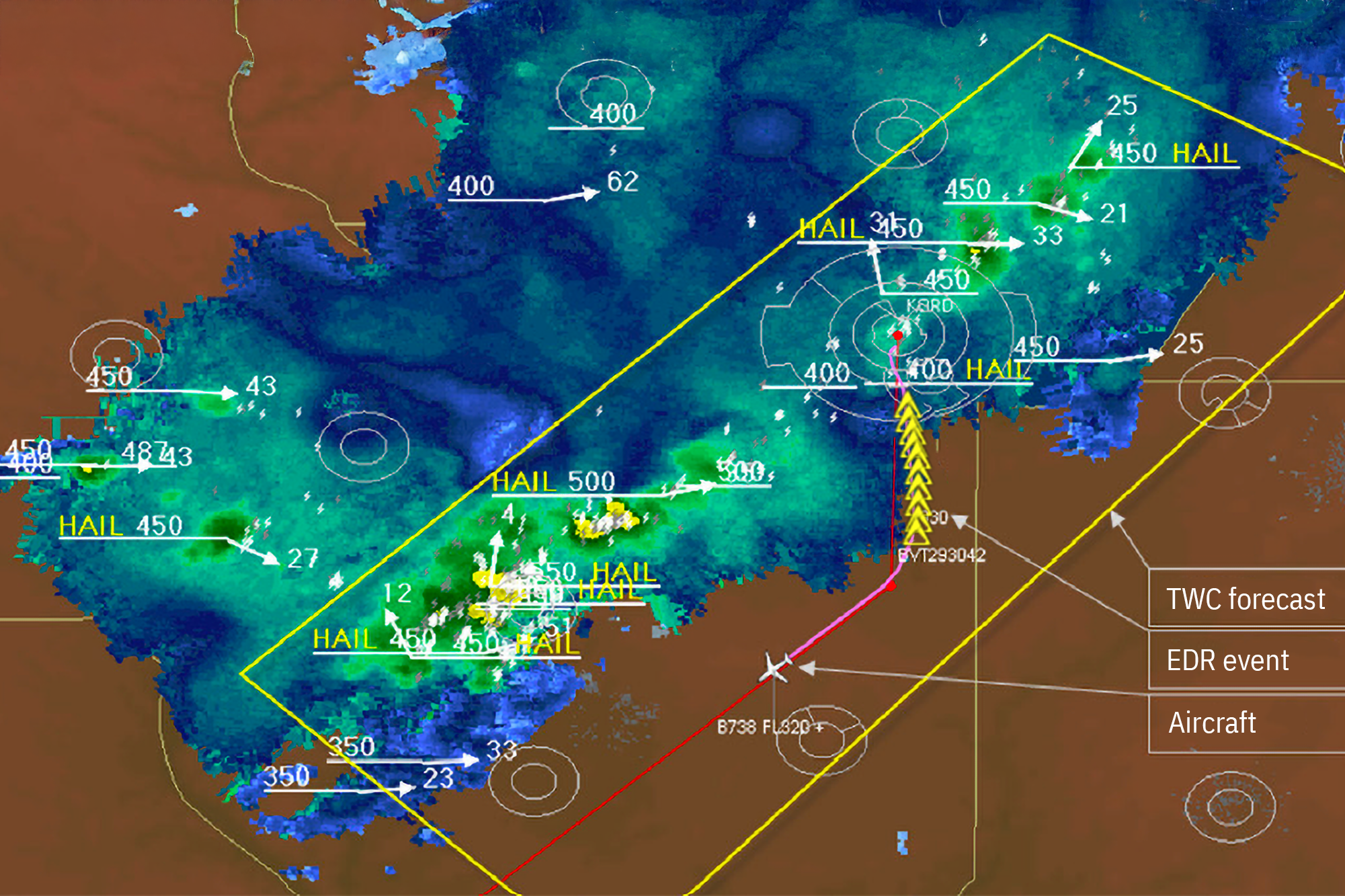
Alert messages are generated when a flight is projected to intersect an enroute hazard.
Turbulence intelligence straight to the cockpit
Real-time, crowdsourced turbulence data becomes exponentially more powerful when it is integrated across the entire operational workflow. This creates a connected ecosystem to enhance safety. The Weather Company is strengthening our turbulence avoidance solutions with the new integration of EDR data.
Maverick WXAlert is more than just a turbulence alerting system. Operation teams can take advantage of the ability to deliver timely, precise, and actionable alerts and other features directly to the cockpit in limited or non-connected scenarios via ACARS, including:
Enroute Hazard SIGMETS (proprietary) and Flight Plan Guidance (FPGs)
Get an incisive, actionable view of:
- Turbulence, crosswinds, proprietary SIGMETs, IROPs, and other impacts; monitored, redefined, and verified continuously by expert aviation meteorologists 24/7 x 365
- Route plan and altitude optimization powered by proprietary modeling
Decision support integration
Help stakeholders operate on the same page with:
- Flight-following solutions: Dispatcher workflows integrated with AI-driven weather awareness for faster, safer decision-making from ground to air
- Fusion Replay: On-demand post-event analysis
- PilotbriefⓇ: Collaborative preflight and in-flight crew awareness
- Aviation APIs: Enterprise data services curated and formatted to specific airline needs
Turbulence advisory
Fill critical information gaps and operational blind spots with:
- Moderate or higher turbulence reports, including EDR, PIREPs, or TAPS – prior to SIGMET or FPG amendments
- Timely alerting to mitigate impacts of emerging significant hazards
- Severity and 3D airspace impacts
Smarter decisions across every phase from preflight to landing
Build confidence, collaboration, and sharpen decision making from flight planning to post-review. Enable a wider range of weather alerts for turbulence and beyond with the Maverick platform’s condition manager, like:
- Expanded hazard alerting: Includes alerts for crosswinds, proprietary SIGMETs and FPGs, as well as official government-issued SIGMETs and AIRMETs
- Deeper intelligence for critical IROP scenarios: Provides real-time context on what’s causing holdings and go-arounds, diversion information, or what weather conditions exist at alternate airports
Clarity and confidence across every flight phase
The recent turbulence events are a clear call to action. As an industry, we have a shared responsibility to meet this evolving challenge with the best technology and most collaborative strategies available. At The Weather Company, our commitment is solid: delivering proven, accurate data and comprehensive flight turbulence solutions that transform atmospheric data into decisive, life-saving actions.
The skies keep changing, but together we have the tools and commitment to keep flying them as safely as possible.
Let's talk
To learn more about our advanced aviation weather solutions, contact our aviation experts today.
Contact usRelated resources
1 AGU: Geophysical Research Letters; Evidence for Large Increases in Clear-Air Turbulence Over the Past Four Decades; June 2023
2 FAA Article: Aviation Weather Research Program: Turbulence
3 ForecastWatch, Global and Regional Weather Forecast Accuracy Overview, 2021-2024, commissioned by The Weather Company